


Hawaiian corals have been subject to increasing heat stress and more prevalent bleaching events since the first major bleaching event in 1996.
Fortunately, new research from oceanographers at the University of Hawaiʻi at Mānoa found that Hawaiian corals have the possibility of adapting to future heat stress, even under a high emissions scenario.
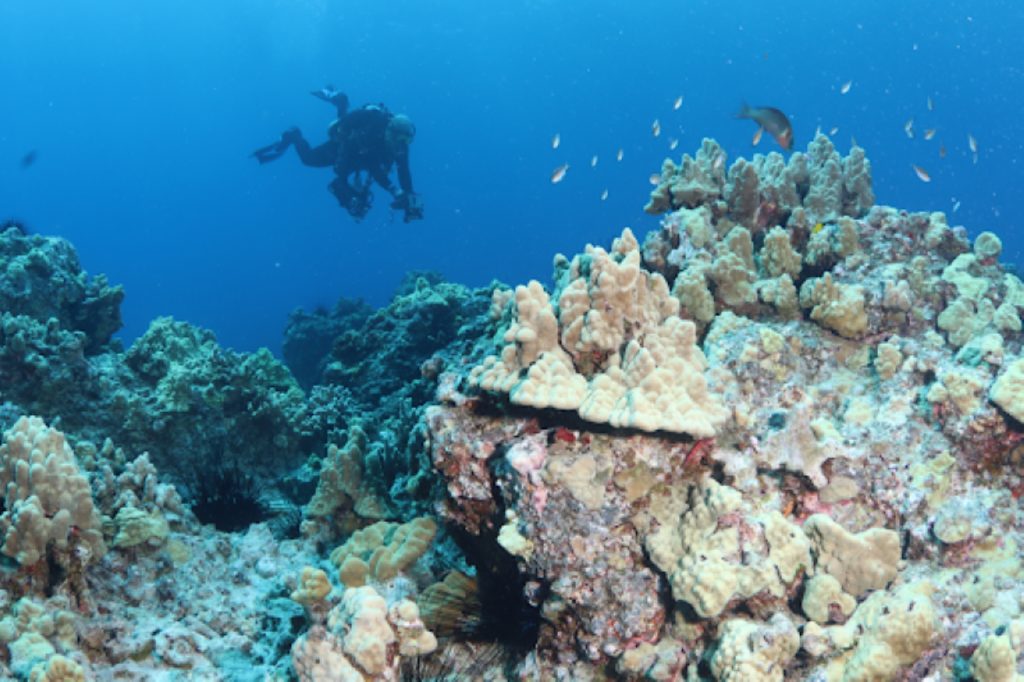
“Our research shows that Hawaiian corals may be exposed to unprecedented human-induced heat stress in the coming decades,” said study lead author Kate Feloy in a university release. “However, our results also provide some surprising hope that Hawaiian corals may be able to adapt to increasing temperatures.”
Researchers used high-resolution modeling that includes small-scale processes to examine projected heat stress on coral reefs during the 21st century and compared this heat stress to previous estimates of the rate at which corals might adapt to changing conditions.
This is the first time this type of high-resolution climate projection has been used to assess future heat stress around the main Hawaiian islands.
Feloy conducted the work as part of her doctoral research in the Department of Oceanography at University of Hawaiʻi at Mānoa School of Ocean and Earth Science and Technology.
Coral reefs have high cultural and economic value, also a critical source of food and coastal protection in Hawaiʻi. This study provides projected heat stress not just for the region as a whole but examines differences around and between individual islands.
The team’s results show that not all coastal locations are projected to experience human-induced climate change at the same rate. They found corals around Hawaiʻi Island are projected to experience higher heat stress than the other islands.
“The differences in warming are caused by complex ocean dynamics on small spatial scales in the waters around Hawaiʻi,” Feloy said. “These dynamics change the spatial patterns of human-induced coastal warming. Because of the spatial differences in projected heat stress, the rate at which corals will need to adapt in order to keep pace with increasing temperatures varies around the islands.”
She added that the study provides important spatial information that could be useful for local marine management; however, it is important to note that it investigates only temperature. There are many other stressors that also impact Hawaiian corals.
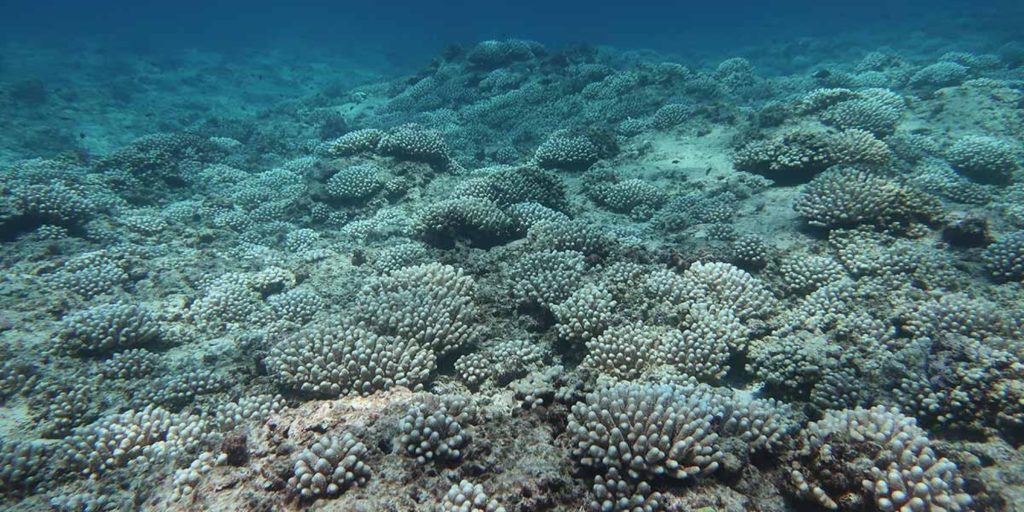
Human-induced climate change is also leading to overlapping environmental stressors such as episodes of extremely high temperature as well acidity and low oxygen concentrations in the water. The research team is also exploring how these overlapping stressors will evolve in the future and how they will affect the marine ecosystem.
Other studies show that corals exposed to variable background temperatures are more resilient to heat stress.
Feloy and colleagues are now investigating how tides contribute to natural temperature variability around Hawaiian corals.