


“Volcano Watch” is a weekly article and activity update written by U.S. Geological Survey Hawaiian Volcano Observatory scientists and affiliates.
Professor Bruce Houghton retired in 2025 from University of Hawaiʻi at Mānoa after 25 years as the Gordon A. Macdonald Chairperson of Volcanology. He was only the second person to have the position in the past half century.
With his retirement, let’s reflect on a career that helped shape how scientists understand explosive eruptions, volcanic hazards and how communities live with active volcanoes.
Houghton was born and educated in New Zealand. He established himself as a leading volcanologist at Institute of Geological and Nuclear Sciences New Zealand before 2000, when he joined University of Hawaiʻi.
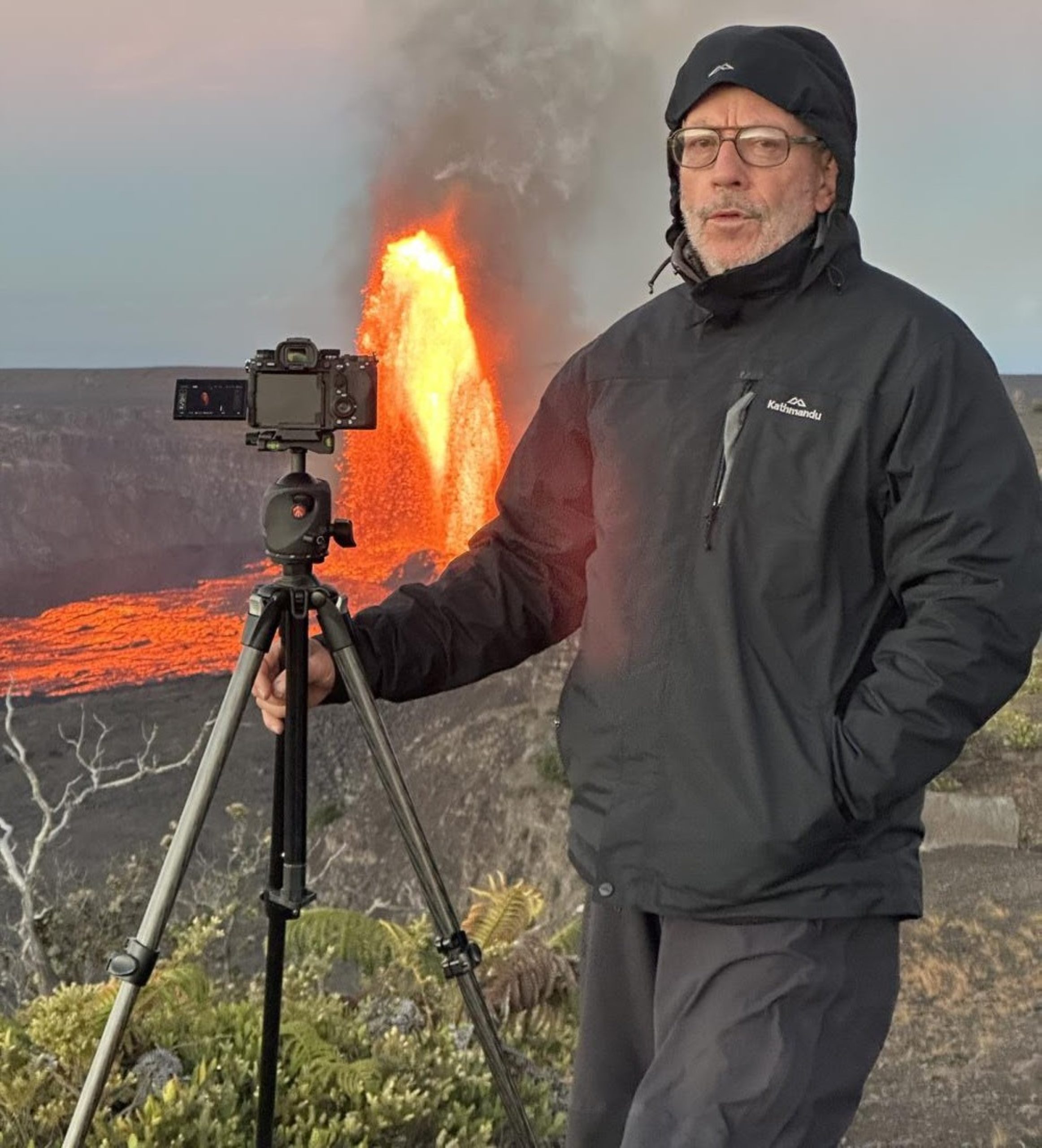
He became not only a researcher and professor in Hawaiʻi, but also state volcanologist.
Much of Houghton’s scientific work focused on a deceptively simple question: what can volcanic deposits tell us about the processes that created them?
His answer: details matter.
The textures and densities of erupted volcanic particles, their organization in volcanic deposits and how they travel in the atmosphere are not just measurements. They are clues to how magma rises, releases gas, interacts with the vent environment and ultimately erupts.
Houghton also pioneered the application of high-speed, high-resolution imaging of active volcanoes to quantify eruption processes with unprecedented spatial and temporal resolution.
The impact of this work is reflected in a research record since 2000 that includes more than $8 million in research funding, 291 journal publications and nearly 20,000 references to his work.
His research challenged the common perception that basaltic volcanoes such as Kīlauea and Mauna Loa on the Big Island are relatively simple compared with explosive volcanoes elsewhere in the world.
Houghton showed that basaltic eruptions can display a remarkable range of explosive behavior, from exceptionally weak bubble bursts to powerful explosive activity.
Basaltic eruptions can shift rapidly and reversibly through a spectrum of styles in a single event, from pulsating gas emission and episodic bursts to Hawaiian fountaining and more explosive eruptions. His work demonstrated that these changes often depend on shallow conduit processes and the vent environment, not just magma composition.
Houghton remained deeply connected to Hawaiʻi’s volcanoes and communities. He worked closely with scientists at Hawaiian Volcano Observatory and participated in the scientific response to both the 2008-18 summit lava lake eruption and 2018 lower East Rift Zone eruption of Kīlauea.
His influence extended far beyond his own research through the generations of students he mentored — 17 doctoral students at University of Hawaiʻi, four in New Zealand and two in Iceland — many of whom now work in universities, geological surveys, volcano observatories and emergency management organizations around the world.
During the 2018 eruption, many former and current University of Hawaiʻi students who trained under Houghton played important roles in the response, demonstrating the lasting impact of his commitment to education, mentorship and public service.
Houghton also refused to separate volcano science from the human world around it.
He championed the idea that volcanic crises are not purely scientific events; decisions by residents, emergency managers, planners and elected officials can strongly influence how communities experience volcanic hazards.
Throughout his career, he advocated for closer collaboration between volcanologists, social scientists, emergency managers and educators. As science director of National Disaster Preparedness Training Center at University of Hawaiʻi, he helped develop training programs connecting volcanic science with emergency preparedness and public safety.
The scientific community recognized Houghton’s contributions through numerous honors.
He was awarded in 2017 with the Thorarinsson Medal, the highest award in international volcanology. He was also elected a fellow of American Geophysical Union, Geological Society of America and Royal Society of New Zealand.
Houghton was named in 2025 as the world’s second-highest-ranked physical volcanologist based on publications, citations, awards and impact. He was president of Geological Society of New Zealand (at age 28!) and deputy secretary-general of International Association of Volcanology.
Although Houghton retired and returned to New Zealand, his connections to volcanology in Hawaiʻi remain strong.
His continuing collaborations, including studies of Kīlauea’s ongoing episodic summit eruption, ensure his influence extends well beyond his years at University of Hawaiʻi.
As volcanic activity continues in Hawaiʻi, many of the scientists, ideas and approaches that guide our understanding of eruptions will continue to reflect the lasting influence of Bruce Houghton.
* * * * * * * * *
VOLCANO ACTIVITY UPDATES
KĪLAUEA volcano
VOLCANO ALERT LEVEL: Advisory
Kīlauea has erupted episodically since Dec. 23, 2024, within its summit caldera. Episode 49 of summit lava fountaining happened for 7.5 hours on June 14. No unusual activity has been noted along Kīlauea’s East Rift Zone or Southwest Rift Zone.
WHAT’S NEXT: Summit region inflation since the end of Episode 49 indicates another fountaining episode is possible. Models currently indicate Episode 50 is most likely to occur between June 25-27.
MAUNA LOA volcano
VOLCANO ALERT LEVEL: Normal
Mauna Loa is not erupting. Find more information about the volcano’s status and activity in the most recent monthly update published June 4.
Hawaiian Volcano Observatory continues to closely monitor Kīlauea and Mauna Loa.
* * * * * * * * *
EARTHQUAKES
Eight earthquakes were reported felt during the past week in the Hawaiian Islands. Those above magnitude-3 were:
- MAGNITUDE-3.6 earthquake at 8:29 p.m. June 24 located 8 miles south of Volcano at a depth of 4 miles below sea level.
- MAGNITUDE-3.2 earthquake at 9 a.m. June 23 located 8 miles south-southeast of Fern Forest at at depth of 3 miles below sea level.
- MAGNITUDE-3.8 earthquake at 6:20 a.m. June 22 located 13 miles south of Hōnaunau-Nāpōʻopoʻo at a depth of 3 miles below sea level.
- MAGNITUDE-3.1 earthquake at 7:55 p.m. June 20 located 7 miles south-southeast of Volcano at a depth of 3 miles below sea level.
Visit the Hawaiian Volcano Observatory website for past “Volcano Watch” articles, Kīlauea and Mauna Loa updates, volcano photos, maps, recent earthquake information and more. Email questions to askHVO@usgs.gov.