


A team of oceanographers, led by the University of Hawaiʻi at Mānoa, has published the first live observations of the rare goblin shark in its natural deep-ocean habitat.
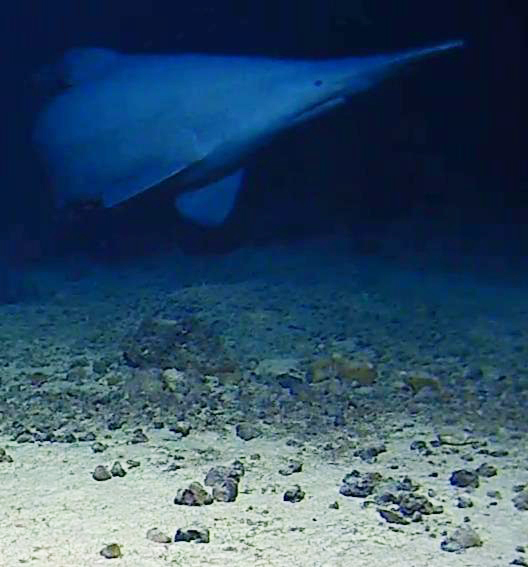
Previously, goblin sharks were only filmed and reported alive after being caught on a fishing line and brought to the surface, where divers could observe them until they soon died. The study documents two live observations of one of the most elusive but iconic sharks on the planet—one at a seamount near Jarvis Island and another on the slope of the Tonga Trench.
Goblin sharks are sometimes referred to as “living fossils” because they are the only living representative of their family, a lineage nearly 125 million years old. These observations greatly extend their known depth and geographic ranges.
Aaron Judah, the lead author of the paper and a doctoral candidate working in the Deep-Sea Fish Ecology Lab and Deep-Sea Animal Research Center in the Department of Oceanography at the University of Hawaiʻi at Mānoa School of Ocean and Earth Science and Technology, noted that this observation extends the depth record for the entire order of Lamniformes, the mackerel sharks, which include other notable species such as the white shark, basking shark, and mako shark.
“Seeing the most iconic of all the deep-sea sharks alive and looking healthy in its natural habitat is a unique honor,” Judah said. “I was also very surprised about how deep this species was found. The observation from the slope of the Tonga Trench is nearly 700 meters deeper than this species was known to live.”
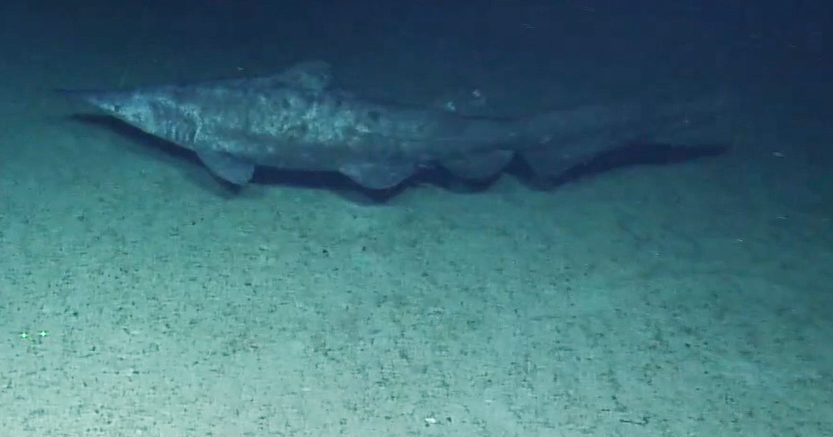
Previously, the goblin shark was only known to inhabit narrow areas off the coast of the western United States, Australia, and Japan in the Pacific Ocean, and narrow regions in the Atlantic and Indian oceans. The findings significantly extend their geographic range, with both sightings made in the Central Pacific.
In 2025, Judah spoke with colleagues at Deep-Sea Animal Research Center who mentioned there had been a potential goblin shark sighting during a 2019 Ocean Exploration Trust expedition aboard the E/V Nautilus, which explored deep-sea ecosystems near Kingman Reef, Palmyra Atoll, and Jarvis Island within the Pacific Remote Islands Marine National Monument.
“I was shocked to hear this because this species was not known to be in the Central Pacific,” said Judah.
The footage from that cruise was captured using a camera system on the remotely operated vehicle Hercules, publicly archived for global access, and later annotated by colleagues at Deep-Sea Animal Research Center. Judah combed through this archive and discovered that the team had documented a goblin shark during a livestreamed dive on an unnamed seamount northwest of Jarvis Island.
The second observation was made during an expedition to the Tonga Trench that took place in 2024 aboard the R/V Dagon as part of the Inkfish Open Ocean Expedition led by scientists from the Minderoo-University of Western Australia Deep-Sea Research Center when a baited camera on a bottom lander captured footage of a goblin shark in its natural habitat.
“The goblin shark is one of those deep-sea charismatic animals that I never thought we’d see alive, and then to do so was amazing, but to then learn that colleagues in Hawaiʻi also saw one was just incredible,” said Alan Jamieson, professor and founding director at Minderoo-University of Western Australia Deep-Sea Research Center and study co-author who documented the 2024 sighting.
“It is really important that we still perform natural history work,” Judah said. “New discoveries like this demonstrate that there is still so much to explore in our deep-ocean home. Given the newly expanded geographic range of the goblin shark, this species can be included in regional management and a nation’s biodiversity list, whereas, beforehand we didn’t know it was even there!”
For more information on the goblin shark, watch a video from Ocean Exploration Trust.