


The Hawaiʻi State Judiciary is warning the public about a scam threatening drivers over nonexistent traffic citations.
The judiciary has been informed that people statewide are receiving text messages claiming to be from the Hawaiʻi District Court or the Department of Motor Vehicles (DMV). The texts claim that unless payment for unpaid traffic citations is made, recipients’ driving privileges and vehicle registration will be suspended, their vehicle will be impounded, and their wages will be garnished, among other penalties.
The Hawaiʻi Police Department has received reports of unknown individuals impersonating representatives from the Hawaiʻi District Court, alleging that recipients have outstanding traffic fines that must be paid immediately to avoid penalties.
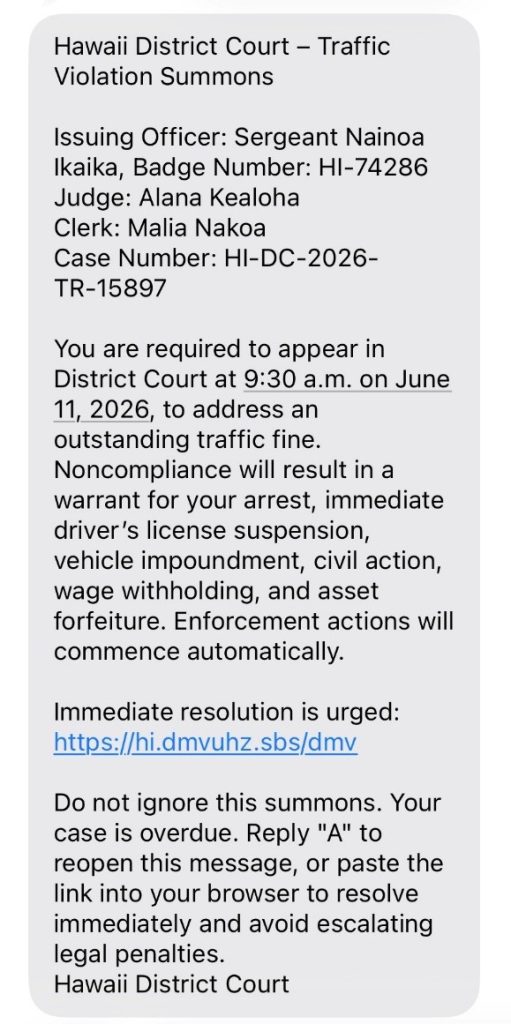
While these types of text scams are not new, this version includes official-looking names, titles, and a seemingly legitimate website link. Multiple residents have reported receiving the text message.
The scam message typically states that the receiver must appear before the court, claims the recipient has unpaid fines, and warns that noncompliance will result in the suspension of the recipient’s driver’s license, arrest, vehicle impoundment, civil action, wage withholding, and asset forfeiture.
All communication from the judiciary regarding unpaid citations is handled through the U.S. mail. You will not receive texts, calls, or emails about unpaid traffic citations from the state courts or the DMV unless you contacted them first either in person, in writing, or over the phone with a specific question.
Anyone unsure whether they have an unpaid traffic citation should search in eCourt Kokua, the judiciary’s public online case lookup system. Traffic infractions and crimes can be found by conducting a search using first and last names. Parking citations can be found by conducting a license plate number search.
This scam follows a familiar pattern in which scammers impersonate court staff, the DMV, or law enforcement to threaten people with fines, license suspension, or arrest for failing to pay for nonexistent traffic citations or appear for jury duty. The perpetrators often spoof courthouse or law enforcement phone numbers and even pose as law enforcement officers.
Important facts to remember:
The Hawaiʻi State Judiciary does not call, email, or text to demand payment or personal information for court-related matters.
Official notices from the courts are sent by U.S. mail, unless you have contacted the judiciary first with a specific question.
The courts will never:
- Ask for your Social Security number, credit/debit card details, or bank account information over the phone or by email or text.
- Demand immediate payment using prepaid debit cards, gift cards, wire transfers, cryptocurrency, or online payment apps to avoid arrest or jail.
- Instruct you to meet at a courthouse, police station, or another location to make a payment.
Protect yourself from scams:
- Delete suspicious texts or emails that appear to come from the judiciary if you did not contact the judiciary first. Do not click on links, open attachments, or reply.
- Do not trust caller ID. Scammers can “spoof” real phone numbers to make their calls look official.
- If you are unsure whether a call or message is legitimate, contact the judiciary directly using the phone numbers listed on the official website.
- If you believe you are in danger or have been threatened by a scammer, call 911. If you have given personal information or sent money to a scammer, report the incident to your local police department, the Federal Trade Commission (FTC), and/or the FBI’s Internet Crime Complaint Center.
If you believe you are in danger or have been threatened by a scammer, call 911. If you have given personal information or sent money to a scammer, report the incident to your local police department, the Federal Trade Commission, and/or the FBI’s Internet Crime Complaint Center.
For more information and updates about judiciary-related scams, visit the Hawaiʻi State Judiciary’s Scam Alerts page.