


The University of Hawaiʻi has been selected as one of five core members of a new national seafood research consortium backed by $13.5 million in federal funding — with Hawaiʻi-based researchers and the state’s unique ocean resources playing a central role.
The National Oceanic and Atmospheric Administration announced the creation of the Cooperative Institute Fostering Aquaculture Research and Markets, known as CIFARM. The University of New Hampshire was named the host institution for the five-year cooperative institute, which emerged from a highly competitive application process.
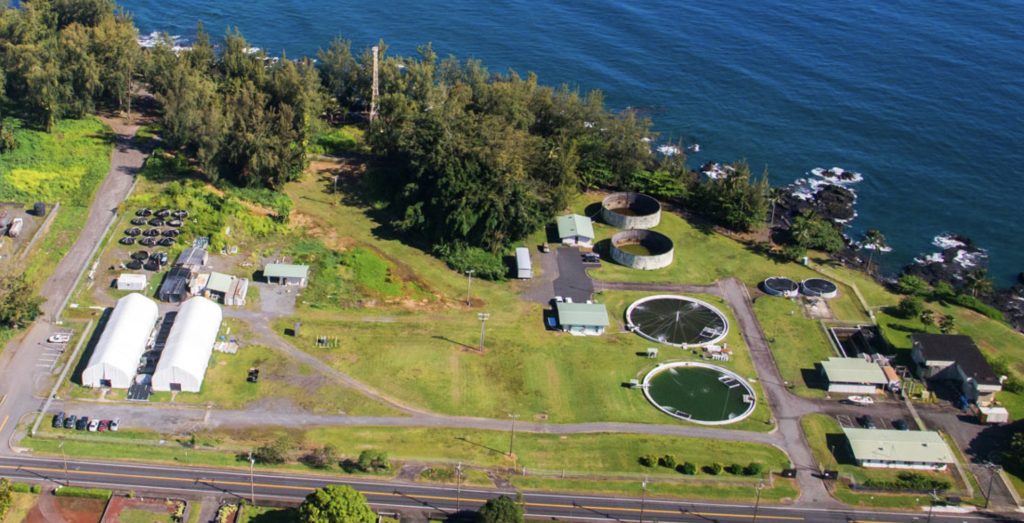
Associate Professor Chatham Callan of the UH Hilo Pacific Aquaculture and Coastal Resources Center is leading the UH effort.
Co-investigators include Professor Maria Haws of PACRC, Associate Research Professor Erik Franklin of the Hawaiʻi Institute of Marine Biology at UH Mānoa’s School of Ocean and Earth Science and Technology, and Hawaiʻi Sea Grant Associate Director for Extension Darren Okimoto, along with other UH faculty.
Callan said being selected as a core member is a “testament to the decades of world-class aquaculture research happening right here in Hawaiʻi.”
He said through UH’s partnerships with Native Hawaiian communities, we draw on a tradition of ocean stewardship and fishpond engineering that stretches back centuries.
“Our UH team is excited to bring that unique Pacific perspective and expertise to the national stage,” Callan said. “By focusing on cutting-edge tech, environmental forecasting, and real-world marine demonstration projects, we are actively building the blueprint for a more resilient, self-sufficient seafood industry.”
Americans consume more than $24 billion in imported seafood each year, roughly half is estimated to be farmed overseas. The goal of the cooperative institute is to reduce that dependence by advancing domestic marine aquaculture, strengthening supply chains, and creating jobs in coastal communities.
Research priorities for the consortium include engineering and technology development, artificial intelligence applications for aquaculture, environmental forecasting and marine demonstration projects.
The UH team will also partner with Pacific island researchers — including University of Guam Sea Grant and the Marine & Environmental Research Institute in the Federated States of Micronesia — to extend the program’s reach across the Pacific.
Hawaiʻi brings a rare real-world asset to the consortium: Blue Ocean Mariculture, the Kona-based operation that is currently the only offshore fish farm in the United States.
“This partnership underscores the University of Hawaiʻi’s vital role in advancing sustainable aquaculture systems that directly impact our global food supply,” said Norman Arancon, director of the UH Hilo College of Agriculture, Forestry and Natural Resource Management.
The national coalition also includes New Hampshire Sea Grant, the University of Miami, Florida Sea Grant, the University of Southern Mississippi, the Mississippi-Alabama Sea Grant Consortium, Hubbs-Sea World Research Institute and California Sea Grant.