


Astronomers using the W. M. Keck Observatory on Maunakea, Hawaiʻi Island are revealing new insight into the composition and origins of Uranus’s two outermost rings.
Researchers using data from Keck Observatory Archive, combined with observations from Hubble Space Telescope and James Webb Space Telescope, constructed the first complete reflectance spectrum — sunlight reflected off the rings — of the two rings, confirming their colors and uncovering their detailed composition.
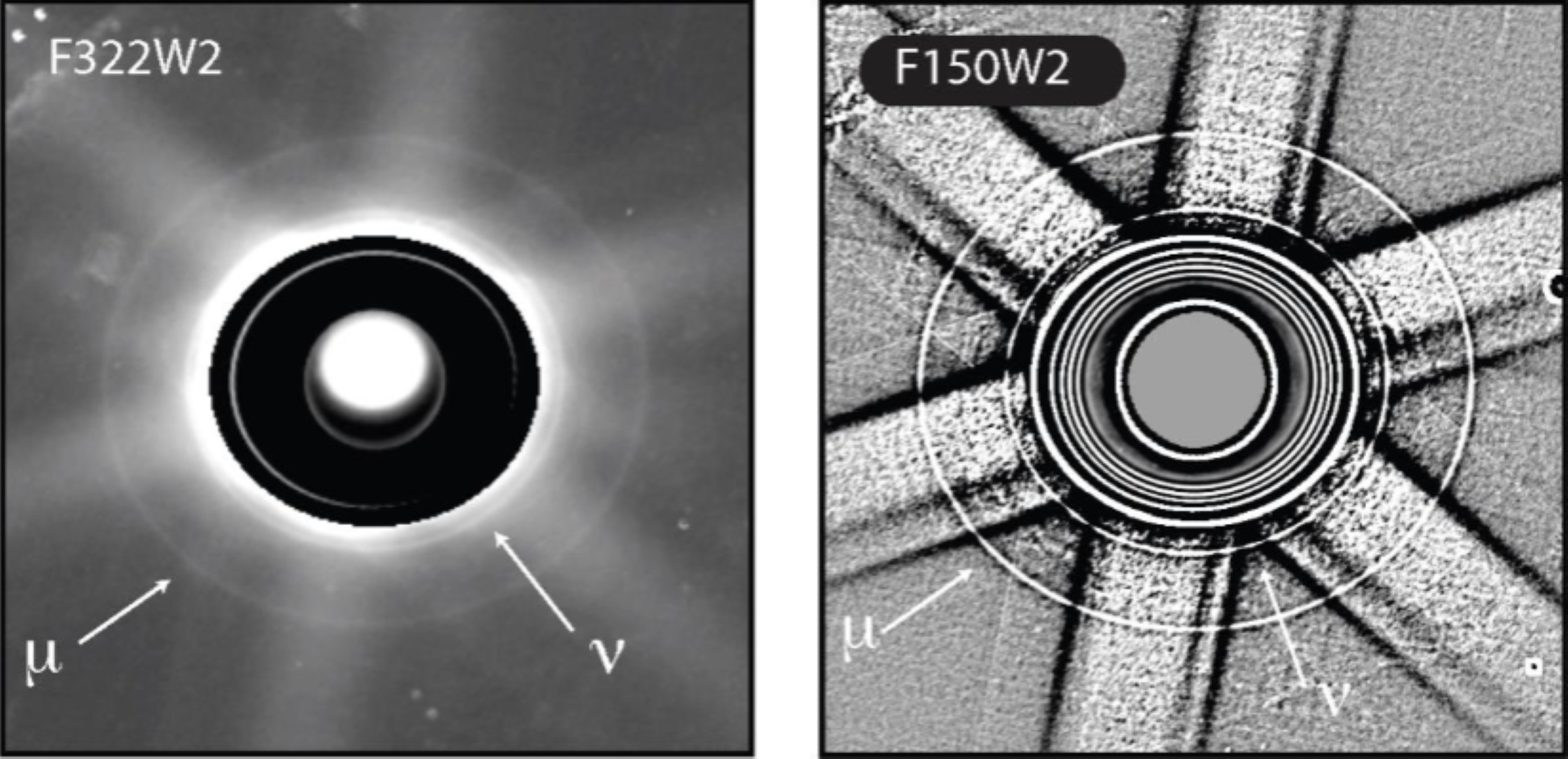
These rings also are peculiar because they are extremely faint and orbit within the planet’s crowded system of 14 inner moons.
“By decoding the light from these rings, we can trace both their particle size distribution and composition, which sheds light on their origins, offering new insight into how the Uranian system and planets like it formed and evolved,” said University of California, Berkeley, professor and lead study author Imke de Pater said in announcing the findings.
The new study — led by University of California, Berkeley, and published in the Journal of Geophysical Research: Planets — points to two very different origin stories.
Though they orbit the same planet, Uranus’s two outermost rings are fundamentally different.
Prior observations with the combined Keck Observatory and Hubble Space Telescope showed one ring appeared blue, a signature of extremely small particles, while the other’s reddish hue points to a more typical dusty ring.
Why the rings were so different remained a mystery, though.
When James Webb Space Telescope came online and observed Uranus, the research team used all its data, taken at different infrared wavelengths, in combination with Keck Observatory and Hubble Space Telescope observations to construct a complete spectrum from visible light through the infrared spectrum.
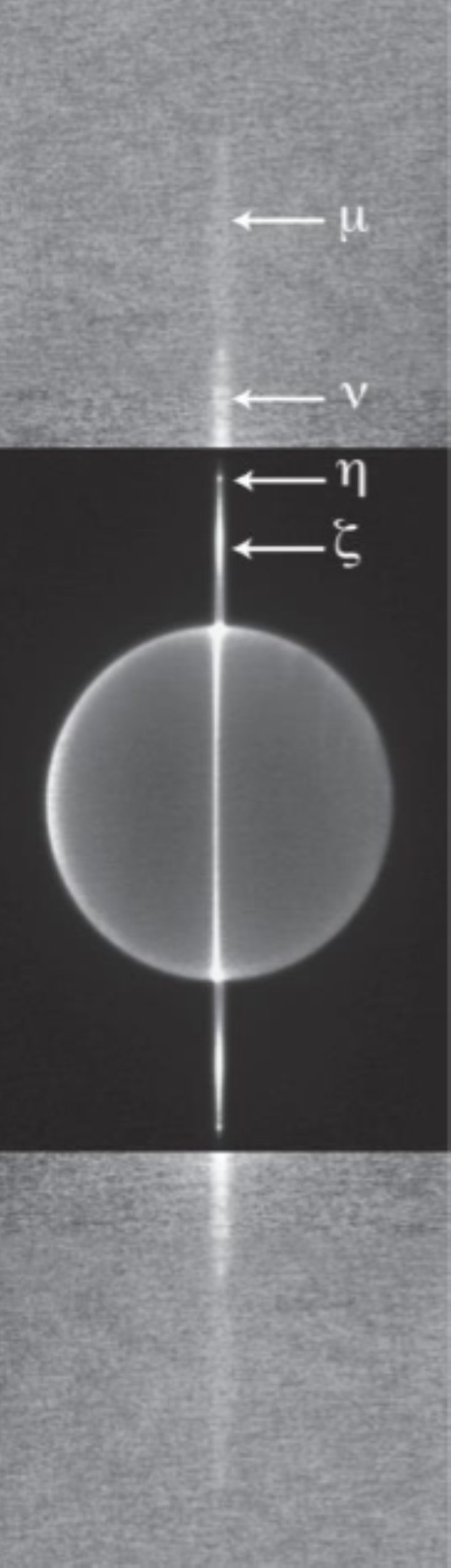
By analyzing how sunlight reflects off the rings, the team identified a strong absorption feature near a wavelength of 3 microns, or 3 millionths of a meter, visible in infrared for both rings.
Beyond that shared feature, the differences become clear when simulating the detailed spectra: one ring closely matches the spectral signature of water ice, while the other is clearly composed of rocky material, mixed with approximately 10% to 15% carbon-rich organic compounds commonly found in the outer solar system.
Tiny icy grains knocked off the planet’s small moon Mab by micrometeorite impacts make up one of the rings. Interestingly, its icy composition also confirms that Mab is composed mostly of water ice.
In contrast, the other ring is sourced from micrometeorite impacts on and collisions between unseen rocky bodies rich in organic materials, which must orbit between some of the known moons.
“One interesting question is why the parent bodies sourcing these rings are so different in composition,” de Pater said.
Rings were first discovered in 1977 around Uranus, when astronomers observed a star dim multiple times as the planet passed in front of it, indicating a surrounding ring system. At the time, only Saturn was known to have rings, making Uranus the second known ringed planet in our solar system.
Unlike Saturn’s bright, easily visible rings, however, rings around Uranus are faint and narrow, making them far more difficult to study.
Throughout the decades, additional rings were identified via NASA’s Voyager 2 spacecraft and Hubble Space Telescope observations, gradually revealing a more complex system.
The new findings raise an interesting question: why is Mab, the source of one ring, so different from the planet’s other, rockier inner moons?
“I suspect we will need closeup images from a future spacecraft mission to Uranus in order to answer that question”, said study co-author and senior research scientist at the SETI Institute Mark Showalter.
Visit the W. M. Keck Observatory website for additional information.