


The Hawaiʻi State Energy Office has admitted to significant errors in a study that has been used to support claims that importing liquefied natural gas could save money for Hawaiʻi consumers for over a year.
Today, the House Committee on Energy and Environmental Protection expressed serious concerns over the reliability of analysis by the Hawaiʻi State Energy Office following its admission of significant errors in the Office’s Alternative Fuels, Repowering, and Energy Transition Study.
“The Legislature, and the people of Hawaiʻi, rely on the State Energy Office to provide accurate, competent, and objective analysis to inform policy directions and decisions,” said Committee Chair Nicole Lowen. “They’ve failed in their mission here.”
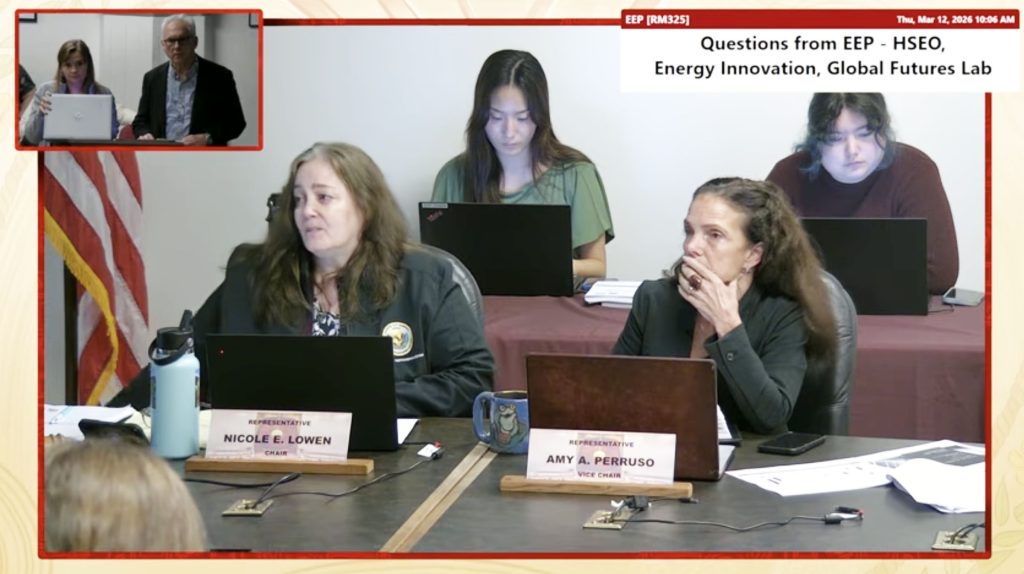
The Committee requested further clarification after the errors were presented in a March 12 informational briefing, yet the State Energy Office responded by denying any error and “unequivocally” standing by its analysis.
However, in a March 19 letter to the Committee, the Office finally acknowledged its critical error of omitting the costs of the liquefied natural gas fuel in the scenario in which it claimed savings (Alternative 3A). That error alone amounted to almost $1 billion, turning purported savings for Hawaiʻi consumers into hundreds of millions of dollars of losses.
Reviews conducted by Hawaiʻi Natural Energy Institute and the University of Hawaiʻi Economic Research Organization confirmed multiple material errors and raised broader concerns regarding questionable assumptions.
According to the reviews, there was a lack of sensitivity analysis, and the study’s narrow focus on comparing liquefied natural gas to oil only, rather than evaluating a full range of pathways that maximize affordability and renewable energy, and minimize volatility and reliance on fossil fuels.
The Natural Energy Institute concluded that “the spreadsheet errors identified during the March 12 briefing are confirmed to exist” and found that these errors render key results “incorrect” and insufficient to determine whether liquefied natural gas would provide meaningful savings to Hawaiʻi ratepayers.
The Economic Research Organization similarly confirmed that liquefied natural gas fuel costs were omitted from key calculations, effectively treating liquefied natural gas fuel as free in the savings estimates and inflating the projected benefits significantly.
In its March 19 letter, Hawaiʻi State Energy Office acknowledged the error in the underlying model and indicated that it would reissue the study and remove its previously endorsed Alternative 3A from the report entirely.
Hawaiʻi State Energy Office has now shifted to promoting another scenario, Alternative 1, which it had previously rejected in its study because it would involve using excess amounts of liquefied natural gas and displacing lower-cost renewable energy development. However, this scenario also relies on assumptions identified by Hawaiʻi Natural Energy Institute and the University of Hawaiʻi Economic Research Organization as unrealistic or unsupported.
“The Energy Office appears to be pivoting to scenarios it previously deemed not viable or cost-effective, including pathways that undermine Hawaiʻi’s renewable energy goals and lead to higher costs,” Lowen said. “It is beginning to seem like the only thing that the Energy Office is worried about getting right with this report is the conclusion.”
All reviewers have emphasized that the current study does not provide any reliable basis for decision-making.
“The Energy Office has a legal responsibility to lead Hawaiʻi’s transition to a more affordable, independent, and secure clean energy future,” said Committee Vice Chair Amy Perruso. “Instead, we have seen the Office focus all their attention and effort on clearing a pathway for one favored fossil fuel company, free from competition.”
The Committee will continue to exercise its oversight authority to ensure that future energy planning and analysis are transparent, accurate, and aligned with Hawaiʻi’s statutory clean energy goals.
“The stakes for Hawaiʻi’s residents are too high to rely on flawed and biased analysis,” Lowen said. “We remain committed to ensuring that analysis and decisions on our energy future are grounded in sound data, rigorous methodology, and full public transparency.”