


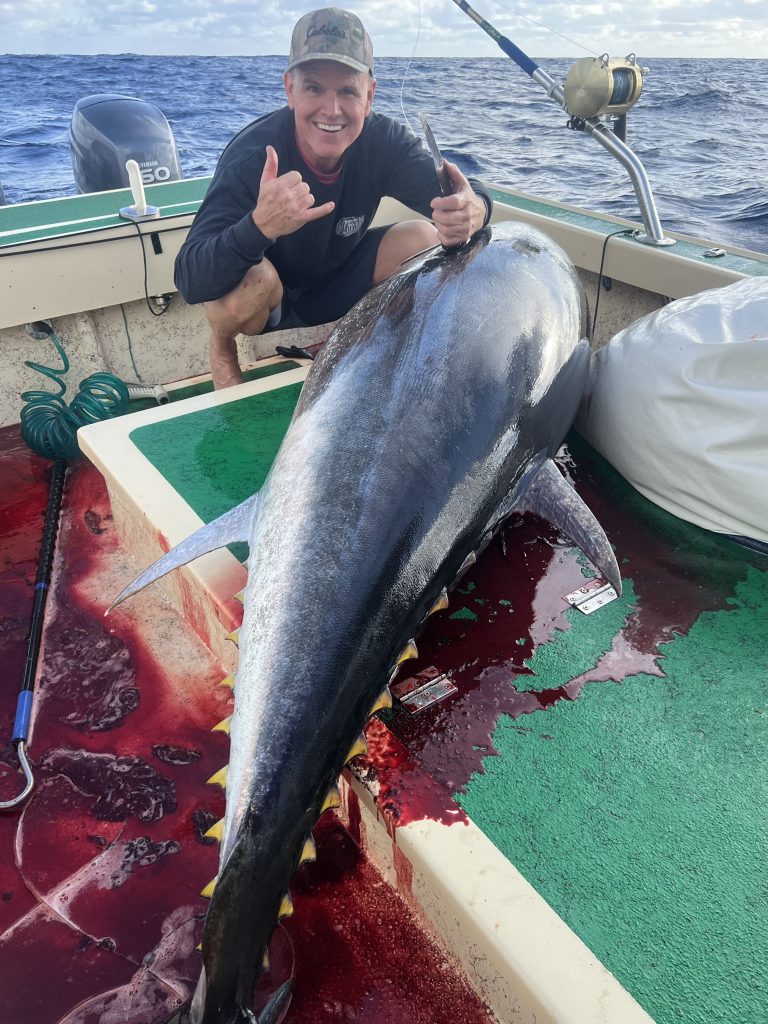
Kaua‘i fishermen Billy Light and Ryan McKnight were trolling about 12 nautical miles from shore when something massive struck the daisy-chain lure at the end of their center line.
The unseen fish hit the lure’s heavy duty hook and dove, draining several hundred yards of line from the “screaming” spool in seconds, McKnight said.
The two fishermen knew they had not hooked a typical ahi, but what was it?
A 45-minute battle with the large animal ensued before they wrestled it onto Light’s boat and discovered it was a giant bluefin tuna. On shore, the fish proved to weigh about 309 pounds and measure about 6 feet 6 inches long.
It was only the second bluefin tuna caught on record in Hawaiian waters, according to bestfishinginamerica.com.
“We stayed relatively calm until we actually saw the fish,” said Light, who slowly reeled in the giant bluefin tuna on Jan. 23 while McKnight provided assistance and shouted moral support.
For every 12 inches of line Light reeled in, the bluefin pulled about seven back out, until it finally surfaced alongside Light’s boat, the Wet Willie.
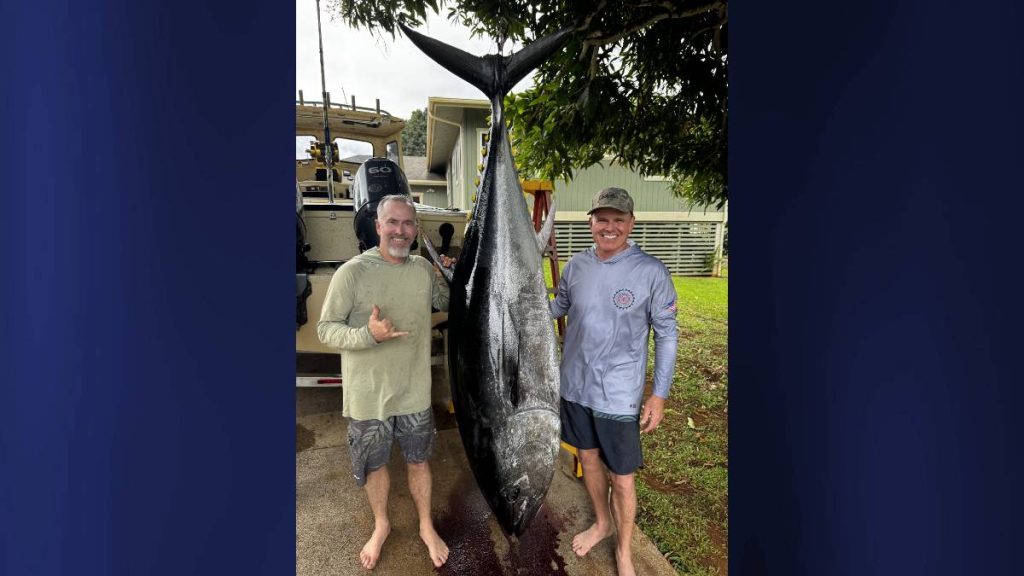
“It was mind-boggling when it came up,” Light said.
McKnight, an EMT, and Light, a drywall contractor, are Kapahi neighborhood residents and longtime friends who have fished together for more than two decades.
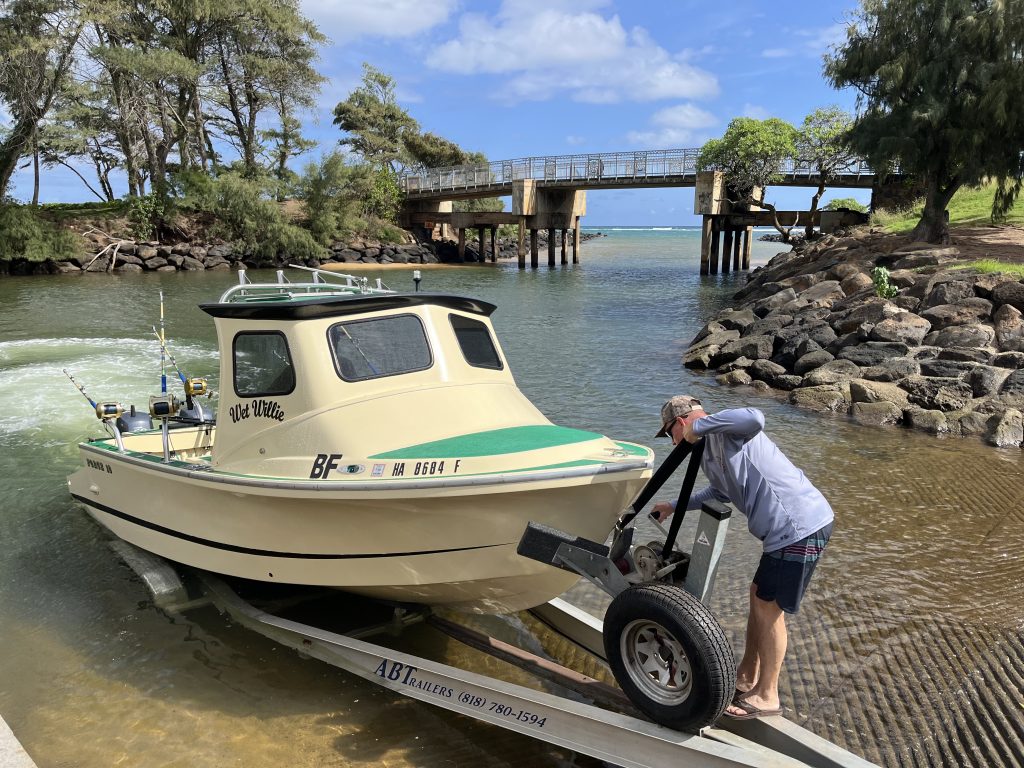
The fateful day of Jan. 23, they boarded the Wet Willie before dawn at the Kapa‘a boat ramp on Kaua‘i’s East Side. They first hooked a marlin, which escaped after a 20-minute struggle, before continuing to troll until the giant bluefin took their bait 30 minutes later.
The fish the size of an NFL offensive lineman spun the 18-foot Wet Willie “sideways and almost started dragging us up-sea,” according to McKnight.
“I was so nervous, thinking, please let us see what this is,” McKnight added, explaining he thought the bluefin could have been anything from a foul-hooked marlin to some kind of marine debris.
Light and McKnight needed 20 minutes, some luck and a lot of elbow grease to pull the giant bluefin into the Wet Willie. When the fish was finally aboard, they realized it was larger than the boat’s fish box, so they tied its tail to the cabin roof before returning to Kapa‘a. They also found their daisy-chain lure had all but fallen apart during the fight.
On their way back to Kapa‘a, McKnight called a friend to confirm he and Light had caught a giant bluefin tuna. The friend did not know for sure but promised to ask around. Soon, Light and McKnight’s smartphones began to explode with calls and messages from local fishermen demanding more information about their already-famous catch.
Pepe Conley, a friend of McKnight’s, conducts surveys among local fishermen on behalf of the State of Hawai‘i. He happened to be stationed at the Kapa‘a boat ramp when the Wet Willie made its triumphant return.
“Growing up as a fisherman, I had heard of this legendary bluefin tuna that someone had caught in 1983,” Conley said. “So I knew it was theoretically possible to catch bluefin in Hawaiian waters. … I didn’t think I’d ever see one in my lifetime, let alone have one of my good friends catch one.”
Conley was looking forward to eating some of the “once in a lifetime” tuna, which Light and McKnight had sold to the Hanalei Dolphin Restaurant over the weekend. The North Shore fish market was still selling the bluefin at $75 per pound, and certain sashimi cuts at $80 per pound, as of Tuesday afternoon.
The only other Hawaiian giant bluefin on record was landed more than 40 years ago, according to bestfishinginamerica.com, which cites a now defunct website operated by Hawai‘i Fishing News. It weighed 376 pounds and was caught on Aug. 13, 1983 by angler Jeffry C. Fear off Kumukahi Point on Hawai‘i Island.
To catch a bluefin is both a rare event and a challenge in Hawai‘i, where other species like bigeye tuna and aku (skipjack tuna) are more prevalent, and ahi (yellowfin tuna) reigns supreme as both a sport fish and seafood favorite.
Ahi can be recognized by their bright yellow dorsal and anal fins. They have a lifespan of 6 to 7 years. Good-sized specimens weigh between 150 and 200 pounds, though they can grow much larger.
Pacific bluefin tuna are found on both sides of the Pacific Ocean, including Japan to the east and Mexico and California to the west. They are bigger than ahi, with lifespans averaging between 20 and 24 years. Light and McKnight’s bluefin was probably about 8 years old, according to Molly Lutcavage, a longtime tuna researcher who splits her time between Gloucester, Mass., and Kaua‘i.
Lutcavage was present to examine the catch at Light’s Kapahi home due to a phone call from a fisherman who knew she could positively identify it as a Pacific bluefin tuna. She described the fish as a typical specimen of medium size, though large enough to be worthy of the term “giant.”
In the realm of bluefin tuna, “giant” is a loose term. Atlantic bluefin tuna, which are larger than their Pacific cousins, grow to more than 1,000 pounds and can reach 10 feet in length.
Satellite tags have documented Pacific bluefin tuna swimming across the ocean from starting points near Japan. Light and McKnight may have caught one of these long-distance travelers. Their tuna’s stomach was empty, though it wasn’t necessarily starving when it was caught, Lutcavage said.
“He may have eaten 48 hours before,” Lutcavage explained. “They have some of the highest turnover of enzymes in the stomach of any living teleost [bony fish] … They are basically a feeding machine.”
Light and McKnight can celebrate the landing of the second giant bluefin in Hawai‘i record books. However, another local — Kristy Kahananui, owner of Lawai‘a Fish Co. in Līhu’e — said she once caught an even larger bluefin tuna that has since been forgotten.
“It was 312 pounds,” she said. “We never thought to report that kind of stuff back then.”
Kahananui was a teenager when she landed her giant bluefin sometime in the early 1980s while fishing with her father, Frank Medeiros Jr.
Editorʻs Note: In the original version, the surname of one of the fishermen was incorrect. The correct name is Billy Light.