


Hawai‘i Department of Business, Economic Development and Tourism recently announced that the seasonally adjusted unemployment rate for December 2025 was 2.2%, the same as in November 2025.
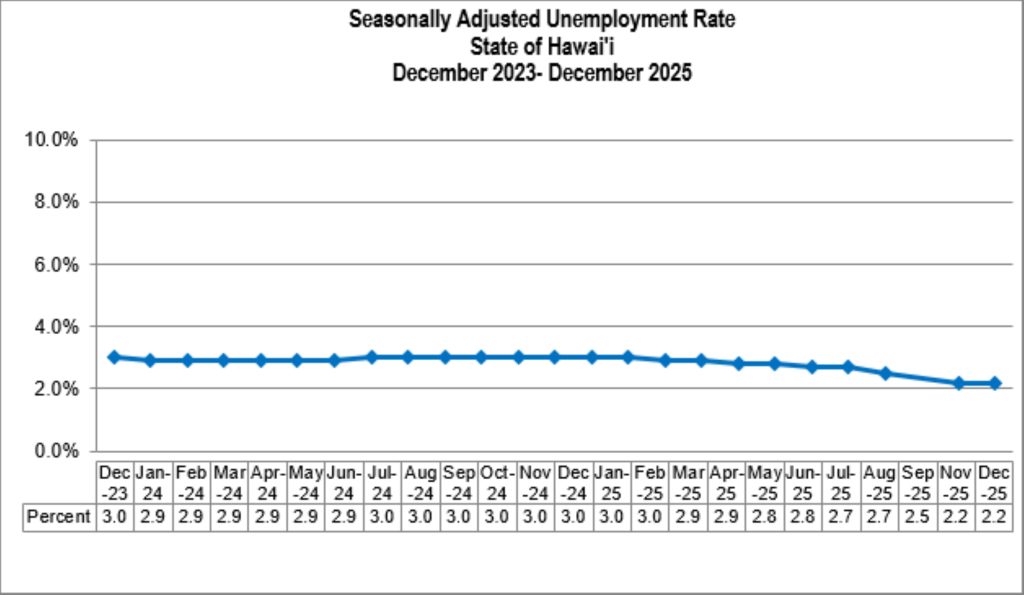
There were just more than 674,050 people employed during the last month of 2025 throughout the islands; 15,200 were unemployed.
That signifies a total seasonally adjusted labor force of 689,250 statewide.
Nationally, the seasonally adjusted unemployment rate for December 2025 was 4.4%, down from the revised rate of 4.5% the prior month.
The unemployment rate figures for the state and nation are seasonally adjusted in accordance with U.S. Bureau of Labor Statistics methodology.
The not-seasonally adjusted rate for the state was also 2.2% last month compared with 2.4% in November 2025.
State of Hawai‘i Seasonally Adjusted Labor Force Data**
| December 2025 | November 2025 | December 2024* | |
| Labor Force | 689,250 | 687,950 | 682,300 |
| Employment | 674,050 | 672,650 | 661,600 |
| Unemployment | 15,200 | 15,300 | 20,700 |
* benchmarked data ** totals might not add because of rounding
Unemployment Rates
County and island rates are not seasonally adjusted * benchmarked data
Industry payroll employment (establishment survey)
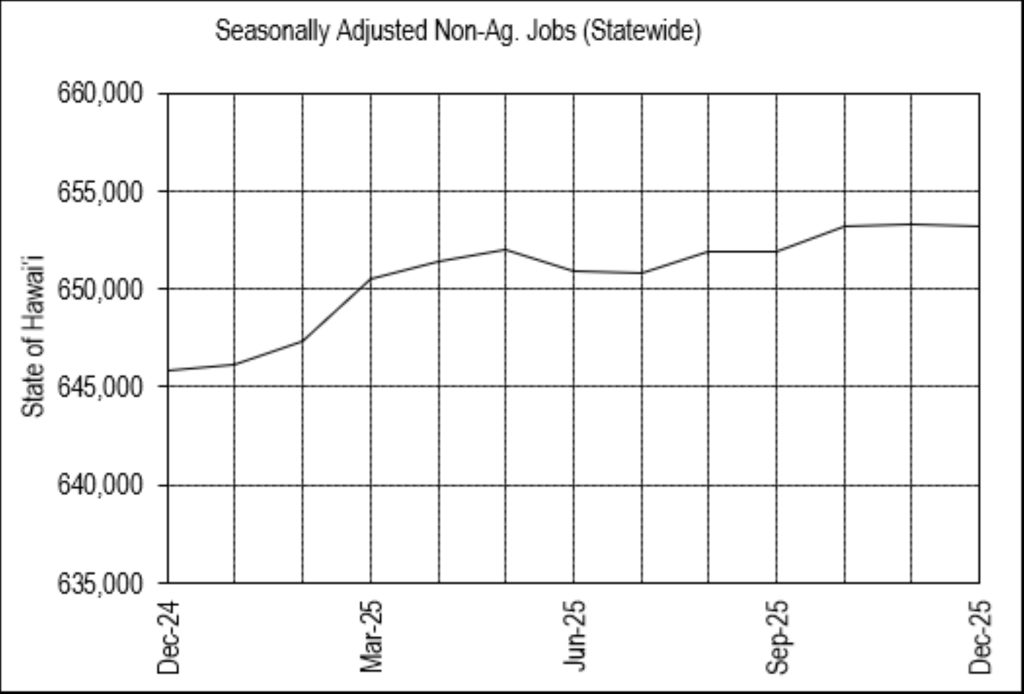
In a separate measure of employment, total nonagricultural jobs decreased by 100 from November 2025 to December 2025.
Job gains were experienced in these sectors:
- Trade, Transportation and Utilities (+400).
- Construction (+200).
- Professional and Business Services (+200).
- Other Services (+100).
Job losses were seen in these sectors:
- Manufacturing (-100).
- Financial Activities (-100).
- Private Education and Health Services (-100).
Government employment went down by 700 jobs, with most of the decline attributed to contraction at Hawai‘i Department of Education, University of Hawai‘i System and several state departments.
Employment remained unchanged in the Information and Leisure and Hospitality sectors.
Nonfarm jobs increased by 7,400, or 1.1%, from December 2024 to December 2025.
| December 2025 | November 2025 | December 2024* | |
| Seasonally Adjusted | |||
| STATE | 2.2 | 2.2 | 3.0 |
| UNITED STATES | 4.4 | 4.5 | 4.1 |
| Not Seasonally Adjusted | |||
| STATE | 2.2 | 2.4 | 2.8 |
| HONOLULU | 2.1 | 2.3 | 2.6 |
| HAWAI‘I COUNTY | 2.5 | 2.7 | 3.1 |
| KAUA‘I | 2.2 | 2.2 | 2.7 |
| MAUI COUNTY | 2.4 | 2.5 | 3.5 |
| Maui Island | 2.4 | 2.5 | 3.5 |
| Moloka‘i | 3.3 | 3.9 | 3.4 |
| Lāna‘i | 1.8 | 1.0 | 2.6 |
| UNITED STATES | 4.1 | 4.3 | 3.8 |
Labor force components
The concepts and definitions used by the Local Area Unemployment Statistics program are the same as those used in the Current Population Survey for the national labor force data:
- Civilian labor force. Included are all people in the civilian noninstitutional population, age 16 years old and older, classified as employed or unemployed.
- Employed persons. Each employed person is counted only once, even if he or she has more than one job. These are all people who, during the reference week (the week including the 12th day of the month):
- Did any work as paid employees, worked in their own business or profession or on their own farm or worked 15 hours or more as unpaid workers in an enterprise operated by a member of their family.
- Were not working but who had jobs from which they were temporarily absent because of vacation, illness, bad weather, childcare problems, maternity or paternity leave, labor-management dispute, job training or other family or personal reasons, whether or not they were paid for the time off or were seeking other jobs.
- Unemployed persons. Included are all people who had no employment during the reference week, were available for work, except for temporary illness, and made specific efforts to find employment sometime during the 4-week period ending with the reference week. People who were waiting to be recalled to a job from which they were laid off need not have been looking for work to be classified as unemployed.
- Unemployment rate. The percent of unemployed civilian labor force (i.e., 100 times [unemployed/civilian labor force]).
Seasonal adjustment
The seasonal fluctuations in the number of employed and unemployed people reflect hiring and layoff patterns that accompany regular events such as the winter holiday season and summer vacation season.
These variations make it difficult to tell whether month-to-month changes in employment and unemployment are because of normal seasonal patterns or changing economic conditions.
Therefore, a statistical technique called seasonal adjustment is used to address these issues.
This technique uses the history of the labor force data and the job count data to identify the seasonal movements and calculate the size and direction of these movements.
A seasonal adjustment factor is then developed and applied to the estimates to eliminate the effects of regular seasonal fluctuations on the data.
Seasonally adjusted statistical series enable more meaningful data comparisons between months or with an annual average.