


Astronomers analyzing data from an array of telescopes — including the W. M. Keck Observatory atop Mauna Kea on the Big Island — determined that luminous fast blue optical transients are powered by an extreme tidal disruption event.
It’s an event in which a black hole up to 100 times the mass of our sun completely shreds its massive stellar companion within days.
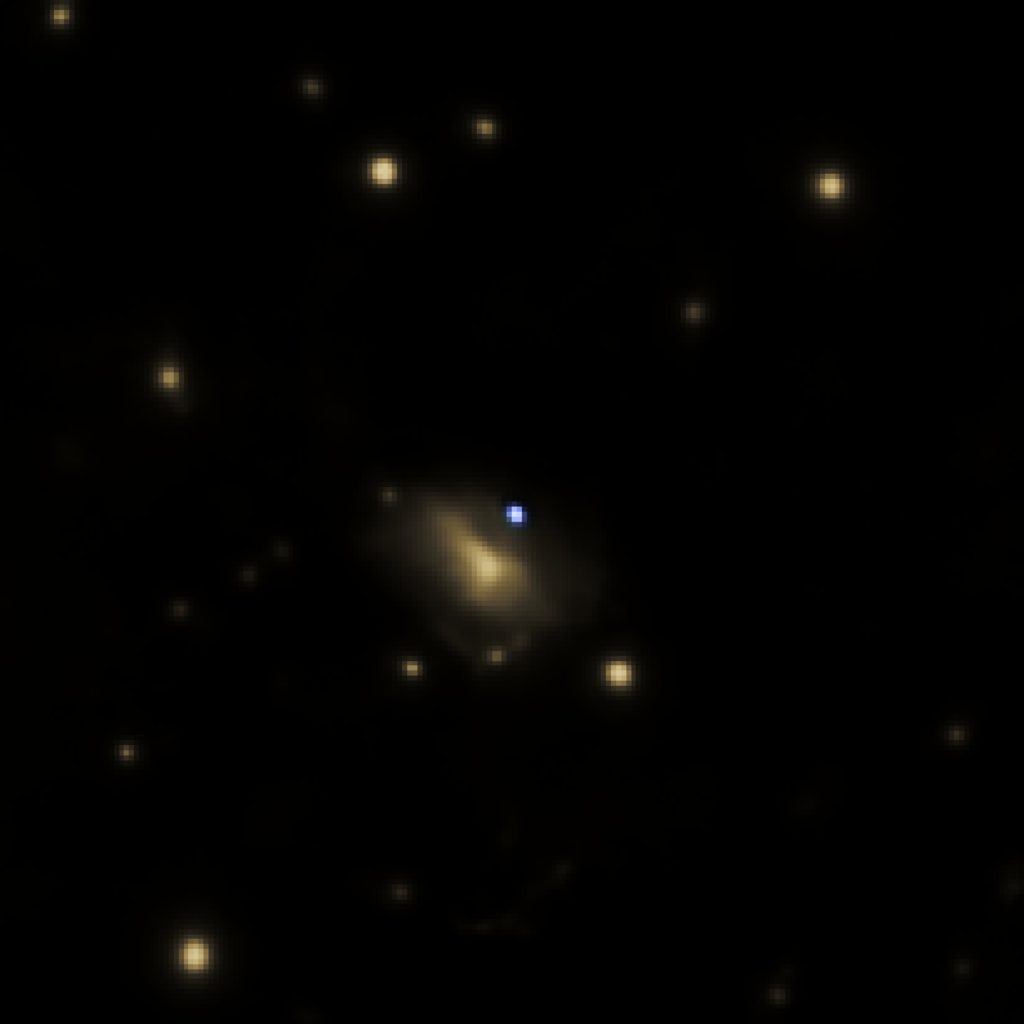
Observations of the event AT 2024wpp provide the clearest evidence yet that these rare cosmic flashes are not unusual supernovae, but instead require a powerful central engine driven by black hole accretion.
The discovery challenges existing models of black hole physics and advances the understanding of stellar evolution.
The mystery of fast blue optical transients
Among the more puzzling cosmic phenomena discovered during the past few decades are brief and extremely bright flashes of blue and ultraviolet light that rapidly fade, leaving behind faint X-ray and radio emissions.
With only slightly more than a dozen detected so far, astronomers have long debated whether luminous fast blue optical transients are produced by an unusual type of supernova or material falling into a black hole.
The brightest event observed to date shows they are neither.
“Its extreme luminosity makes AT 2024wpp the brightest of all [luminous fast blue optical transients],” said University of California, Berkeley grad student Natalie LeBaron in a recent release about the new discovery. “For the first time we have confirmed that these transients require some sort of central energy source beyond what a supernova can produce normally on its own.”
LeBaron — lead author on one of the studies that analyzed the optical, ultraviolet and near infrared emissions of the object — and her team infer the existence of this extra central engine energy source because AT 2024wpp radiated an amount of energy in the first 45 days, which is 100 times greater than what is radiated in a normal supernova throughout a longer timescale.
AT 2024wpp is analyzed in a pair of studies led by the University of California, Berkeley and published in The Astrophysical Journal Letters.
A flash too powerful to be supernova
The inferred mass of the black hole — in a range sometimes referred to as intermediate-mass black holes — is also intriguing for astronomers.
While black holes of more than 100 times the mass of our sun are known to exist because their mergers were detected by gravitational wave experiments, they have never been directly observed — and how they grow to this size remains a major open question.
“Theorists have come up with many ways to explain how we get these large black holes,” said University of California, Berkeley associate professor of astronomy and physics Raffaella Margutti in the release. “[luminous fast blue optical transients] allow you to get at this question from a completely different angle. They also allow us to characterize the precise location where these things are inside their host galaxy, which adds more context in trying to understand how we end up with this setup — a very large black hole and a companion.”
How a black hole destroys a star
Researchers hypothesize that the intense, high-energy emission from AT 2024wpp arose from a long-lived black hole binary system that had been siphoning material from its massive companion for an extended period.
This process likely surrounded the black hole in a halo of gas too distant to be immediately consumed.
When the companion star finally ventured too close, it was torn apart by tidal forces.
The newly disrupted material became entrained in the black hole’s rotating accretion disk, slamming into existing gas and producing powerful bursts of X-ray, ultraviolet and blue light.
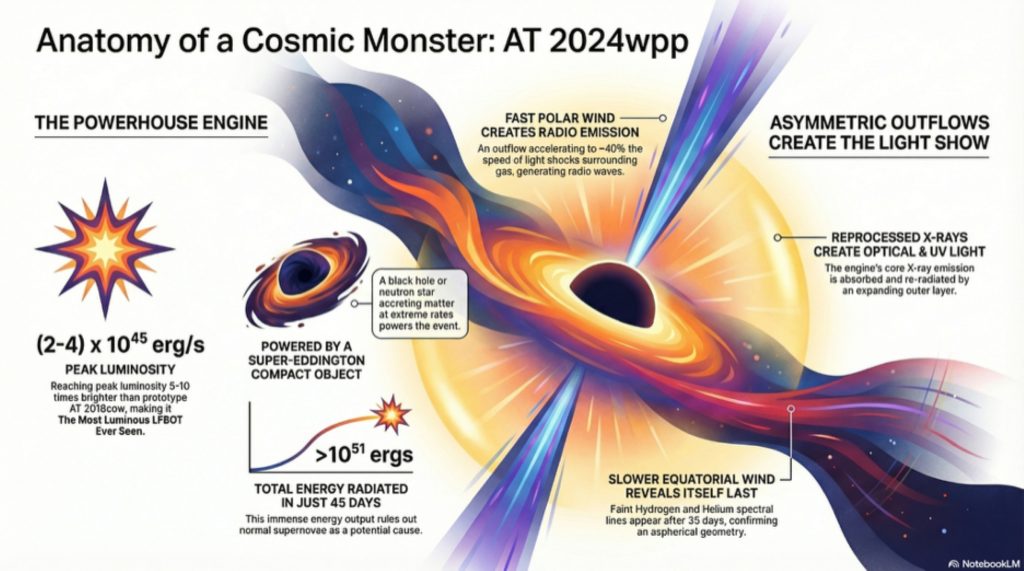
Some of the material was funneled toward the black hole’s poles and ejected as jets traveling at roughly 40% the speed of light, generating radio waves when they collided with surrounding gas.
The shredded companion star was likely more than 10 times the mass of our sun and might have been a Wolf–Rayet star — an evolved, extremely hot star that has already lost much of its hydrogen.
This scenario naturally explains the weak hydrogen emission observed from AT 2024wpp.
Keck Observatory uncovers key clues
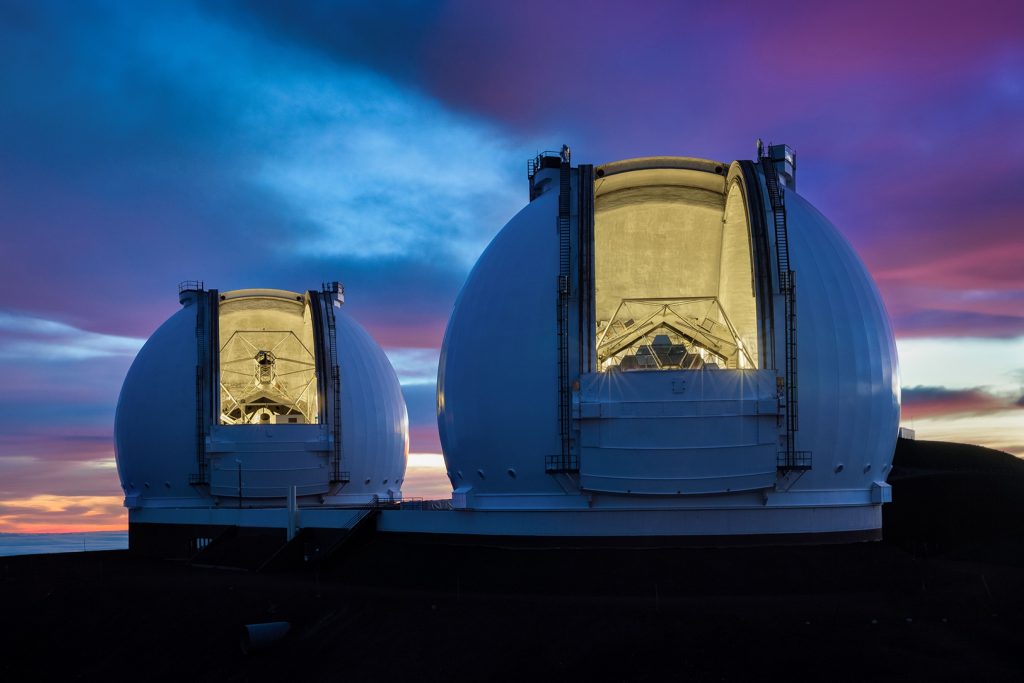
The team used Keck Observatory’s Low Resolution Imaging Spectrometer to detect extremely faint signatures of hydrogen and helium in the event’s light.
These signals appeared multiple times and showed an unusual double-peaked pattern, indicating the explosion was not evenly shaped but instead lopsided and complex.
Observations from Keck Observatory’s Near-Infrared Echellette Spectrograph uncovered another critical clue.
Keck Observatory detected an unusual excess of near-infrared light roughly 24 days after the explosion — only the second time such a feature was observed in this rare class of events.
Follow-up observations from Gemini Observatory confirmed the finding, suggesting this infrared glow is likely a defining characteristic of luminous fast blue optical transients.
This finding strengthens the case for future mid-infrared observations of similar events, which could help reveal the physical processes responsible for this mysterious glow.
“Studies like AT 2024wpp are only possible because of rapid, highly coordinated observing campaigns across many telescopes, both on the ground and in space,” LeBaron said. “While working on this object, we were very excited to be able to combine observations in optical, ultraviolet, infrared, X-ray and radio light so that we could fully piece together a much more complete picture of what powers these extraordinary explosions — something no single telescope could do on its own.”
While luminous fast blue optical transients are extremely rare — on average, astronomers discover about one per year — there is hope for luminous fast blue optical transient enthusiasts.
The next generation of observatories such as the Rubin Observatory’s Legacy Survey of Space and Time (and NASA’s Roman Space Telescope will dramatically increase the number of discoverable luminous fast blue optical transients.
“This new era of time-domain astronomy will allow us to uncover many more hidden explosions and use them to probe extreme physics and black holes across the universe,” said University of California, Berkley postdoctoral fellow and lead author on the companion study on the analysis of X-ray and radio emissions Nayana A.J. in the release.