


Astronomers using W. M. Keck Observatory and Subaru Telescope on the Big Island’s Mauna Kea discovered a massive planet and a brown dwarf orbiting distant stars — two rare companions that deepen our understanding of how giant planets and substellar objects form and evolve.
These discoveries are the first results from the Observing Accelerators with SCExAO Imaging Survey, or OASIS, program, a new large-scale survey that combines precision stellar motion data from space-based missions with the cutting-edge imaging capabilities of Mauna Kea’s observatories.
“These discoveries may help advance our abilities to image another Earth with future space-based observatories such as NASA’s Roman Space Telescope,” said University of Texas at San Antonio professor and OASIS principal investigator Thayne Currie in a release about the discoveries. “These results show what happens when we combine [Mauna Kea’s] unmatched observing conditions with cutting-edge instrumentation,”
The pair of studies, led by University of Texas at San Antonio, are published in the The Astronomical Journal and The Astrophysical Journal Letters, respectively.
Only about 1 percent of stars host massive planets or brown dwarfs that can be photographed directly with today’s telescopes.
Even in young systems, where these objects still glow with heat from their formation, they remain far fainter than their host stars — requiring ingenuity and advanced technology to detect.
OASIS identifies promising targets by analyzing measurements from the European Space Agency’s Hipparcos and Gaia missions to find “accelerating stars” — stars whose motion reveals they are being tugged by unseen companions.
Subaru Telescope’s extreme adaptive optics system SCExAO then captures high-contrast images of these hidden worlds, while follow-up observations using Keck Observatory’s second-generation near-infrared camera, also called a NIRC2 camera, provide longer-wavelength measurements essential for characterizing their atmospheres and orbits.
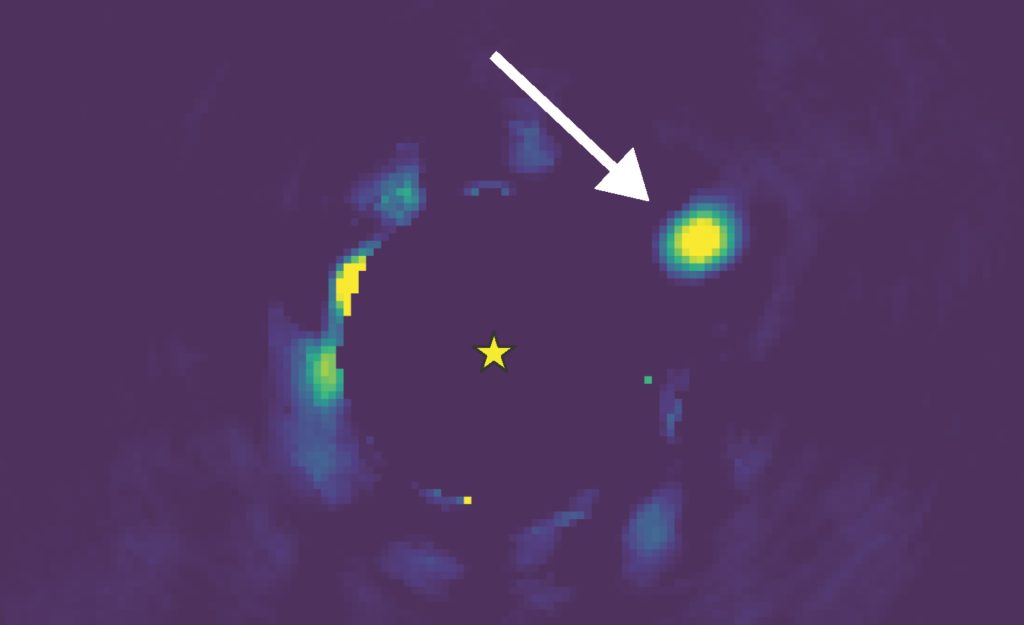
The first discovery, Hipparcos Catalogue (HIP) 71618 B, is a 60-Jupiter-mass brown dwarf located 169 light-years — or about 993 trillion miles — away from Earth, located in the constellation Bootes.
Brown dwarfs, sometimes referred to as “failed stars,” form like stars but never accumulate enough mass to sustain nuclear fusion and cooler. They are cooler than stars and much fainter at visible wavelengths we can see than at longer, infrared wavelengths that can be seen with Keck Observatory and Subaru Telescope.
Data from Keck/NIRC2 and SCExAO taken within days of one another discovered this companion. Follow-up data from Keck Observatory and Subaru Telescope taken throughout the next year then revealed the companion’s orbit.
One exciting outcome of this discovery is its unique suitability for NASA’s Roman Space Telescope.
Roman will conduct a technology demonstration to test coronagraph systems — tools future telescopes will depend on to image Earth-like planets that are billions of times fainter than their host stars.
Before this discovery, no confirmed object met all the strict criteria needed to validate this technology.
HIP 71618 B provides that rare target: a bright host star, an ideal separation and a companion that will be faint enough at visible wavelengths where Roman operates to challenge and confirm the performance of its coronagraph.
“The discovery of HIP 71618 B is demonstrably suitable for the Roman Coronagraph Technology Demonstration,” said postdoctoral researcher at University of Texas at San Antonio and lead author of this study Mona El Morsy in the release. “Providing a target that advances the community’s preparation for this mission is directly relevant, and I am optimistic that these discoveries will pave the way for many more systems identified through the OASIS survey.”
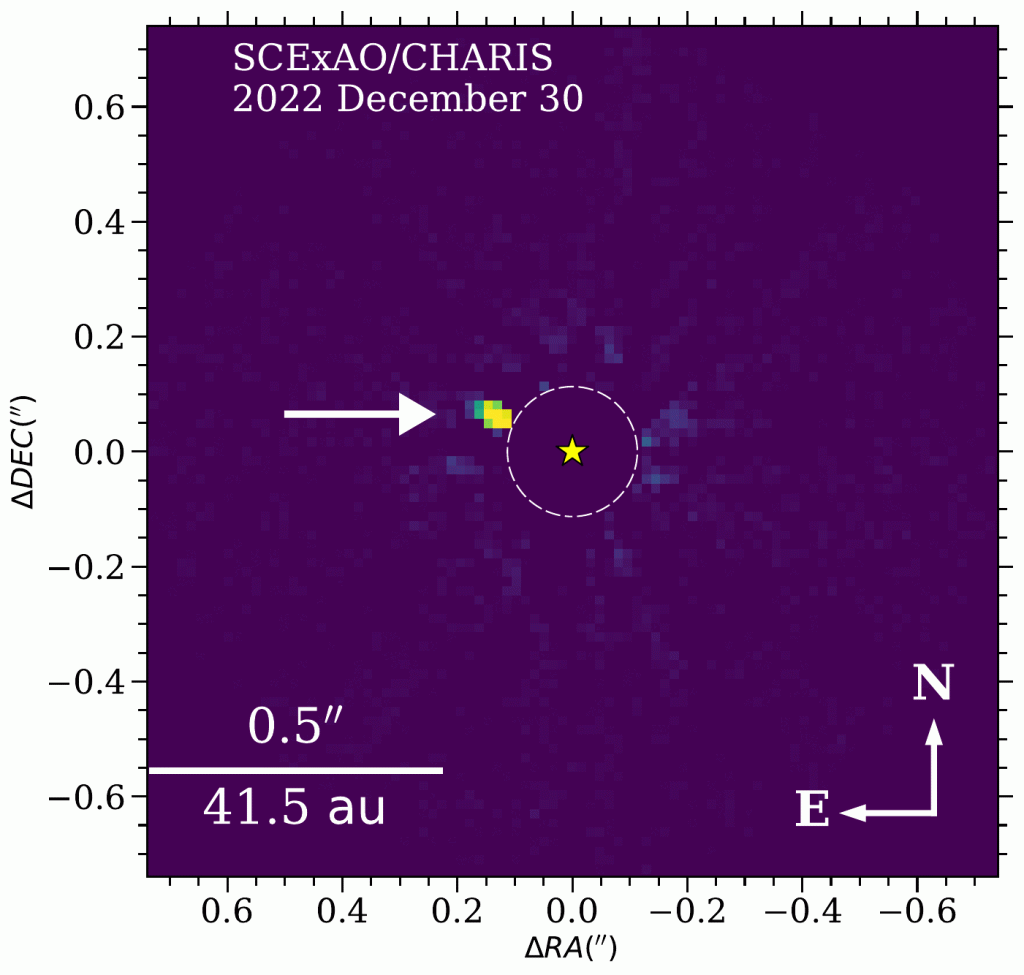
The other newly discovered companion, HIP 54515 b, is an 18-Jupiter-mass planet orbiting a star 271 light-years — or about 1.59 quadrillion miles — away from Earth, located in the constellation Leo.
HIP 54515 b — at a distance from its star similar to Neptune’s orbit around the sun — appears extraordinarily close to its host star as seen from Earth, comparable to the apparent size of a football viewed from more than 200 miles away.
Subaru Telescope’s SCExAO system delivered the ultra-sharp images needed to reveal this faint, giant planet beside its bright star.
While SCExAO imaged the planet, Keck Observatory data played a critical supporting role in interpreting it, enabling researchers to precisely model its properties and evolutionary history.
“We used over a decade’s worth of data from the Keck Observatory Archive to help precisely calibrate SCExAO,” Currie said.
These discoveries together highlight the power of combining space-based precision measurements with the unparalleled imaging capabilities of Mauna Kea’s observatories.
Early results from OASIS demonstrate how Subaru Telescope’s SCExAO system, Keck Observatory’s high-resolution infrared imaging and decades of archival data continue to uncover companions that would otherwise remain invisible.
“As these discoveries show, [Mauna Kea] observatories like Keck Observatory and the Subaru Telescope remain leading engines of discovery in astronomy even 25 [to] 30 years after their construction,” Currie said. “They will be even more powerful in the near future with new instruments coming online and improvements to existing instrumentation.”
He added that with improved technology serviced by a team of dedicated local staff, Keck Observatory and Subaru Telescope will remain critical telescopes in astronomy for many decades to come.
 The Subaru Telescope basks under the golden light of sunset, ready for observations. Photo Courtesy: Subaru Telescope
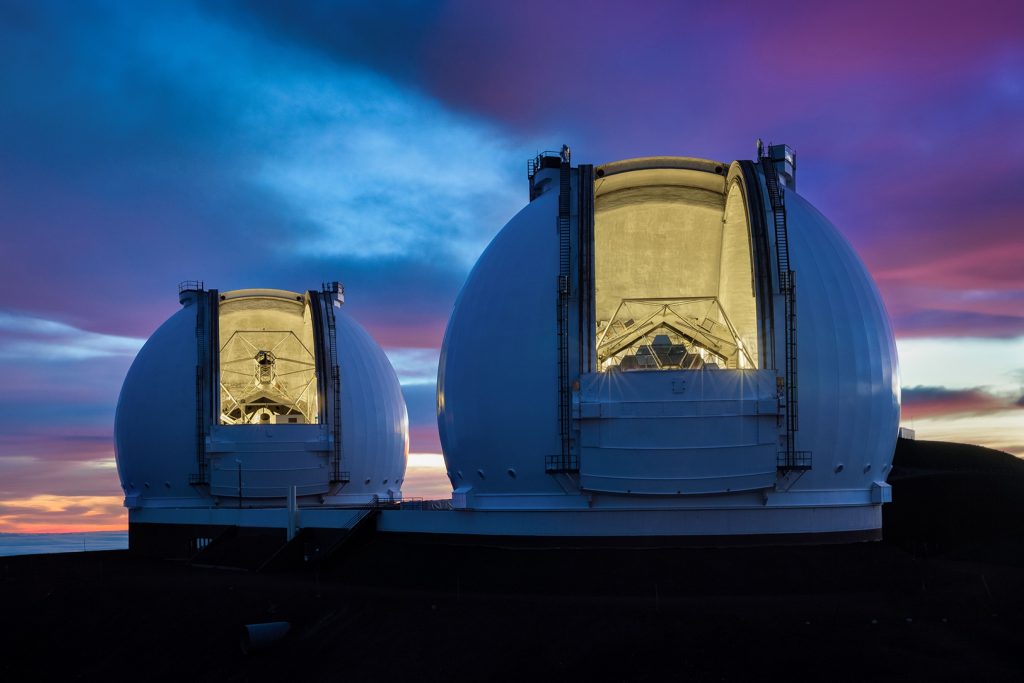
- Twin telescopes Keck I and Keck II with their “eyes” open, ready to observe the universe as the sun sets over the Big Island, filling the sky with a stunning mix of blue, purple, pink and orange hues. (Photo Credit: Ethan Tweedie/Courtesy of W. M. Keck Observatory website)


Plans are underway to collect new Subaru Telescope SCExAO images of HIP 71618 B and reimage HIP 54515 b using Keck Observatory to refine the companions’ properties and orbits.
The research team also uncovered additional planetary and brown dwarf companions through OASIS, which will be announced in 2026.