


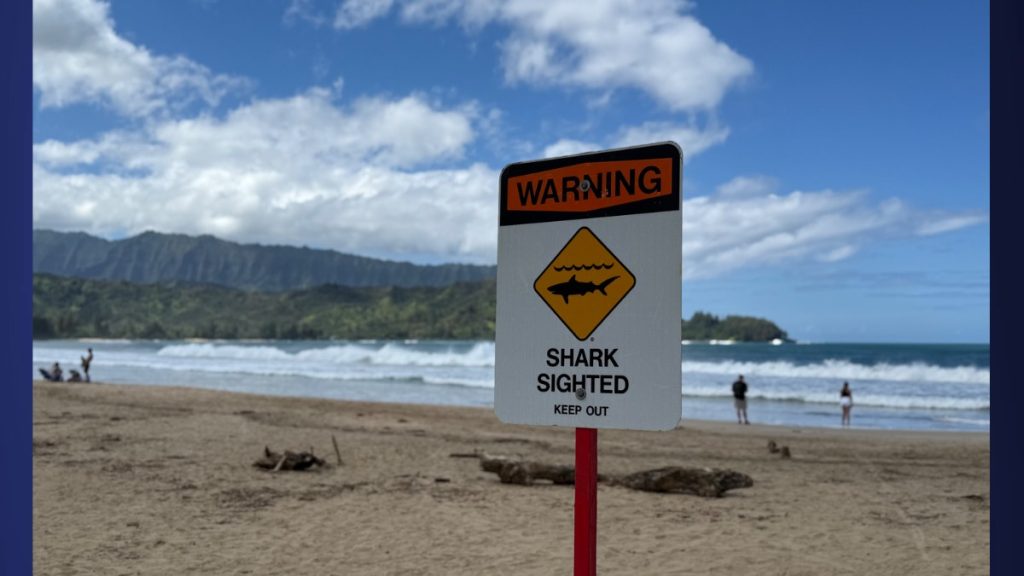
Two recent shark bites at Hanalei Bay off Kaua‘i’s North Shore prompted a temporary beach closure and caused fear in some beachgoers.
But shark researcher Carl Meyer with the Hawai‘i Institute of Marine Biology said the shark encounters align with normal seasonal patterns and do not indicate elevated danger for swimmers, surfers or beachgoers.
He said tiger sharks — the species most often involved in encounters with people around the islands — routinely inhabit nearshore waters, including reefs and beaches throughout the Garden Isle. But he also said it remains rare and largely unpredictable for people to be bitten by them in Hawai‘i.
“The places where we surf, snorkel and swim are also the natural habitat of tiger sharks,” said Meyer, who has studied sharks for more than 30 years. “Decades of tracking show that their movements are concentrated over the insular shelf — the relatively shallow zone that extends from the shoreline out to about 600 feet deep.”
He said there are no consistent patterns in the timing or location of these rare events.
“They simply reflect our own patterns of ocean use,” he said. “In most cases, being bitten by a shark is a matter of chance and bad luck, not predictable behavior.”
But Meyer said, “data shows a statistically significant increase in shark bites during the fall, particularly in October, although incidents occur year-round.”
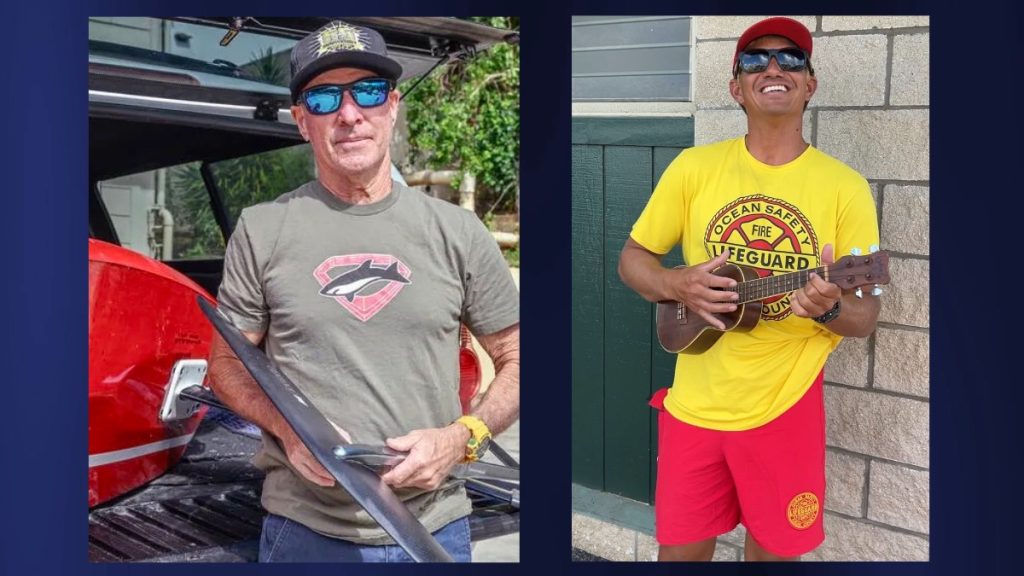
In February, Chris “Shewy” Shewman of Līhu’e encountered a shark while hydrofoiling, leading to the installation of shark warning signs at Lydgate Beach.
In July, two shark sightings were reported at Hanalei Bay. A shark, estimated to be 4 to 6 feet long, was spotted, prompting officials to issue an initial advisory prohibiting swimming and other ocean activities in the area.
On Nov. 4, a shark sighting at Hanalei Bay prompted the posting of shark-sighting signs once again.
The following day, off-duty lifeguard and surfer, Chance Swanson, was attacked at the bay.
Approximately two hours later, Kauaʻi County Ocean Safety Bureau officials reported spotting a reef shark, measuring three feet or longer, near Poʻipū on Kaua’i’s south shore, prompting more signs to go up.
Princeville resident Tim Blackwell said he was at Hanalei Bay when Swanson was bitten by a shark. He saw a firetruck and heard a voice on a blowhorn say: “Everyone out of the water.”
“They put a Jet Ski out there as well, and they went down the coast and had everyone clear out of the water,” Blackwell said.
Officials said Swanson was taken to Wilcox Medical Center in Līhuʻe and later flown to Queen’s Medical Center on O‘ahu for additional treatment. He has undergone multiple surgeries and remains hospitalized, according to the press release. He is in good spirits and thankful to be alive.”
On Monday, Swanson’s doctor reported that “he will be able to surf, run, and ride his dirt bike in the future. It does take time for everything to heal and start working again, and it may be months; only time will tell.”
To date, Swanson’s GoFundMe page has raised $170,000 to support his recovery efforts.
Ocean Safety Bureau Chief Kalani Vierra praised his team in a press release for “the quick thinking and decisive actions of the lifeguards on duty,” noting that their professionalism saved Swanson’s life.
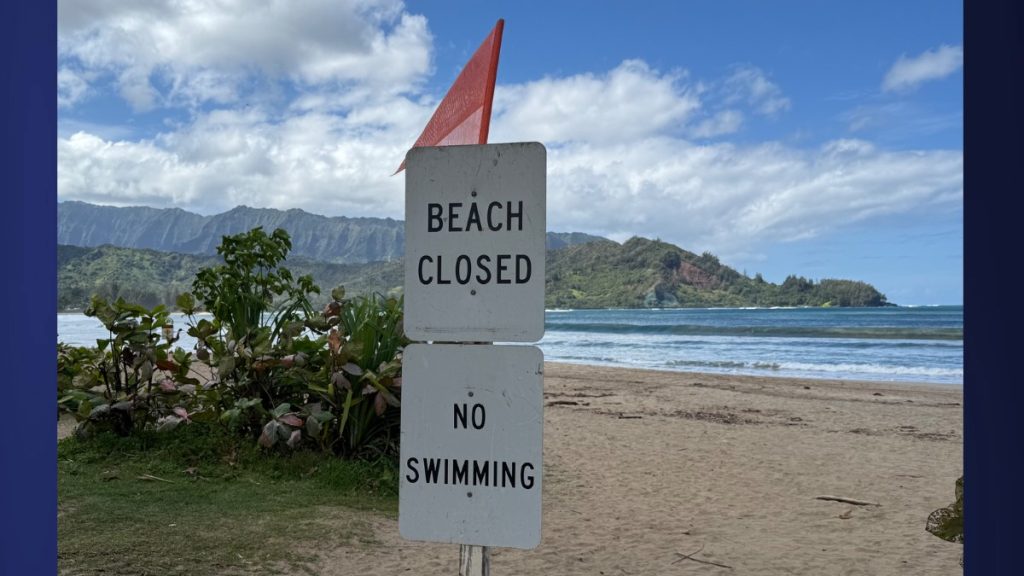
Kauaʻi County officials have advised beachgoers to exercise caution and heed all posted warnings. Despite this, some individuals were seen swimming at Hanalei Bay while signs were up.
“I wouldn’t go deeper than my knees,” Nashville resident Matt Alpert said. “Anytime you go in the ocean, you take a risk. That’s their home.”
California resident Woody Woods said: “Enter at your own risk.” His wife, Melanie Woods, added: “And don’t let your kids enter the ocean alone.”
These are all excellent tips that ocean enthusiasts now know well.
But historical records show that in the 1960s, when sharks were spotted, the typical response was to fish for them to remove the threat.
On Sept. 3, 1968, Hawaiʻi Gov. John A. Burns responded to a letter from lawyer James E. Cox, informing Cox that a “Cooperative Shark Research and Control Program” was underway under the direction of Dr. Albert I. Tester, Senior Professor of Zoology, at the University of Hawai’i.
The letter revealed that a catch of 20 sharks, of which 14 were taken off Poʻipū Beach.
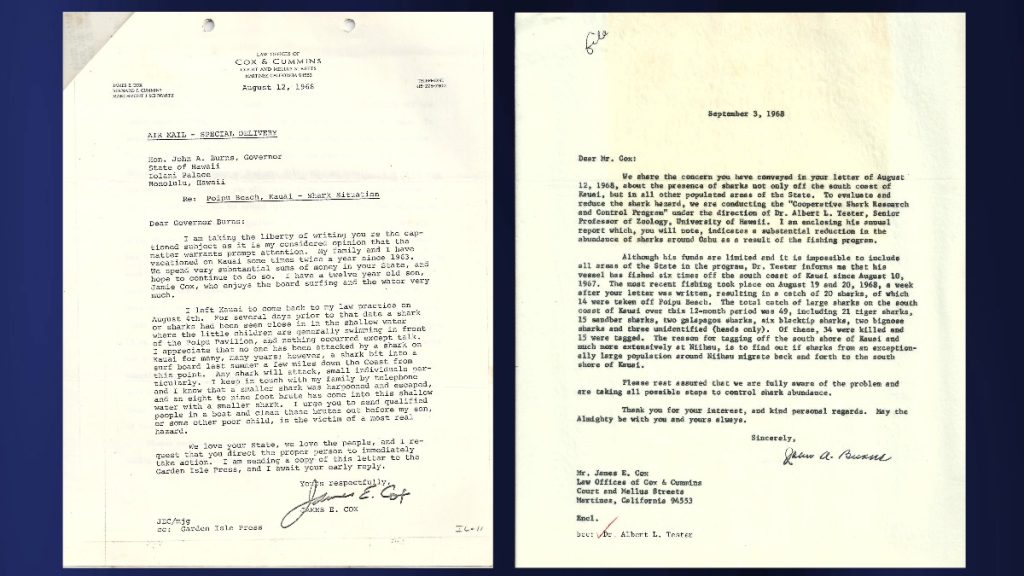
or some other poor child, is the victim of a most real hazard,” said Lawyer James E. Cox in a letter to Hawaiʻi Gov. John A. Burns regarding the shark sightings at Po’ipū Beach in 1968. (Image Credit: Carl Meyer, Ph.D., Research Professor)
The total catch of large sharks on the south coast of Kaua’i over the 12-month period was 49, including 21 tiger sharks, 15 sandbar sharks, two galapagos sharks, six blacktip sharks, two bignose sharks, and three unidentified (heads only).
Of these, 34 were killed and 15 were tagged.
Now, when shark bites or sightings occur, protocol is to notify the state Department of Land and Natural Resources, which usually puts out warning signs advising people not to enter the water.
Officials recommend swimming at beaches with lifeguard stations and following all posted signs. Always ask a lifeguard for the latest ocean conditions before entering the water.
“Be safe out there and listen to the lifeguards,” Blackwell added. “I’ve come here for years, and I am shocked. So listen to them; they know more than we do.”
For the latest updates on ocean conditions and safety, beachgoers should speak with a Kaua‘i County lifeguard at any lifeguard station. For questions or concerns, contact the Kaua‘i County Ocean Safety Bureau at 808-241-4984 or visit the Safe Beach Day website.