



University of Hawaiʻi Institute for Astronomy researchers are using telescopes on Maunakea and Haleakalā to gather crucial galaxy color data, helping the European Space Agency’s Euclid mission map the universe in three dimensions.
Their work supports the European Space Agency’s Euclid space telescope, a six-year mission to observe billions of galaxies across roughly one-third of the sky. Together, observations from space and Hawaiʻi will help scientists trace how the universe has evolved.
“The Euclid images are stunning,” said Ken Chambers, director of IfA’s Pan-STARRS telescopes, “but the mission needs the data from telescopes right here in Hawaiʻi, as well as in Chile, to achieve its science goals.”
The collaboration reached a milestone on November 12, when Euclid released its first major batch of mission data, called DR1-Foundation. It includes approximately 13 months of observations and more than 900 million galaxies, opening a vast collection of cosmic targets for researchers to explore.
Adding cosmic color
Euclid’s visible-light camera captures sharp images that reveal galaxies’ shapes and overall brightness. But those images alone do not provide the color measurements scientists need to estimate distances.
That is where Hawaiʻi’s telescopes come in. By comparing a galaxy’s brightness through different color filters, astronomers can estimate its distance and help place it within a three-dimensional map.
One IfA group contributes through the Ultraviolet, Near-Infrared, Optical Northern Survey, or UNIONS. Working with colleagues in Japan, Canada, France and Germany, the researchers have spent years collecting deep images in multiple colors using telescopes on Maunakea and Haleakalā.
Their observations cover nearly half of Euclid’s planned survey area. Telescopes in Chile will supply complementary observations for the remaining coverage.
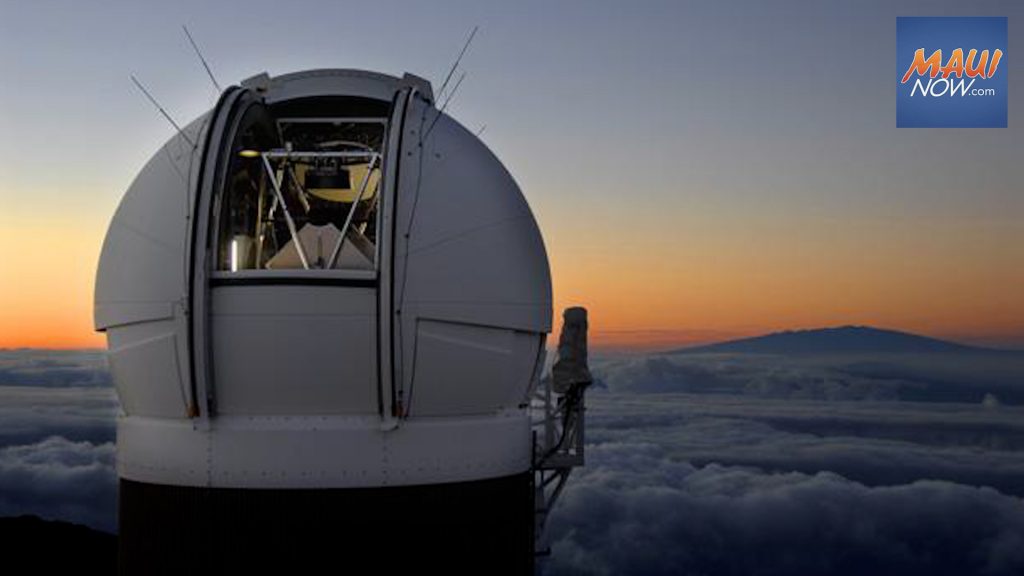
The effort also draws on the versatility of IfA’s Pan-STARRS telescopes on Haleakalā, whose observations support both searches for near-Earth objects and studies of distant galaxies.
“I especially appreciate that we are able to breathe new life into the data from Pan-STARRS, originally taken to discover asteroids that could threaten the Earth,” said IfA Astronomer Eugene Magnier. “By combining hundreds of images of each part of the sky, taken over many years, we create the very sensitive images needed by UNIONS and the Euclid science mission.”
Looking deeper
A second IfA team, known as H2O, is concentrating on the Euclid Deep Fields—smaller patches of sky where the space telescope spends extra time collecting light to detect exceptionally faint, distant galaxies.
Together, these fields span an area about 100 times the apparent size of the full moon. The IfA team is gathering extremely deep images in multiple colors to help researchers interpret what Euclid finds.
“The Euclid Deep Fields are essential for calibrating the rest of the Euclid survey, and they also allow us to study the early universe. With the H20 survey, we can explore how galaxies have evolved over the history of the universe and try to understand how their environments shaped their evolution,” said IfA graduate student Grey Murphree.
A homegrown connection
For IfA graduate student Chris Storfer, the mission offers a chance to investigate galaxies through a striking phenomenon: gravity bending light.
Strong gravitational lenses form when a massive foreground galaxy distorts light from a galaxy behind it, producing arcs or multiple images. Those distortions give astronomers a way to measure the mass of the foreground galaxy.
Storfer has already found more than 1,000 lenses in UNIONS images. He is now working with the Euclid team to use the space telescope’s sharper views to study these systems and measure the galaxies’ masses.
“Euclid is revolutionizing the field of strong gravitational lensing which has the potential to address important questions about dark matter and the expansion history of the universe,” said Storfer. “Combining the incredible images from Euclid with data from world-class telescopes here in Hawai’i, we are uniquely positioned to execute on incredible science.”