


“Volcano Watch” is a weekly article and activity update written by U.S. Geological Survey Hawaiian Volcano Observatory scientists and affiliates. Today’s article is by Oregon State University scientist Bill Chadwick and a team of scientists from other agencies*.
Submarine volcanoes are enigmatic and mysterious because they are cloaked by the overlying ocean, yet their activity represents 75% of earth’s volcanism.
These underwater volcanoes influence ocean chemistry, sustain specially-adapted biological communities and when they grow to shallow depths they can be extremely hazardous.
We often only know if submarine volcanoes are erupting when we detect big commotions at a distance, but recent work shows they can also erupt quietly and undetected.
This was the case for a recent eruption of Ruby seamount in the Commonwealth of the Northern Mariana Islands, located about 31 miles north-northwest of Saipan in the west Pacific Ocean.
On Sept. 14–15, the U.S. Geological Survey Alaska Volcano Observatory detected large underwater explosion signals from Ruby on seismometers throughout the Pacific and hydrophones more than 1,370 miles away at Wake Island.
Scientists also observed in satellite imagery for 2 days a large plume of discolored water at the ocean surface near Ruby. Then everything went quiet.
What happened on the seafloor?
We didn’t know until research vessel Thomas G. Thompson was able to remap Ruby with a multibeam sonar system in March 2026.
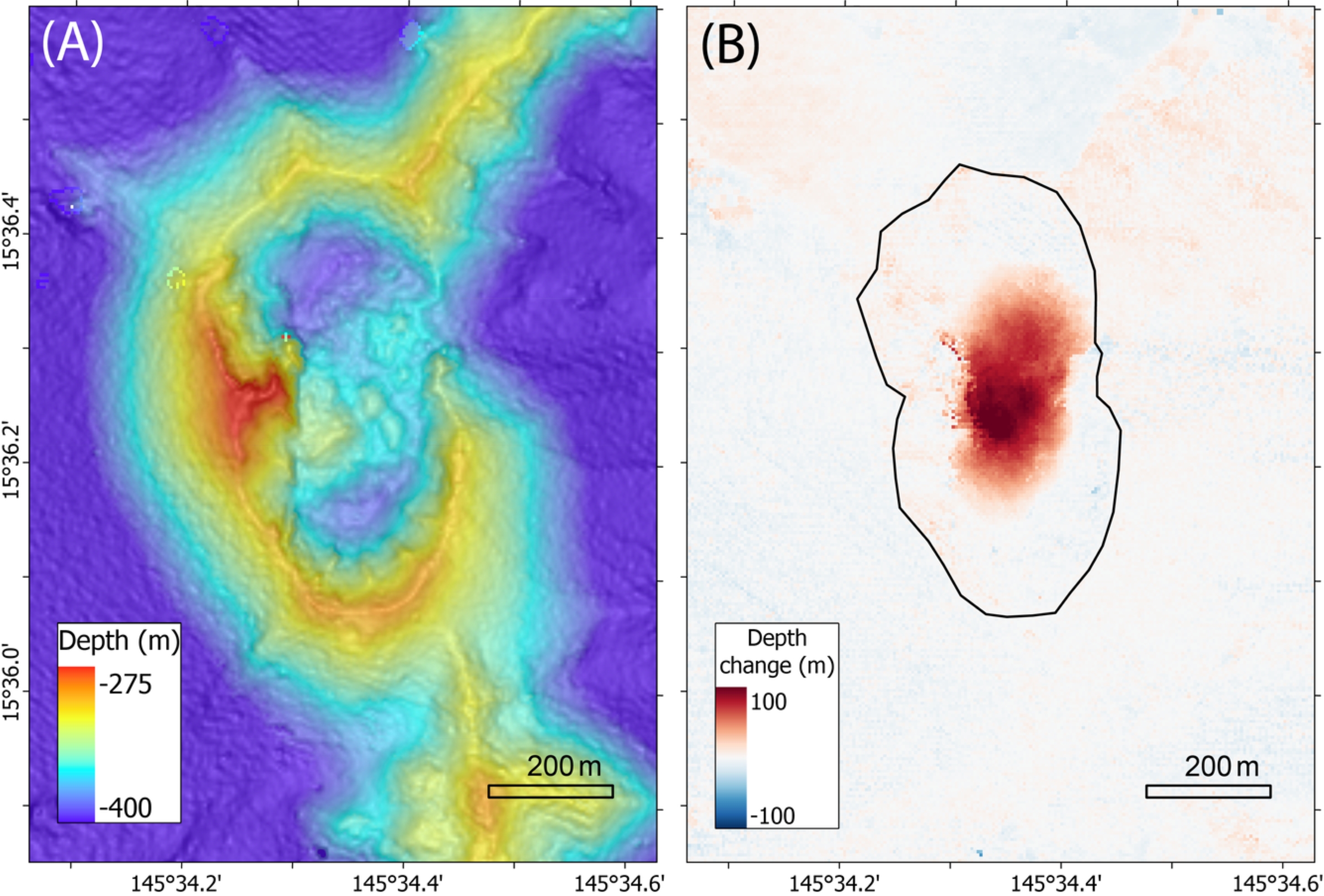
That bathymetric survey, by colleagues at University of Washington, showed dramatic depth changes, including new eruptive deposits, scars from landslides on the volcano’s flanks and a large new summit crater 2,300-by-1,150 feet in size.
Where the summit of the volcano previously was at a depth of 575 feet before the 2-day explosive eruption, the floor of the new crater was 900 feet deeper. That was presumably the end of the story, since the September 2023 eruption apparently was short-lived and there was no evidence of any activity since.
However, we often don’t really know what submarine volcanoes are up to because of our limited monitoring capabilities in the oceans.
A recent collaborative expedition on the Ocean Exploration Trust exploration vehicle Nautilus in July 2026 provided the first post-eruption opportunity to make direct observations to investigate what happened at Ruby.
Using the remotely operated vehicle Little Hercules, scientists aboard Nautilus explored the new summit crater. The ship remapped the volcano once again for good measure, not expecting to see any changes. But that’s the value of exploration — often you find things you didn’t expect.
The new bathymetry collected in July showed the floor of the summit crater was now about 360 feet taller than it was in March!
Our first thoughts were that this change could either have been caused by collapse of material from the crater rim accumulating into the bottom of the crater or by the eruption of new lava onto the crater floor.
At the bottom of the crater the remotely operated vehicle encountered fresh lavas, which immediately confirmed the second hypothesis.
Comparing the March and July bathymetric surveys showed the only changes were indeed at the bottom of the crater where a new lava dome formed.
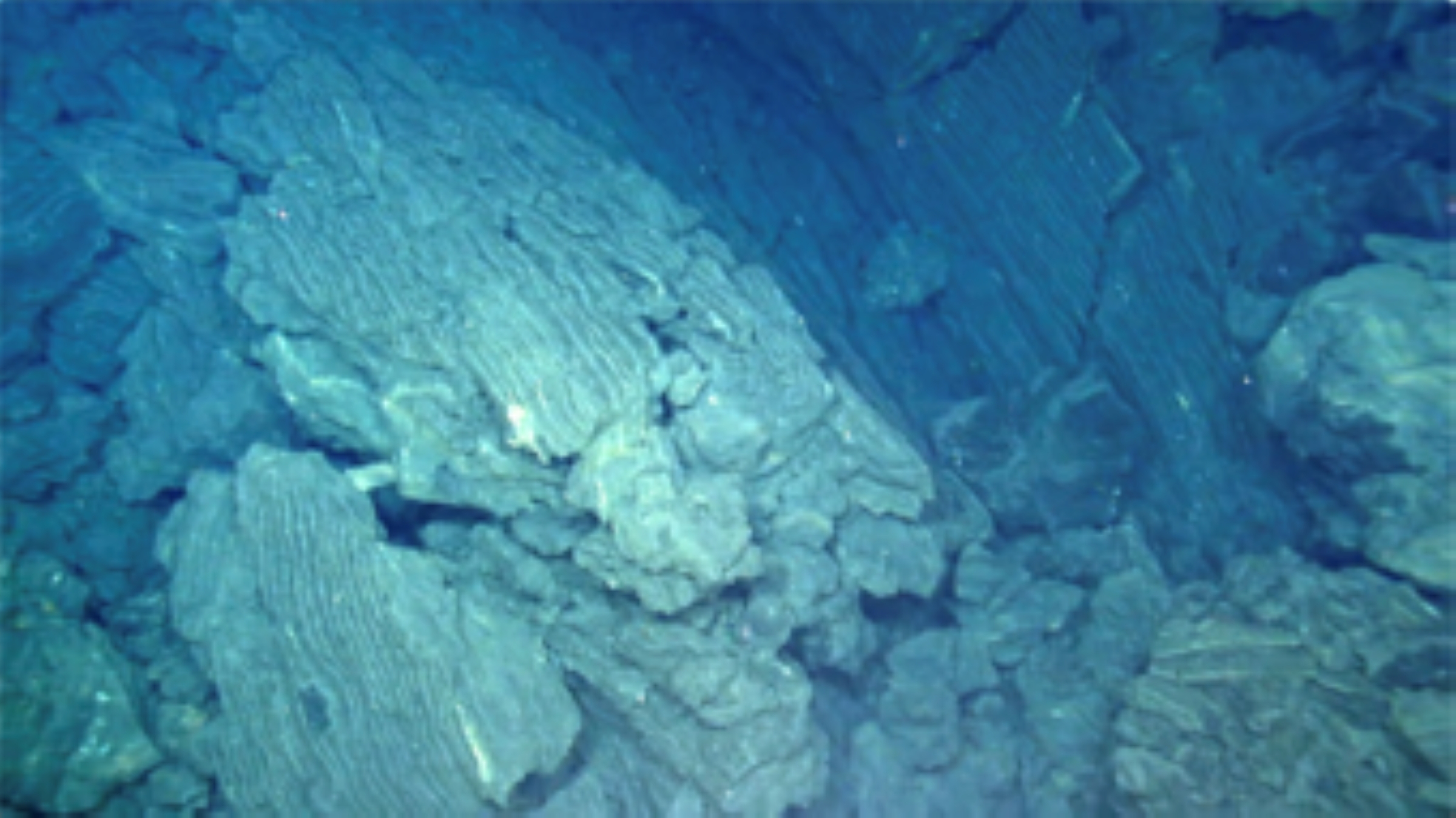
The remotely operated vehicle video showed the new dome lavas had distinct striations on some of the fracture surfaces, which is likely evidence of incremental crack growth during slow lava extrusion, similar to what has been observed on lava domes growing at volcanoes on land, like Mount St. Helens.
We learned a lot more about what happened during the September 2023 eruption at Ruby seamount by simply remapping it in March 2026, and we learned even more by remapping it again in July 2026 and making a single remotely operated vehicle dive.
This shows that revisiting and remapping submarine volcanoes, even with no evidence they are active, can reveal a lot about their secret lives.
Ruby quietly erupted between March and July 2026, but no one knew it.
Was it still slowly erupting in July? Maybe. Will it continue to rebuild the summit cone that was destroyed during the September 2023 eruption? The only way to find out is to keep coming back and looking.
Bathymetric and remotely operated vehicle surveys are one of the ways we can learn more about submarine volcanoes: how they grow, what their range of activity is, how often they are active and what hazards they pose as their activity evolves.
*Interagency co-authors
- Jeffrey Beeson: Cooperative Institute for Marine Ecosystems and Resource Studies, Oregon State University, and College of Earth Ocean and Atmospheric Sciences, Oregon State University.
- Jeremy Powell: College of Earth Ocean and Atmospheric Sciences, Oregon State University.
- Ashton Flinders: U.S. Geological Survey Hawaiian Volcano Observatory.
- Larry Mayer: University of New Hampshire, Center for Coastal and Ocean Mapping.
- Samantha Wishnak: Ocean Exploration Trust, University of Rhode Island.
* * * * * * * * *
VOLCANO ACTIVITY UPDATES
KĪLAUEA volcano
VOLCANO ALERT LEVEL: Advisory
Kīlauea has erupted episodically since Dec. 23, 2024, within the summit caldera.
The Halema’uma’u Crater eruption of Kīlauea is paused after Episode 55 lava fountaining ended Oct. 17. Summit sulfur dioxide emissions are in the range of 1,000 to 5,000 tonnes per day. No unusual activity has been noted along Kīlauea’s East Rift Zone or Southwest Rift Zone.
WHAT’S NEXT: Summit reinflation continues and the preliminary forecast for Episode 56 fountaining is between Nov. 1 and 7.
MAUNA LOA volcano
VOLCANO ALERT LEVEL: Normal
Mauna Loa is not erupting. Read the most recent monthly Mauna Loa activity update online.
Hawaiian Volcano Observatory continues to closely monitor Kīlauea and Mauna Loa.
* * * * * * * * *
EARTHQUAKE ACTIVITY UPDATE
One earthquake was reported felt during the past week in the Hawaiian Islands:
- MAGNITUDE-3.3 earthquake at 5:52 a.m. Oct. 23 located 1 mile south-southwest of Pāhala at a depth of 18 miles.
Visit the Hawaiian Volcano Observatory website for past “Volcano Watch” articles, Kīlauea and Mauna Loa updates, volcano photos, maps, recent earthquake information and more. Email questions to askHVO@usgs.gov.