


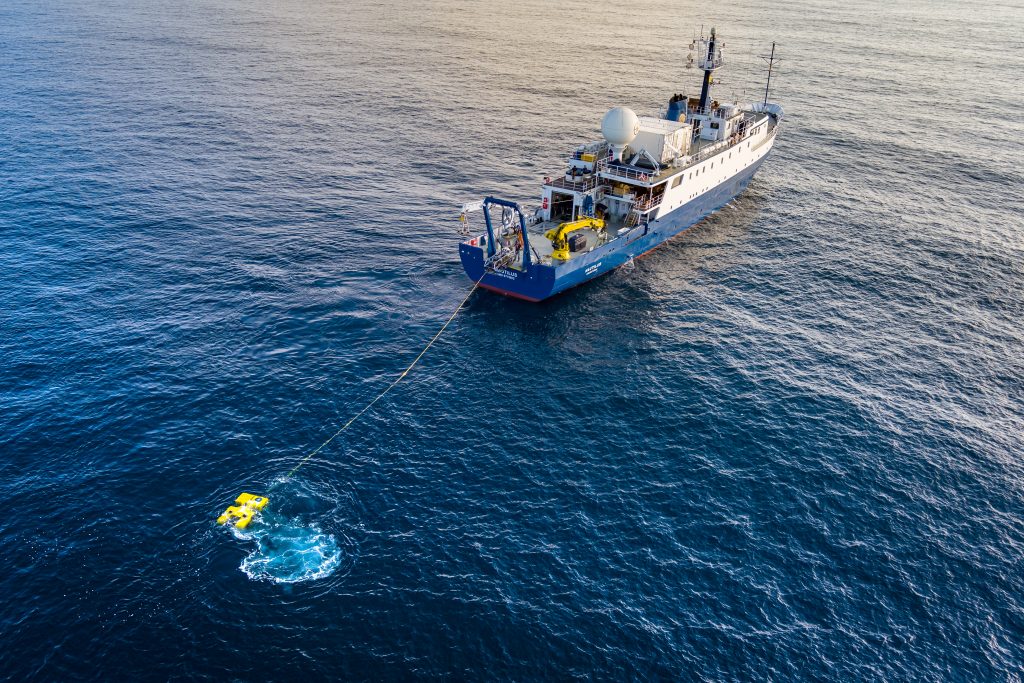
Ten local scientists, students and educators are currently sailing aboard Ocean Exploration Trust’s exploration vessel E/V Nautilus for a 20-day expedition to explore previously unsurveyed deep-sea habitats around the Hawaiian Islands and within Papahānaumokuākea National Marine Sanctuary.
The expedition will utilize remotely operated vehicles and seafloor mapping technologies to explore never-before-seen ridges, seamounts and abyssal plains throughout the Hawaiian Archipelago.
The expedition sails with a global team of scientists, engineers, Hawaiian cultural experts and students, including early-career professionals having their first experiences at sea.
Due to the ship’s advanced telepresence technology, community audiences can join the team live-streaming remotely operated vehicle dives and seafloor mapping data collection around the clock, with interactive opportunities to meet explorers and help reveal new knowledge at NautilusLive.org.
“I’m hoping to bring back a better understanding of the deep ocean from this expedition,” said University of Hawaiʻi at Hilo undergraduate student Mahealani Akui, who is an ocean science intern on the expedition.

“With so much of the ocean already previously unexplored, I’m hoping to leave the expedition with new scientific discoveries and data surrounding this unique ecosystem. And ideally, I hope to see the data implemented into broader scientific impact, such as resource management and expansion of our biological and geographical knowledge within the waters of the Hawaiian Islands.”
ROV dives will gather data to characterize deep-ocean habitats, biodiversity, bathymetry and geological formations. This data helps establish a scientific baseline that future research, resource management and responsible ocean stewardship decisions depend on. All data from E/V Nautilus expeditions are publicly archived with no embargo or access restrictions to ensure that deep-sea data is permanently available.
“Voyaging across the deep ocean of Hawai’i on board E/V Nautilus always offers a new perspective and a heightened sense of both wonder and responsibility,” said Daniel Kinzer with Pacific Blue Studios and a member of the Papahānaumokuākea National Marine Sanctuary Advisory Council.
This is Ocean Exploration Trust’s sixth expedition in 2026, the 19th expedition in Hawaiian waters since 2018, and the 182nd mission since E/V Nautilus’ inaugural season in 2009.
Throughout this time, the mission has remained the same: to use cutting-edge technologies to explore the fascinating underwater world and engage curious minds of all ages along the way. This expedition is funded by National Oceanic and Atmospheric Administration’s Ocean Exploration via the NOAA Ocean Exploration Cooperative Institute.
Viewers across the Pacific and around the world are invited to participate in the exploration: audiences can engage with the team at sea, ask questions and receive real-time behind-the-scenes updates via NautilusLive.org and social media.
Classrooms and community events are invited to connect with the at-sea team through free educational Q&A interactions, including sessions available in ʻŌlelo Hawaiʻi (Hawaiian language).
Educators and students interested in sailing on future E/V Nautilus expeditions can still apply at NautilusLive.org/join for paid internship and fellowship opportunities in 2027. The deadline is Oct. 15.
For this expediton, the 10 Hawaiʻi-based explorers will join the team at-sea. They are Akui; graduate students Kelsie Pīkake Kuniyoshi (ocean science intern) and Emily Palmer (scientist) from the University of Hawaiʻi at Mānoa; and local educators as onboard communicators Gandharva Mahina Hou Ross from Molokaʻi High School, Gina Errico from Bishop Museum and Daniel Kinzer from Pacific Blue Studios.
The expedition also includes scientists and technical team members Dr. Fanny Girard from the University of Hawaiʻi at Mānoa (co-lead scientist) Meagan Putts, DARC Lab (navigator), ROV pilot Dani Hinshaw, and Andy Collins, Papahānaumokuākea National Marine Sanctuary staff member (resource monitor).