


“Volcano Watch” is a weekly article and activity update written by U.S. Geological Survey Hawaiian Volcano Observatory scientists and affiliates. Today’s article was written by Hawaiian Volcano Observatory geologist Katie Mulliken.
Benjamin Franklin said, “If you fail to prepare, you are preparing to fail.”
The past year in Hawai‘i has shown hurricanes, eruptions, earthquakes, flooding and severe weather can happen with little or no warning and result in power outages, disrupted roadways and other impacts.
Steps you take to prepare for any one emergency can help you and your family be better prepared overall.
Four steps you can take to be better prepared for any disaster include:
- Learning what hazards can affect you and when.
- Making an emergency plan.
- Building an emergency supply kit, or go bag.
- Getting involved in your community.
Earthquakes and volcanic eruptions in Hawai‘i, unlike hurricanes, do not have a season and can happen any time.
The earthquake hazard in the state is among the highest in the United States, with the south side of the Island of Hawai‘i having the highest hazard. Earthquakes in Hawai‘i can have far-reaching impacts and result in ground cracks, ground settling, landslides and local tsunami.
While earthquakes can strike unexpectedly, eruptions often are preceded by signs of unrest.
Hawaiian Volcano Observatory scientists closely monitor active volcanoes in Hawai‘i for any signs of unrest and communicate via volcano alert level and aviation color code.
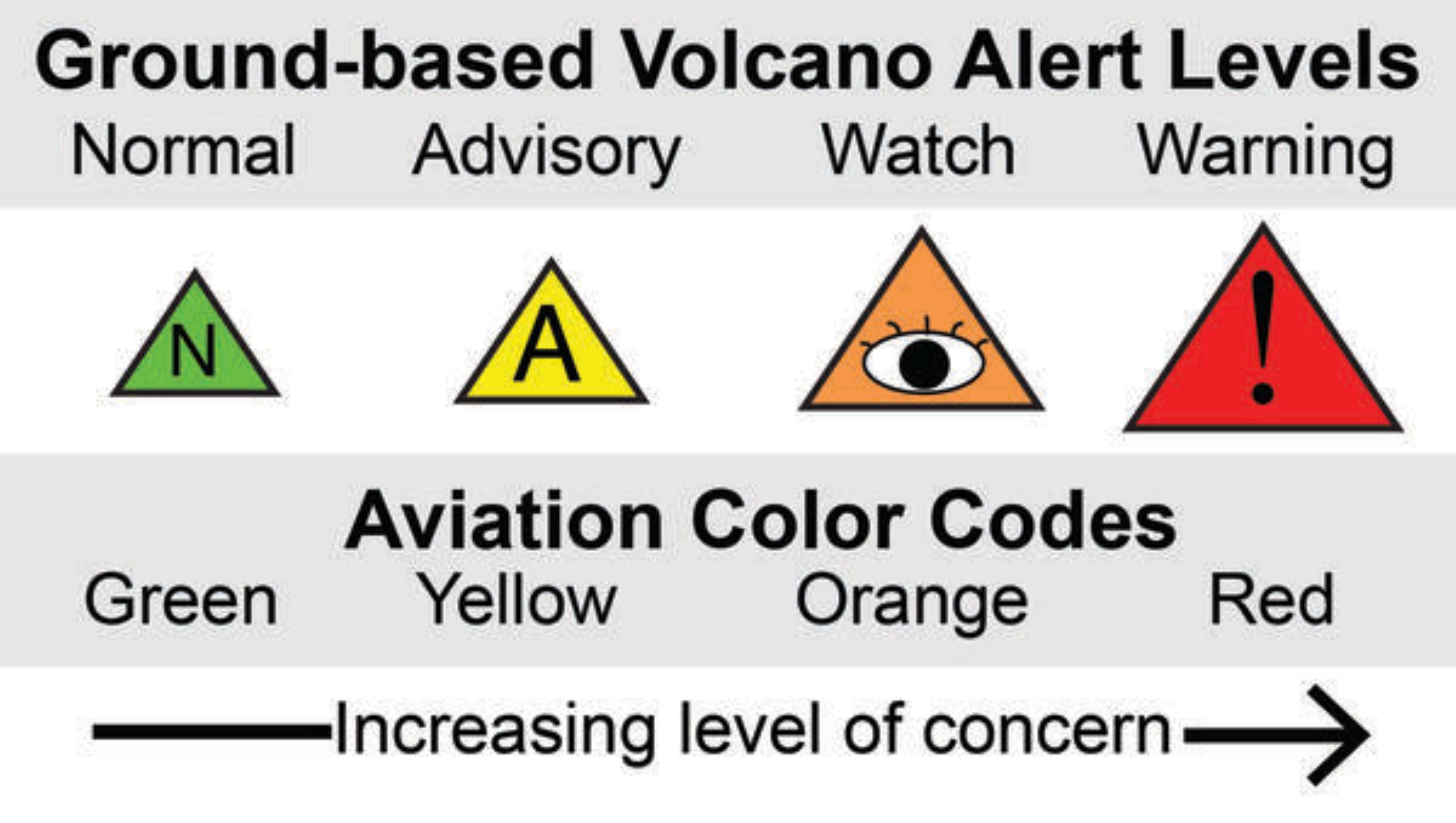
Volcano alert levels include Normal, Advisory, Watch and Warning, each describing activity and associated hazards to people on the ground. A volcano at Normal is not erupting or showing signs of unrest, such as earthquakes, ground deformation and gas emissions, while a volcano at Warning is erupting in a hazardous way — or about to.
Aviation color codes are Green, Yellow, Orange and Red, each used to inform the aviation sector about airborne ash hazards. A volcano at Green is not erupting or showing signs of unrest while a volcano at Red mean a volcano is erupting and generating significant volcano ash emissions into the atmosphere — or about to.
Usually, these are paired and move together, but they can occasionally be de-coupled when hazards on the ground and in the air are very different.
For example, if lava flows were threatening infrastructure, the ground-based volcano alert level might be at Warning, but the aviation color code might not be at Red because of the lack of significant airborne ash emissions.
If you live in Hawai‘i, consider learning which active volcanoes encompass the areas where you live and work. Areas that can be hazardous during a volcanic eruption include those immediately around the erupting volcanic vent, areas downwind of the vent if the eruption produces ash and significant volcanic gas emissions and areas downslope of the vent if the eruption produces lava flows.
Consider signing up to receive notifications from Hawaiian Volcano Observatory via the Volcano Notification Service as well as messaging from other relevant authoritative organizations such as Hawai‘i County Civil Defense when putting together an emergency plan.
The Federal Emergency Management Agency website has resources for preparing an emergency plan for your household, which should also consider evacuations and communication channels.
The state of Hawai‘i is isolated in the middle of the Pacific Ocean. Many communities across the Hawaiian Islands are rural. The arrival of aid can take time when disaster strikes.
Building an emergency supply kit can ensure during or after hazardous events you and your family can be temporarily self-sufficient if needed.
The Federal Emergency Management Agency website also provides an emergency supply checklist to get you started, but be sure to consider the unique needs of your family, such as pets supplies.
The last step in preparation is to get involved in your community.
Because Hawai‘i’s communities are so isolated, the first response to a hazardous event often falls on the shoulders of the community affected. Practice and socialize your plan with family and friends in your community.
This will familiarize yourself with your plan and encourage others in your community to also prepare.
Local resources, including information for businesses and additional checklists, are available from Hawai‘i County Civil Defense and Hawaiʻi Emergency Management Agency.
Additional preparedness resources also are available through Federal Emergency Management Agency.
* * * * * * * * *
VOLCANO ACTIVITY UPDATES
KĪLAUEA volcano
VOLCANO ALERT LEVEL: Advisory
Kīlauea has erupting episodically since Dec. 23, 2024, within its summit caldera. Episode 54 of lava fountaining happened throughout 9 hours Aug. 25. Summit region inflation has been very irregular since. No unusual activity has been noted along Kīlauea’s East Rift Zone or Southwest Rift Zone.
WHAT’S NEXT: Forecast models indicate Episode 55 lava fountaining could occur between Sept. 7 and 12, but this window is subject to change as more monitoring data is collected.
MAUNA LOA volcano
VOLCANO ALERT LEVEL: Normal
Mauna Loa is not erupting. Read the most recent monthly Mauna Loa activity update online.
Hawaiian Volcano Observatory continues to closely monitor Kīlauea and Mauna Loa.
* * * * * * * * *
EARTHQUAKE ACTIVITY UPDATES
No earthquakes were reported felt during the past week in the Hawaiian Islands.
Visit the Hawaiian Volcano Observatory website for past “Volcano Watch” articles, Kīlauea and Mauna Loa updates, volcano photos, maps, recent earthquake information and more. Email questions to askHVO@usgs.gov.