


Beekeepers on Kauaʻi are being asked to help monitor honeybee colonies for the next one to two years after confirmation of the island’s first invasive Varroa mites, one of the most damaging honey bee pests in the world.
During a Zoom briefing on Wednesday, University of Hawaiʻi at Mānoa honeybee health specialist Dr. Ethel Villalobos said researchers have confirmed Varroa destructor in a wild colony discovered on Nov. 9. She said it is not yet known if the mites have spread to other wild or managed colonies
“What we have now is a detection,” Villalobos said.
While they confirmed the pest is “here” on Kaua’i, they do not know if it already was present before this detection.
“Like in Oʻahu, we may have missed the previous arrival and/or if it’s established,” Villalobos said. “So besides the particular colony that we’re talking about that we found on Nov. 9, we don’t know what has happened before.”
Villalobos said this is a serious concern.
“Going to the dark side of things, the Varroa mite — Varroa destructor — is an external parasite of bees, and the mite by itself is already a problem. But the mite, in combination with a series of bee viruses, is really the biggest threat there is to honeybee health worldwide.”
Bees are vital because they pollinate flowering plants, which support food production, agriculture and healthy ecosystems.
The infected colony on Kaua’i was found beneath a cattle trailer that had been transported from Oʻahu.
Researchers said the trailer arrived at Nāwiliwili Harbor on Oct. 30 and remained there until Nov. 9, when it was moved and the colony was discovered.
Researchers plan to conduct a survey and travel to Kauaʻi to trace the trailer’s movements on the island, including where it parked at the harbor, its route after leaving the port, and how long it spent at each location.
They will meet with people familiar with the trailer’s movements
“We want to determine whether bees carrying mites could have dispersed along the trailer’s route,” said Scott Nikaido, who works with the University of Hawai’iʻs Agrosecurity Laboratory and has experience responding to previous Varroa detections in the state.
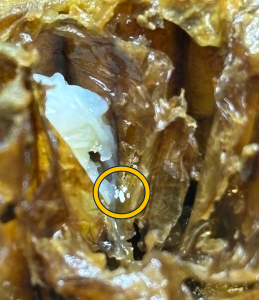
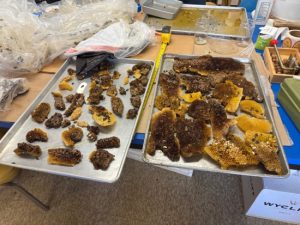
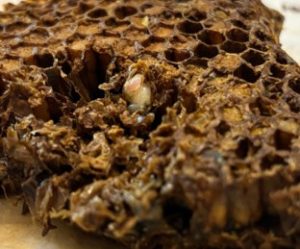
Villalobos said she and Nikaido had already traveled to Kauaʻi on Nov. 13 to examine the intercepted colony’s adult bees and brood, and determined that the sampled adult bees had a low infestation level of about 1%, with similarly low levels found during the brood inspection.
“We sampled, roughly, my best guesstimation was about 2700 bees, which in context of the actual colony itself, we’re looking at somewhere between half to 40% of the actual number of adult bees that was inside that package,” Nikaido explained.
“So it’s a pretty decent representative of the colony, at around 50%,” he said.
Villalobos said the low infestation level reduces the likelihood that many mites escaped. However, she cautioned that the results apply only to the intercepted colony and do not establish whether other colonies on Kauaʻi are affected.
Nikaido estimated that perhaps 10 mites could have escaped, but emphasized that figure was only a rough guess.
An escaped mite also would need to reach another colony, be accepted by its bees, and reproduce before an infestation could grow, he said.
Mites are particularly damaging because they feed on honeybees and can transmit viruses that threaten colony health.
“It’s going to take a while for us to even detect it, even if, let’s say, 10 mites got loose,” Nikaido said.
Researchers said the monitoring effort could take at least one to two years because detecting a small number of mites in a large bee population is difficult.
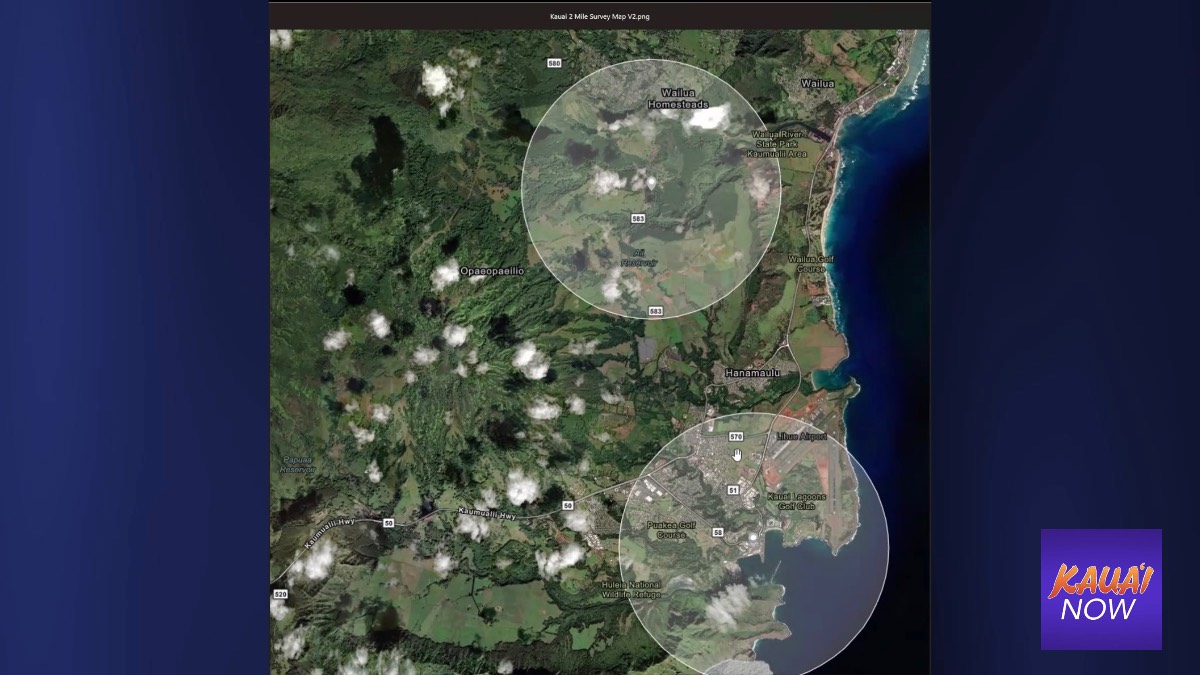
The initial monitoring effort will focus on areas within approximately one to two miles of Nawiliwili Harbor and the ranch where the colony was discovered.
Researchers are asking beekeepers in those areas to contact Villalobos directly if they are willing to have their colonies inspected. They also want help identifying wild bee colonies that could be included in the survey.
Nikaido said the team will handle the information confidentially to encourage participation.
The team plans to use several monitoring methods, including sampling adult bees, inspecting broods, and placing sticky boards beneath hives to detect mites. Researchers are also considering swarm traps and sentinel hives to monitor areas over time.
Beekeepers are encouraged to maintain records showing where colonies and captured swarms originated, particularly if they have recently moved or collected bees from other parts of the island.
Villalobos urged beekeepers not to hide or move colonies unnecessarily out of concern about being detected.
“If people start freaking out and hiding colonies or not saying, ‘Oh, I’m here,’ then we don’t get the full picture of what’s going on,” she said.
Researchers also advised against bringing queen bees from Hawaiʻi Island or importing bee semen from outside Hawaiʻi.
When asked whether beekeepers should stop moving hives and performing removals, Villalobos said the issue is being discussed with the state Department of Agriculture and Biosecurity.
But she encouraged beekeepers to avoid unnecessary movement and keep detailed records of removals and relocations. Nikaido said maintaining a separate quarantine apiary where newly collected colonies can be inspected before being introduced to established apiaries is a useful precaution.
Villalobos also cautioned against rushing into purchasing chemical treatments or commercial monitoring products before researchers determine whether the mites have become established.
She said Hawaiʻi’s tropical climate, abundance of feral colonies, and differences in local bee populations mean strategies used in other regions may not work the same way on Kauaʻi.
“Your situation in Hawaiʻi is very unique,” she said. “So I want to kind of try to focus people on understanding the uniqueness of your situation.”
Villalobos also cautioned against relying on artificial intelligence-based monitoring products and other commercially marketed technologies that have not been adequately evaluated under Hawaiʻi’s conditions.
Varroa was first detected in Hawaiʻi on Oʻahu in 2007 and in Hilo on the Big Island in 2008. Nikaido said a survey of Oʻahu beekeepers after the initial detection found that many lost nearly 70% of their colonies, with some losing all of them.
“So when beekeepers started very astutely seeing it, it was already spread all over Oʻahu,” Villalbos said, “There was not even a chance to try to do a containment or anything like that. It was widespread.
“So that means it was probably there for at least two years before people noticed.”
However, researchers said the effects on Kauaʻi cannot be predicted with certainty. The island’s bee population and environmental conditions may differ from those on Oʻahu and Hawaiʻi Island.
The College of Tropical Agriculture and Human Resilience is coordinating the university’s research and educational response with local extension personnel and state agriculture officials.
Villalobos said Roshan, a Kauaʻi-based extension agent and entomologist, is the local contact for suspected mite activity and beekeeper concerns.
University personnel are part of a research and educational institution, not a regulatory or enforcement agency. The Department of Agriculture and Biosecurity is involved in the broader response, including discussions about providing supplies for monitoring.
Nikaido said while the research effort does not currently have dedicated funding, the department is working with administration officials to secure money for the response.
Researchers said they hope to build a collaborative working group involving beekeepers, university specialists, state agencies and community organizations.
“You are now all officially beekeepers,” Nikaido added.
University researchers and state agriculture representatives will host a hands-on beekeeper workshop on Wednesday Dec. 2, from 2 to 4 p.m. at the Kauaʻi Community College in Līhuʻe.
The session will cover Varroa biology, sampling techniques, monitoring equipment and approaches to managing the parasite in Hawaiʻi’s climate.
Researchers said they plan to bring equipment for demonstrations and provide additional educational materials tailored to local beekeepers.
The team also hopes to make information available to people who cannot attend in person and to organize additional community outreach as the response develops.
Villalobos said the immediate priority is to determine whether the mites have spread beyond the colony found Nov. 9.