


“Volcano Watch” is a weekly article and activity update written by U.S. Geological Survey Hawaiian Volcano Observatory scientists and affiliates.
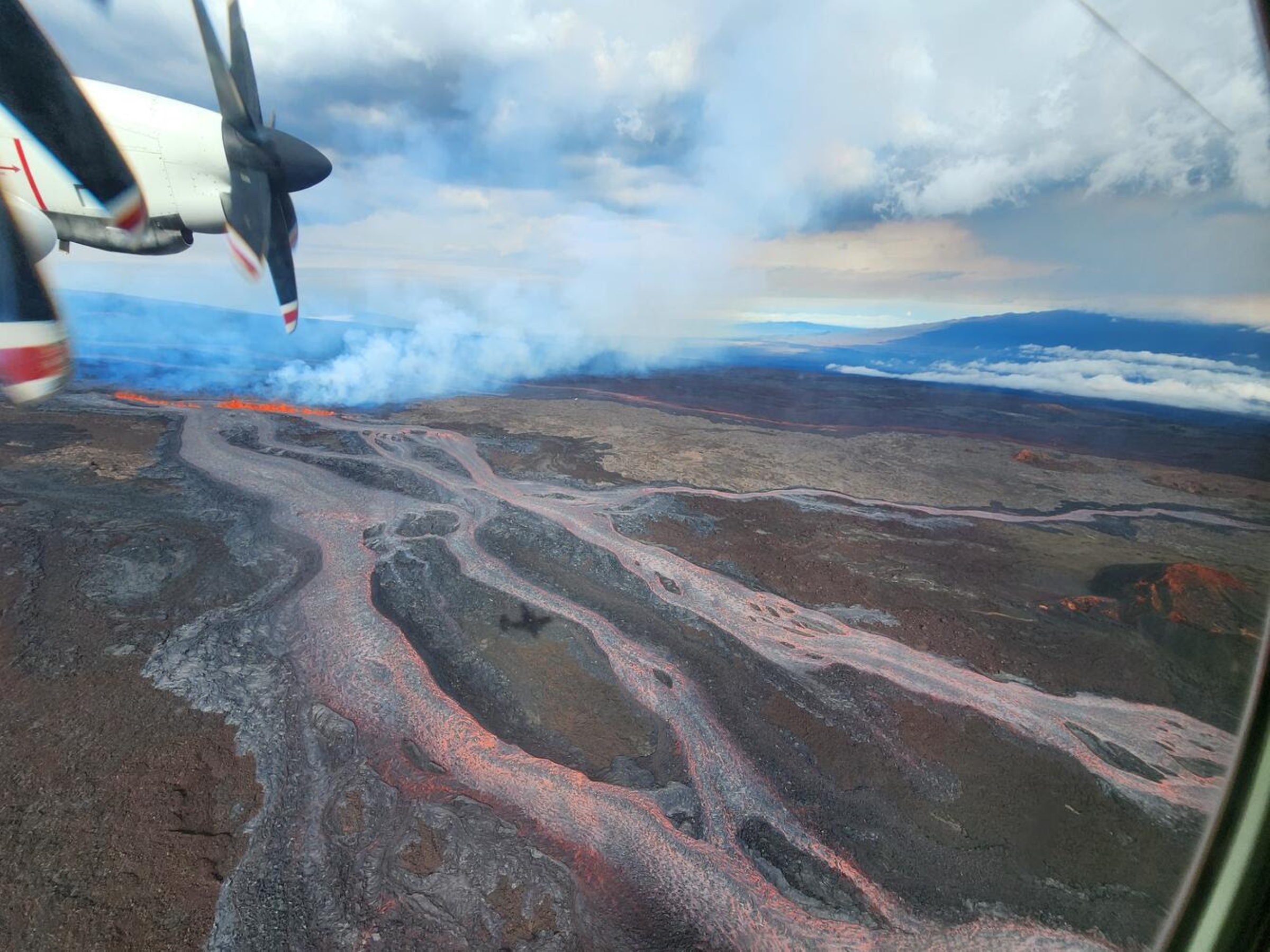
After 38 years of quiescence, Mauna Loa began erupting at 11:21 p.m. Nov. 27, 2022.
This week marks the 4th anniversary since the most recent eruption of Mauna Loa. Let’s take a moment to reflect back on the 2022 eruption and examine how we have advanced our understanding of this volcanic system in light of those events.
Mauna Loa encompasses more than half of the Island of Hawai‘i, with an eruption frequency of about 1 every 6 years during the past 3,000 years. U.S. Geological Survey classifies Mauna Loa as “very high threat” because of its frequent eruptive activity, with communities and infrastructure on the flanks that could be exposed to hazards from activity on the volcano.
As such, Hawaiian Volcano Observatory maintains a comprehensive monitoring network to detect signs of unrest that might lead to eruption.
Mauna Loa showed varying signs of unrest for nearly 10 years, but a change in activity began in mid-September 2022, with shallow earthquake swarms under the summit and northwest flank. At the same time, ground tilt and global positioning system station motion throughout the summit region showed that magma moved into shallower depths beneath Moku‘aweoweo, the summit caldera.
Because of increased unrest, Hawaiʻi Volcanoes National Park on Oct. 5 closed the backcountry at Mauna Loa’s summit on October 5.
Roughly 1 hour prior to the start of the eruption, seismic activity increased in frequency and intensity, including 5 earthquakes greater than magnitude-3.5. Twenty-five minutes prior to eruption, volcanic tremor signaled that magma was moving beneath the summit.
At 11:21 p.m. Nov. 27, fissures cut across Moku‘aweoweo and lava fountains soon reached heights of nearly 400 feet. From the onset of the eruption, the glow and lava flows were visible around the island, particularly in the early hours of Nov. 28, when lava flows from the summit region flowed west.
By 6:30 a.m., activity at the summit died down and migrated into the upper Northeast Rift Zone.
During the next several days, activity focused at one vent at 11,188 feet above sea level. Lava flows traveled 12 miles to the northeast throughout 2 weeks, coming within about 2 miles of Daniel K. Inouye Highway, also known as Saddle Road.
The vigor of the eruption decreased significantly Dec. 7, and the eruption officially ended Dec. 12.
In many ways, the 2022 eruption was typical of Mauna Loa’s past 200-year history:
- Activity began in the summit and subsequently migrated into a rift zone.
- The final run up to eruption was very fast (about 1 hour of intense seismicity).
- The duration (15 days), area covered (8,896 acres, volume (186 million to 196 million cubic yards and flow length (11 miles) were close to the average parameters for eruptions on the Northeast Rift Zone.
This eruption, however, also provided many “firsts” for scientists, giving us an unparalleled modern view into volcanic activity at Mauna Loa.
A collection of more than 20 research articles is hosted by the Bulletin of Volcanology, and many of them are available as “open access” and freely available for download.
These contributions cover a broad range of topics, including the first application of real-time lava flow forecasting, chemical evidence for how the magma was formed in Earth’s mantle, how lava fountains evolved the first night of the eruption and characteristics of the gas plume from satellite observations.
Another open-access study in Nature Communications used the chemistry of erupted minerals to determine when and where magma moved within the volcano and how that relates to the suite of monitoring data recording the run-up to eruption.
The 2022 eruption inspired a new generation of curious scientists to learn more about Mauna Loa. Relatively understudied compared with neighboring Kīlauea during the past several decades, we have much to learn about Earth’s largest active volcano.
* * * * * * * * *
VOLCANO ACTIVITY UPDATES
KĪLAUEA volcano
VOLCANO ALERT LEVEL: Advisory
Kīlauea has erupted episodically within the summit caldera since Dec. 23, 2024.
Episode 57 of lava fountaining in Halema’uma’u Crater at the summit of Kīlauea occurred for 6 hours Nov. 23. Summit sulfur dioxide emissions during pauses between episodes are in the range of several thousand tonnes per day. No unusual activity was noted along Kīlauea’s East Rift Zone or Southwest Rift Zone.
WHAT’S NEXT: The summit region immediately switched from deflationary to inflationary tilt at the end of fountaining, indicating another episode is likely during the coming weeks.
MAUNA LOA volcano
VOLCANO ALERT LEVEL: Normal
Mauna Loa is not erupting. Read the latest Mauna Loa activity update issued Nov. 5 online.
Hawaiian Volcano Observatory continues to closely monitor Kīlauea and Mauna Loa.
* * * * * * * * *
EARTHQUAKE ACTIVITY UPDATES
Two earthquakes were reported felt during the past week in the Hawaiian Islands:
- A MAGNITUDE-2.5 earthquake at 7:29 p.m. Nov. 19 located 29 miles north-northwest of Pa‘auilo at a depth of 0 miles.
- A MAGNITUDE-3.3 earthquake at 4:37 p.m. Nov. 23 located 1.5 miles west-northwest of Pāhala at a depth of 19 miles.
Visit the Hawaiian Volcano Observatory website for past “Volcano Watch” articles, Kīlauea and Mauna Loa updates, volcano photos, maps, recent earthquake information and more. Email questions to askHVO@usgs.gov.