

More than half of Hawaiʻi households for the first time are unable to afford basic necessities.
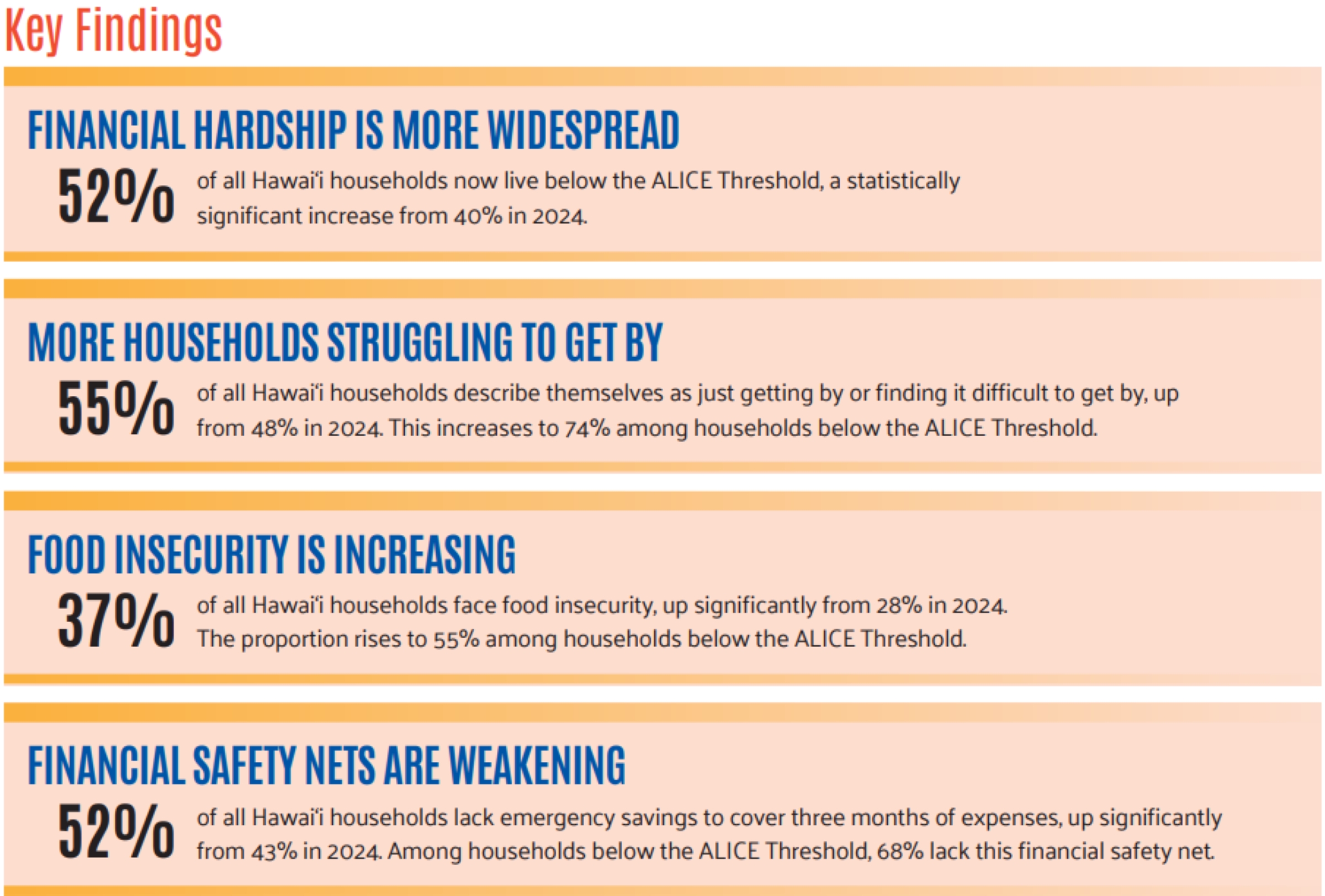
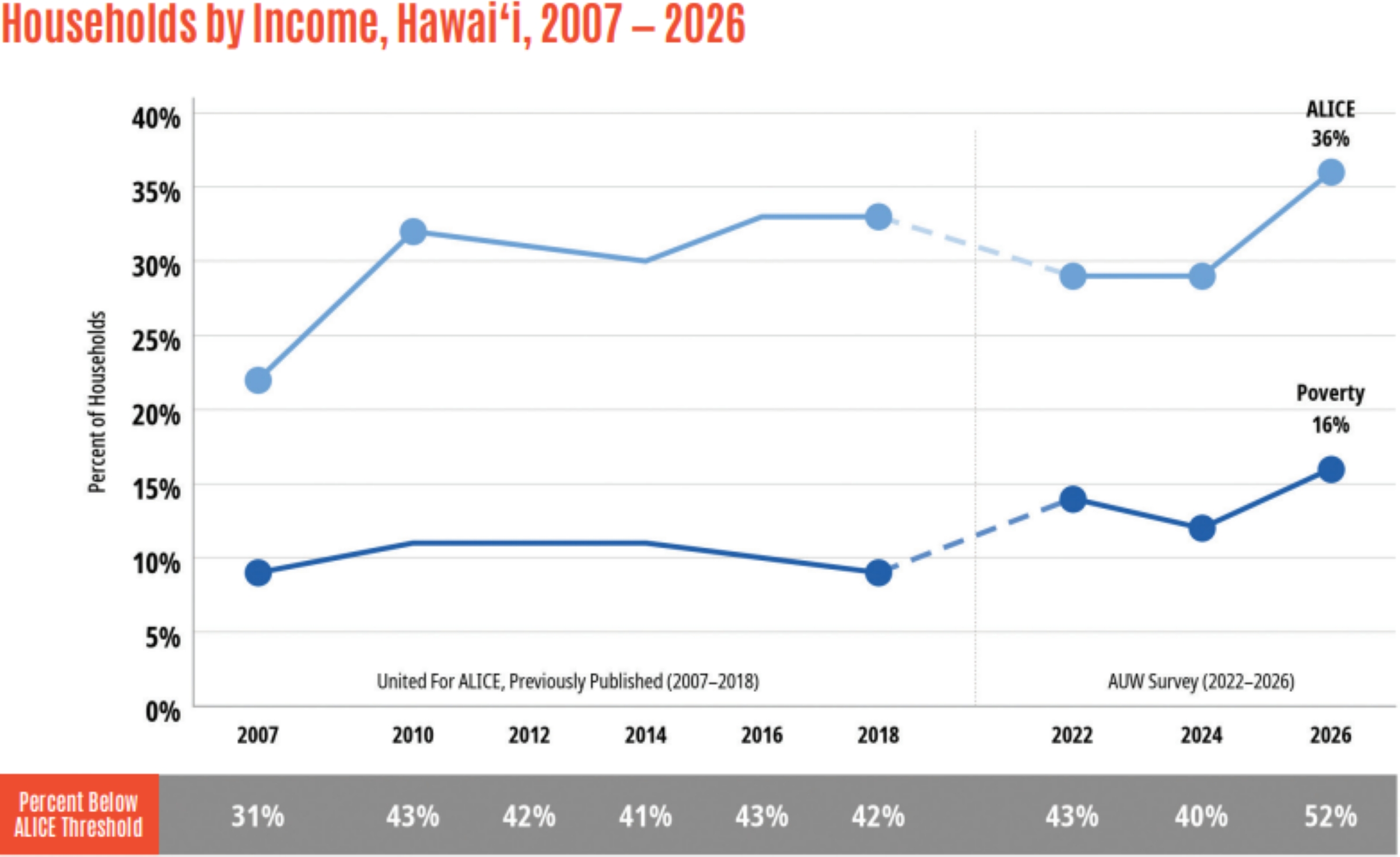
Aloha United Way’s new ALICE in Hawaiʻi: 2026 Facts and Figures report finds 52% of households throughout the islands are living below the asset limited, income constrained, employed — or ALICE — threshold, a significant increase from 40% in 2024 and highlighting growing financial instability.
The findings reveal mounting financial pressures on Hawaiʻi residents, raising concerns about household stability, workforce retention and the state’s long-term economic future.
Asset limited, income constrained, employed describes households earning above the federal poverty level but not enough to cover basic living expenses. The annual household survival budget exceeds $112,000 for a Hawaiʻi family of 4, including two adults, an infant and a preschooler.
That represents the minimum income needed to cover housing, child care, food, transportation, health care, a smartphone plan and taxes.
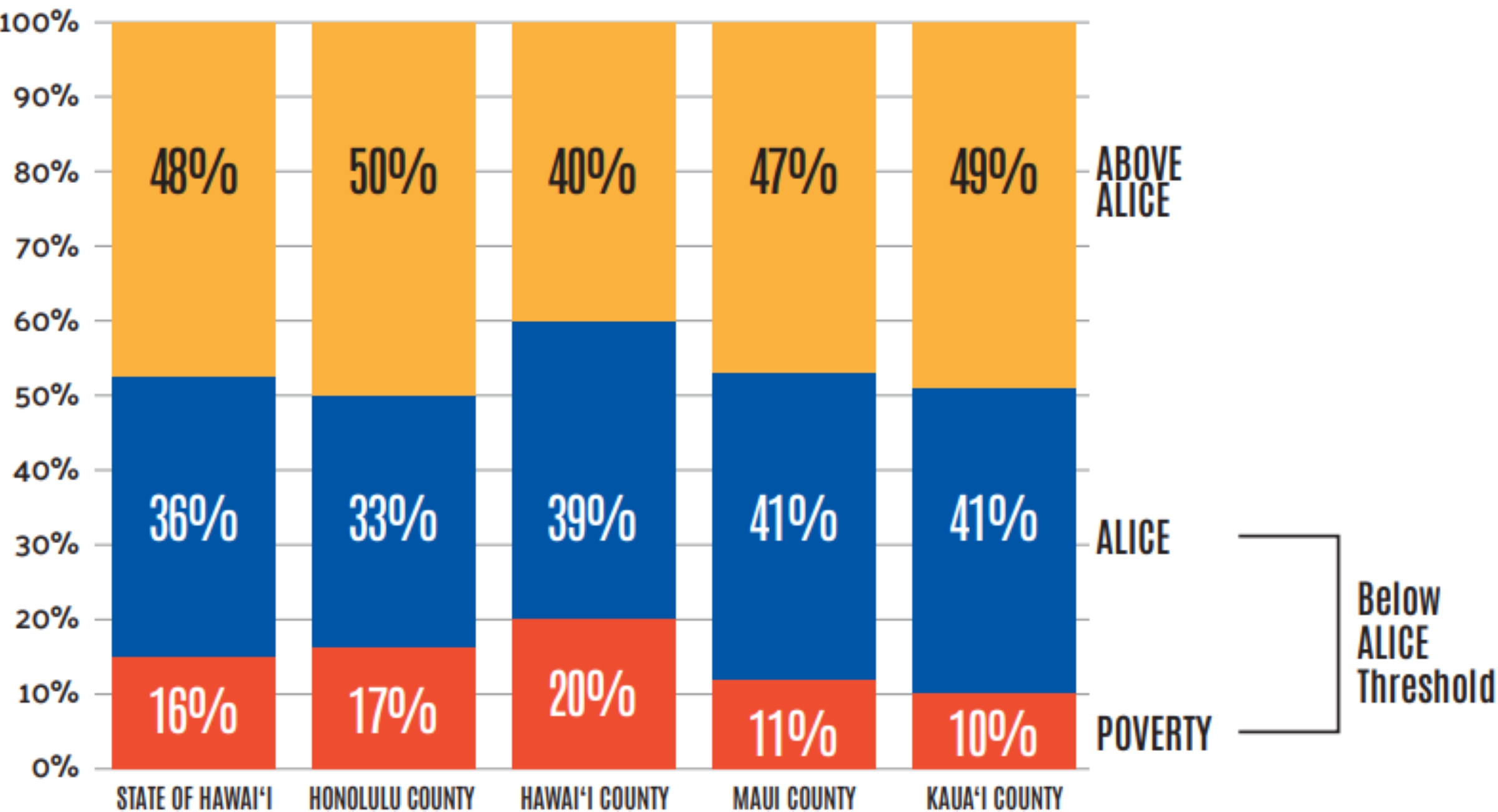
Financial hardship affects every county, with Hawaiʻi County reporting the highest percentage of households below the ALICE threshold at 60% followed by Maui County at 53%, Kauaʻi County at 51% and Honolulu County at 50%.
Other key findings include:
- Fifty-five percent of households below the ALICE threshold reported not having enough food, an issue that is increasing. More than one-third (37%) of Hawaiʻi households reported struggling to afford enough food to meet their needs, up from 28% in 2024.
- Emergency savings are shrinking. More than half (52%) of households lack sufficient savings to cover 3 months of expenses compared with 43% in 2024. The figure increases to 68% among households below the ALICE Threshold.
- More households are struggling financially. Fifty-five percent of Hawaiʻi households describe themselves as getting by or finding it difficult to get by, up from 48% in 2024. More than 1 in 4 households (28%) spent more than they earned during the past year.
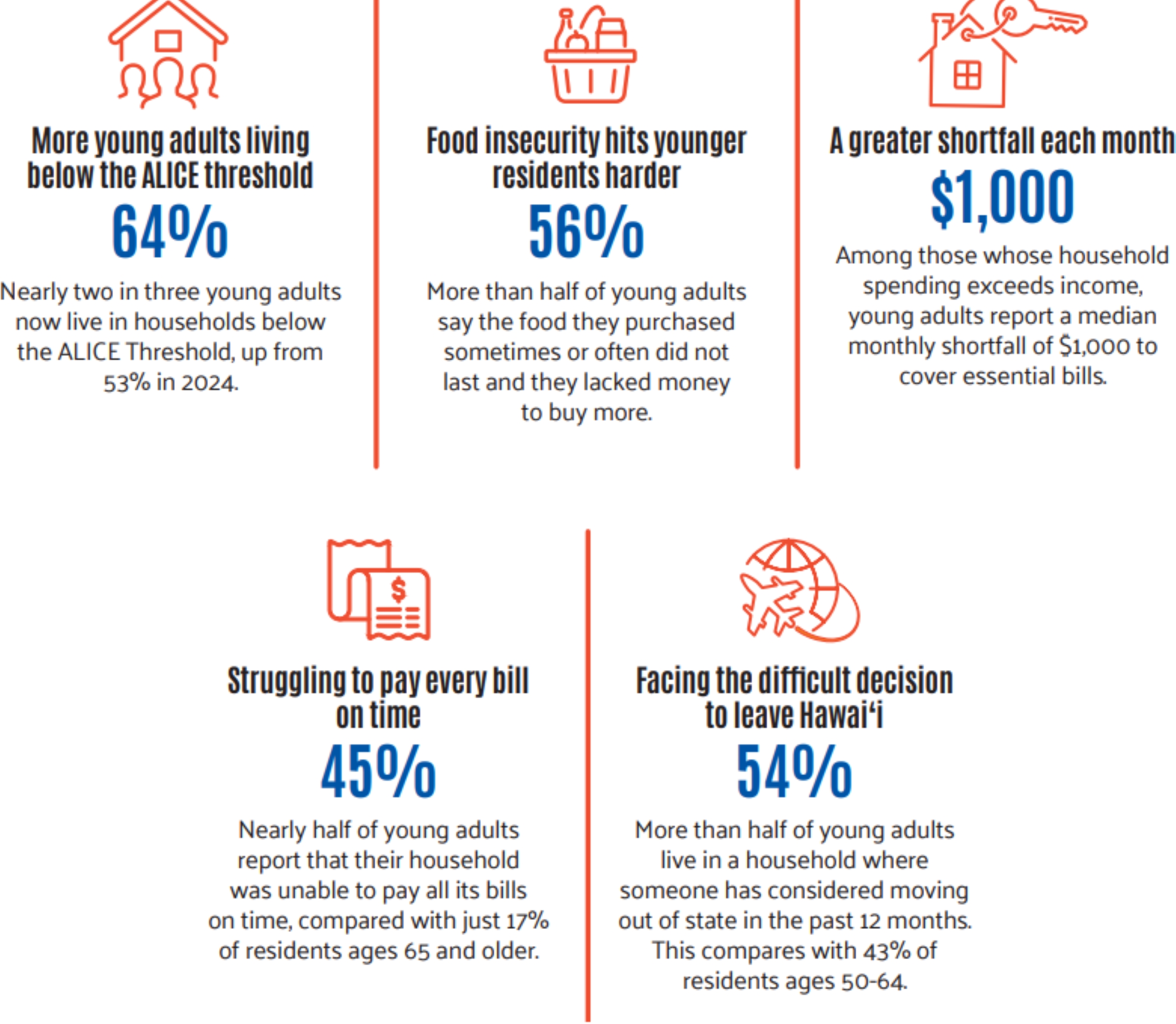
- Families with children and young adults face greater hardship. Sixty-eight percent of households with children younger than 18 years old live below the ALICE Threshold, up from 50% in 2024. The figure is 64% among young adults ages 18 to 34 years old.
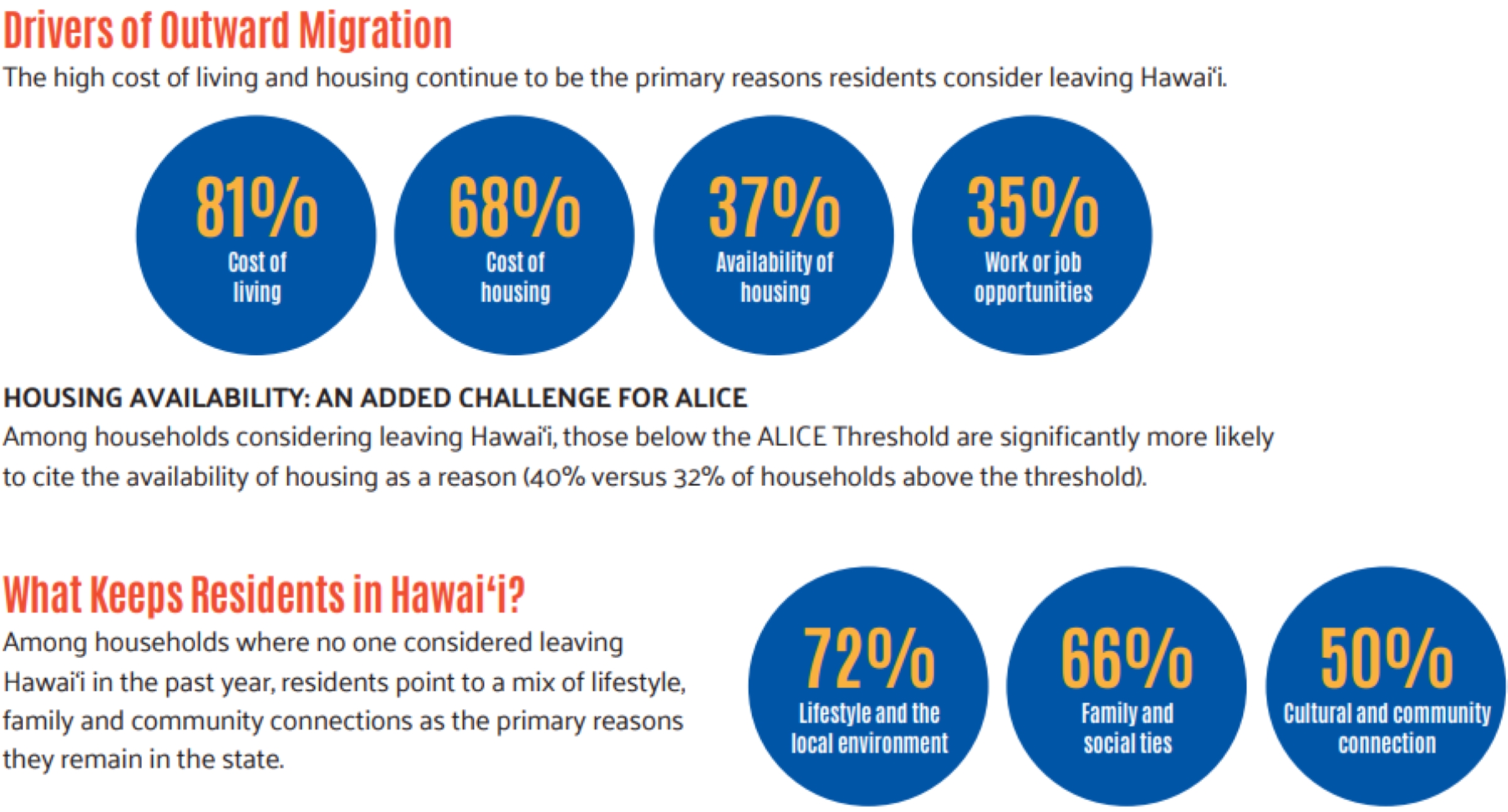
- More residents are considering leaving Hawaiʻi. Forty percent of households reported someone considered moving out of state during the past year compared with 37% in 2024. The cost of living and housing remain the leading reasons.
- Growing financial strain extends beyond household budgets. Among households below the ALICE threshold, 53% reported feeling tired or lacking energy because of financial concerns while 46% felt less hopeful about their future in Hawaiʻi.
- Native Hawaiian residents face particularly high rates of economic hardship. Seventy-four percent of respondents are living below the ALICE threshold, the highest percentage among the major ethnic groups surveyed.
- Among households where someone considered leaving the state, 81% cited the cost of living and 68% cited housing costs.
“These findings underscore the financial pressures facing so many families across our state and the need to think differently about how we address them,” said Aloha United Way President and Chief Executive Officer Michelle Bartell. “Incremental change alone will not be enough. This is a moment for nonprofits, businesses, philanthropy and government to come together around shared goals and bold solutions that address the root causes of financial hardship.”
Bartell added people, organizations, businesses and agencies need to think bigger, work together more effectively and pursue meaningful systemic change so more families can build a stable and prosperous future in Hawaiʻi.
“The financial well-being of Hawaiʻi’s workforce has a direct impact on the strength of our economy,” said Bank of Hawaiʻi President and Chief Executive Officer Jim Polk. “When employees struggle to afford housing and other necessities, businesses face greater challenges attracting and retaining the people they need.”
Polk added that the findings in the 2026 report reinforce why improving financial stability must be a priority for Hawaiʻi’s business community.
Aloha United Way is working with partners through the ALICE Initiative to address the root causes of financial instability and create pathways to greater economic mobility.
The partnership aligns with Hawaiʻi Community Foundation’s CHANGE Framework, which emphasizes shared data, collective action and systemic solutions to build a more inclusive, community-centered economy.
Together, they invest more than $1.3 million annually to support a cohort of 21 nonprofit organizations working to strengthen financial stability, expand housing and workforce opportunities and remove barriers that prevent families from getting ahead.
“ALICE is one of the key measures we use to understand whether Hawaiʻi is becoming a place where everyone has the ability to thrive,” said Hawaiʻi Community Foundation President and Chief Executive Officer Terry George. “Behind these numbers are real people working to sustain a life in Hawaiʻi while facing increasingly difficult choices about what they can afford.”
George added that the report’s findings demonstrate a need to accelerate those efforts and reinforce why economic mobility will be one of Hawaiʻi Community Foundation’s key priorities in 2027.
“Ultimately, we want people across Hawaiʻi to do more than just survive,” he said. “We want them to have the stability and opportunity to lay the foundation for a hopeful future.”
The report offers ways to address challenges with several recommendations including:
- Preserving tax credits and providing targeted relief for households with children.
- Expanding free tax preparation services so eligible families receive benefits they earned.
- Establishing paid family and medical leave.
- Improving access to affordable health care.
- Offering flexible support programs that address immediate financial challenges while helping households build long-term economic security.
The 2026 report is the third in Aloha United Way’s biennial ALICE in Hawaiʻi: Facts and Figures series, tracking changes in household financial stability since 2022.
It urges Hawaiʻi to rethink its approach to economic development by investing in industries essential to the state’s residents, including health care, education, child care, food production, social services, public transportation, housing and energy.
The goal is to strengthen these sectors while creating jobs with wages sufficient for workers to afford living in Hawaiʻi.
The full report is available online.