


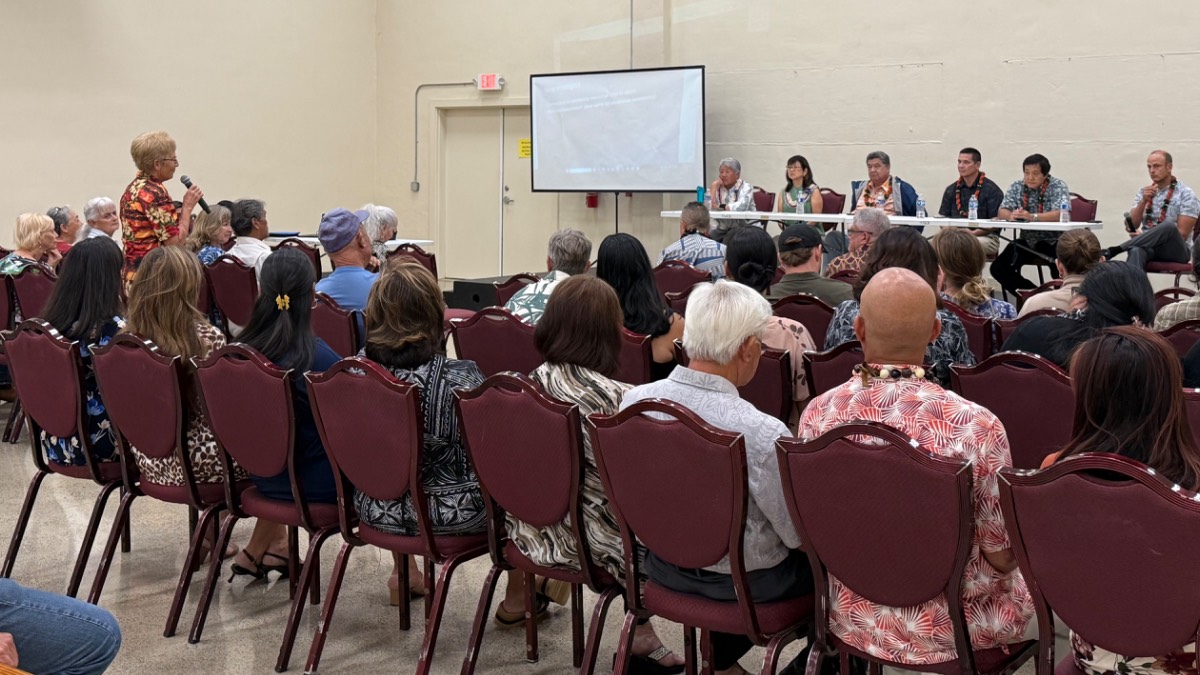
State lawmakers from Kauaʻi attended a town hall Tuesday to update Kauaʻi residents about affordable housing, infrastructure improvements, including at Līhuʻe Airport, and Hurricane Lowell recovery.
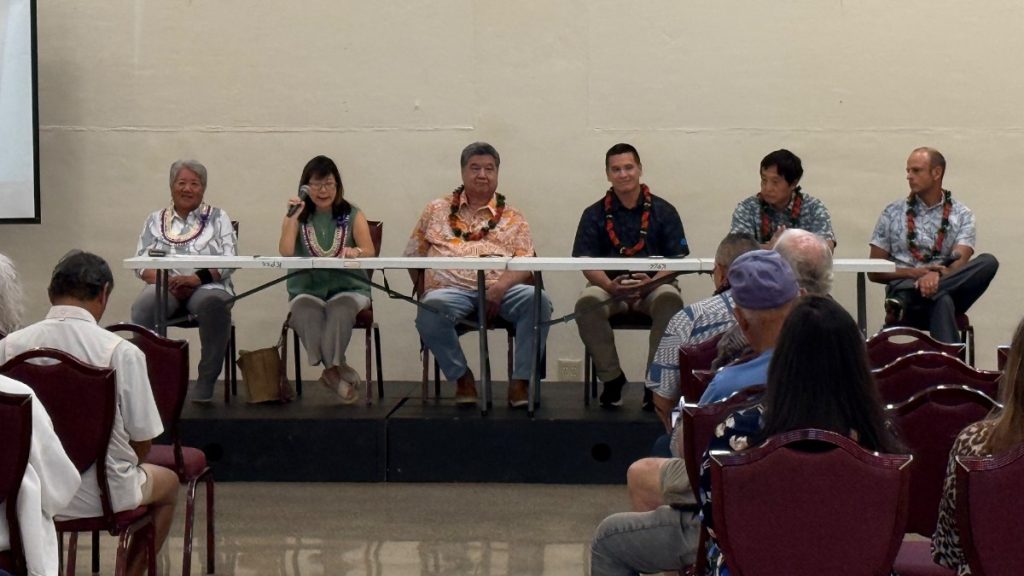
Kauaʻi state lawmakers—Senate President Ronald D. Kouchi, House Speaker Nadine K. Nakamura, House Majority Leader Dee Morikawa, and Rep. Luke A. Evslin — and Elton Ushio, who administers the Kauaʻi Emergency Management Agency, were at the Kauaʻi Philippine Cultural Center to emphasize the need for collaboration to address the island’s challenges.
Housing affordability emerged as a central issue, with Evslin describing the housing shortage as both an economic challenge and a disaster preparedness concern.
“We have a housing crisis,” Evslin said. “Everybody knows it’s really bad.”
He said the state needs to increase housing production while reducing construction costs, regulatory barriers and other expenses that make homes unaffordable for many residents.
Evslin noted that Hawaiʻi’s aging housing stock also creates challenges for disaster resilience, underscoring the need to build homes that can better withstand storms and other hazards.
“We have growing population and declining housing,” he said, describing a trend that has contributed to rising prices and made it increasingly difficult for residents to remain in Hawaiʻi.
Evslin outlined several approaches lawmakers have pursued, including regulatory reform, new financing options, infrastructure investment and policies designed to encourage homes to remain available to Hawaiʻi residents.
He highlighted a $100 million initiative intended to support housing for households that earn too much to qualify for traditional low-income housing assistance but still struggle to afford market-rate homes. Such programs could benefit teachers, police officers and other working families, he said.
Lawmakers also discussed manufactured housing and ways to streamline permitting without compromising building safety.
During the question-and-answer session, residents raised concerns about rebuilding homes damaged by the storm and the time and expense associated with obtaining permits.
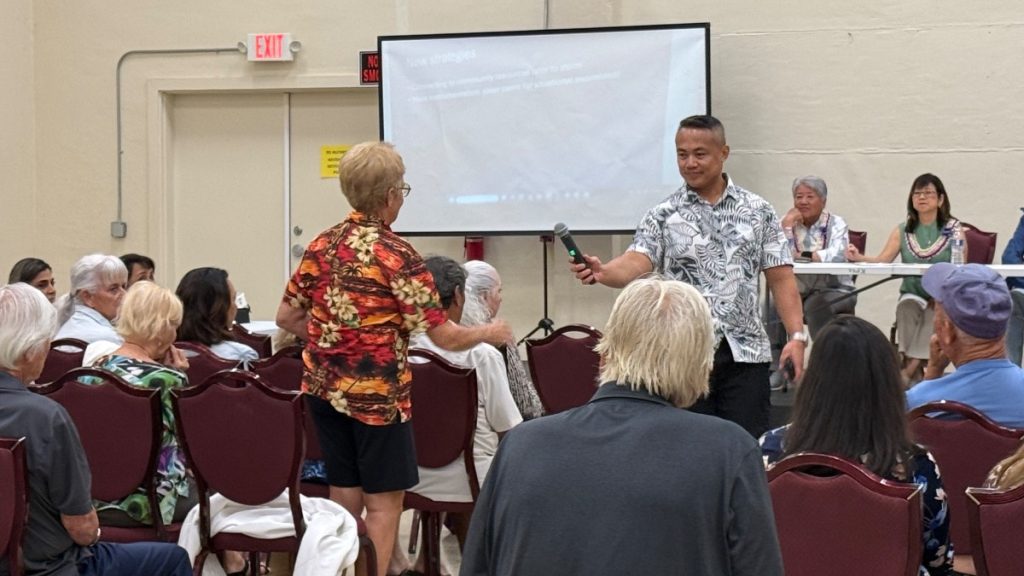
County officials said certain storm-damaged homes outside designated coastal and flood hazard areas can be repaired or rebuilt without a permit under the emergency declaration, provided the work does not expand the home’s footprint or change its structure.
But properties in hazardous areas must undergo additional assessments before rebuilding.
Evslin said lawmakers are also examining ways to make prefabricated homes easier to approve and finance, including preapproved building plans and cooperation among counties on factory inspections.
Lawmakers emphasized that expanding housing opportunities will require investments in roads, drainage, water systems and other infrastructure.
Evslin urged residents to support proposed state constitutional amendment #2 that would allow counties to use tax increment financing, commonly called RISE bonds, to help pay for infrastructure improvements.
He said the financing mechanism could allow counties to fund projects upfront and repay bonds using future increases in tax revenue generated as areas develop.
“Let’s give the counties some flexibility here to build the infrastructure,” Evslin said.
Kouchi also stressed the importance of pairing state funding with clear plans for accelerating housing development, including faster permitting and coordinated infrastructure improvements.
State Department of Transportation Director Ed Sniffen, who flew in from Japan, outlined transportation projects and preparations intended to improve Kauaʻi’s resilience during future storms.
Following Hurricane Lowell, the state Department of Transportation identified power reliability at Līhuʻe Airport as a major concern. Sniffen said the department is planning additional backup generators for airports and ports statewide, including a 1,000-kilowatt generator for Kauaʻi.
The department also plans improvements at Līhuʻe Airport, including an expanded security checkpoint, upgrades to passenger waiting areas and a jet bridge intended to make boarding more convenient.
Sniffen said the security checkpoint project is estimated to cost $40 million.
He emphasized that the proposed airport improvements are intended to address existing passenger volumes and operational needs, rather than substantially increase the airport’s capacity for future tourism growth.
On the highway system, Sniffen said the department is prioritizing stream clearing and drainage improvements to reduce flooding on roads and in nearby communities.
“We’re making sure that we move forward on this,” Sniffen said, describing efforts to work with public and private landowners to clear vegetation and remove obstructions that can worsen flooding during heavy rain.
Sniffen also discussed traffic congestion along key highway corridors and the need to evaluate intersection improvements before pursuing larger widening projects.
Emergency management officials said Hurricane Lowell reinforced the importance of planning, reliable communications and coordination among government agencies and community organizations.
Officials described efforts to improve storm surge forecasting, strengthen emergency communications and develop a more coordinated long-term recovery process.
Kauaʻi’s pre-disaster recovery framework identifies six areas of focus: community planning, permitting and land use; economic recovery; health and social services; housing; infrastructure systems; and natural, cultural and historic resources.
During public testimony, residents stressed that recovery must also address the needs of families, communities and natural resources affected by the storm.
One resident urged officials to prioritize local livelihoods and environmental stewardship alongside housing construction, emphasizing the role community members played in responding to the disaster.
Evslin acknowledged the contributions of residents who helped clear roads and assist their neighbors, saying the state and county need better ways to recognize and reimburse community members for that work.
“The first response post-disaster certainly is community,” Evslin said.
He also underscored the urgency of making housing more affordable for residents facing displacement.
“I don’t care about new homes,” Evslin said. “I care about the new home for the person who’s living in the home.”
Kauaʻi Mayor Derek S.K. Kawakami, who is terming out as mayor and is running for Lieutenant Governor of Hawaiʻi, praised the island’s legislative delegation for working with county officials through recent emergencies, including Hurricane Lowell, without allowing political disagreements to interfere with recovery efforts.
“As mayor, I couldn’t ask for a better partnership,” Kawakami said. “These folks have not politicized any of the big challenges that we were faced with.”
Nakamura also told Kauaʻi Now that she was happy with the turnout.
“It was a productive gathering to discuss transportation improvements, disaster, what’s happening post-hurricane Lowell, and to talk about past and next session.
“I think it was a lot of information all in one place, and Iʻm glad weʻre able to take questions and answers and a good way to connect with the community.”