Hawaiʻi Community Foundation fund Kauaʻi disaster response, future resiliency efforts
Through its Stronger Hawaiʻi Initiative, rolling grant funding is still available for readiness, response, recovery and rebuilding after Hurricane Lala
As Hurricane Lowell approached Kaua‘i and Ni‘ihau earlier this month, Mālama Kaua‘i prepared for potential flooding and winds; however, they were unprepared for the extensive work now required to repair, recover, and rebuild.
The nonprofit began striving to deliver direct financial relief to those most impacted, particularly Kaua‘i’s food producers.
With assistance from a grant by Hawai‘i Community Foundation, Mālama Kaua‘i has supported farmers and ranchers across Kaua‘i by providing emergency resources and addressing losses to agricultural infrastructure, equipment, crops, and livestock.
Following two devastating hurricanes, the Hawaiʻi Community Foundation is continuing to award grants to nonprofits working on recovery efforts and preparedness for future storms across the state.
The Stronger Hawaiʻi Fund is dedicated to supporting statewide disaster response and is designed to move quickly and flexibly across all islands, deploying resources to where the need is greatest at the moment it arises.
“Stronger Hawaiʻi is granted for all phases of recovery. When we fund for response, we’re also funding for future resiliency,” said Michelle Kaʻuhane, chief operating officer and vice president for Hawaiʻi Community Foundation. “Our nonprofit organizations know our communities best. They are the first to identify and address immediate and long-term needs.”
“Funding allows them to do the necessary work in responding to and rebuilding after disaster, which is why we are quick to provide our support,” Kaʻuhane continued.
Through the Stronger Hawaiʻi Initiative, the Hawaiʻi Community Foundation ensures that it funds all four phases of disaster response: risk reduction and readiness, rapid relief and response, recovery and stabilization, and rebuilding resilience.
Funding decisions are guided by community needs and an organization’s ability to serve impacted individuals, according to Keanu Lau Hee, vice president of Community Resilience and Strategic Implementation.
“Earlier this year, we made a great investment in a data collection system to get immediate feedback from people on the ground. The ability to see in real time what the needs are helps us to make the most informed decisions,” said Lau Hee, who oversees the Stronger Hawaiʻi Initiative.
A couple of weeks following Hurricane Lala, U.S. Rep. Jill Tokuda was urging the state and counties to focus on preparation between storms.
“I think the Kona Lows and Lala are a huge reminder that Hawaiʻi is susceptible to so many natural disasters, whether it’s lava flow from the volcano or a hurricane, and our communities need to be prepared for worst-case scenarios,” Tokuda said. “Over-preparation is always better than under-preparation and I think the response would have been a lot less chaotic if every community was well-equipped and as ready as possible for unexpected circumstances.”
Nonprofit organizations, fiscally sponsored projects, and community-based groups engaged in direct response, recovery, or resilience efforts across Hawaiʻi are eligible for grant funding. Applicants should demonstrate a clear connection to the communities they serve.
Applications are reviewed on a rolling basis across the full network of participating funders, meaning a single submission can connect organizations to multiple funding sources. The streamlined process allows nonprofits to minimize paperwork and focus on serving communities.
There are no fixed deadlines. The rolling review ensures funding decisions happen quickly and continuously as needs evolve.
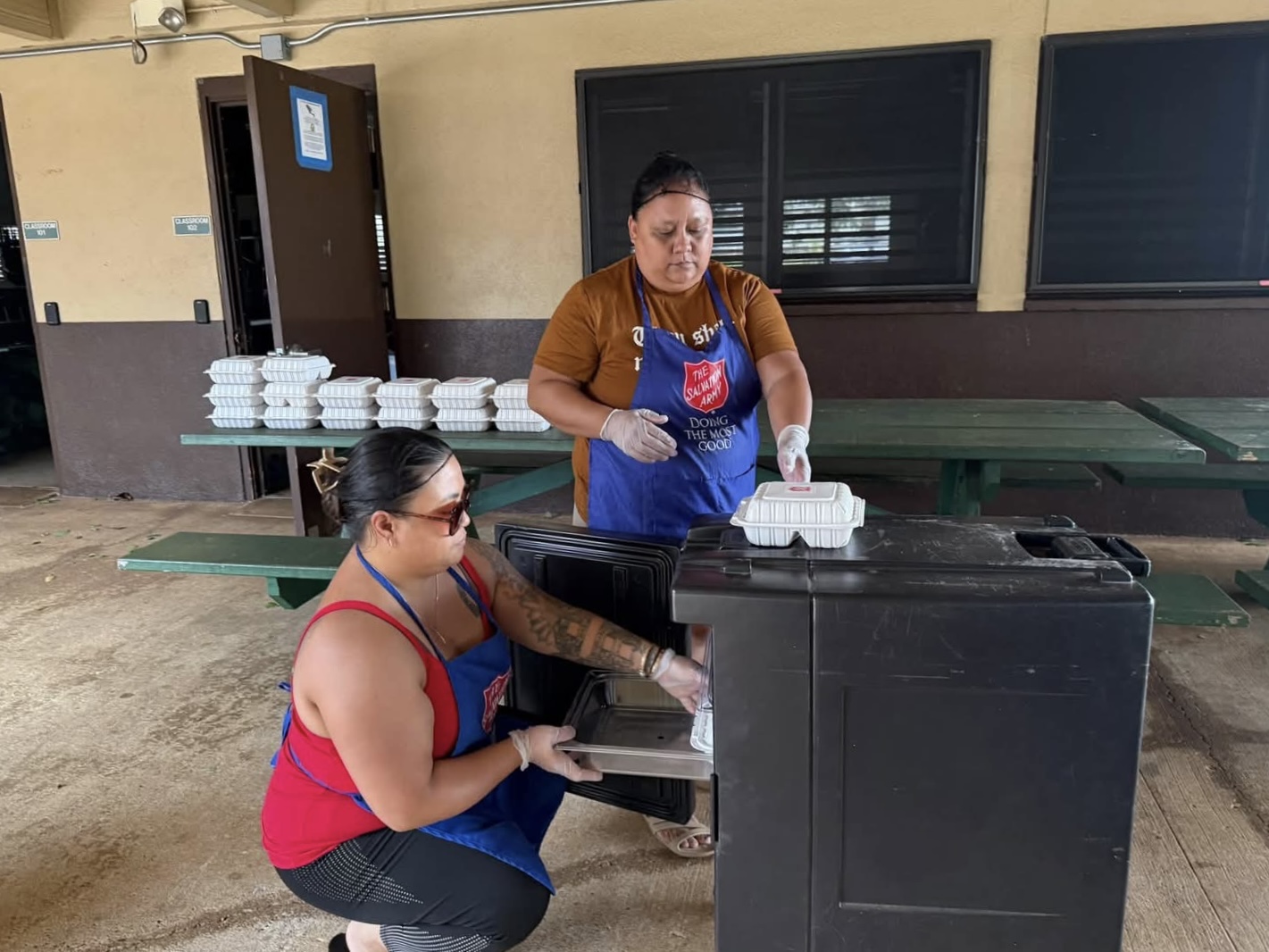
Volunteers meal prep for shelter services at the Hanapēpē Corps. (Courtesy of The Salvation Army)
As of Sept. 14, the Hawaiʻi Community Foundation has provided grants to the following nonprofits for Hurricane Lowell response:
Aloha United Way — $20,000 to connect Kauaʻi residents with critical information, resources, and support through the 211 Hawaiʻi helpline in partnership with Kauaʻi United Way.
American Red Cross— $50,000 to support displaced residents through emergency shelter operations, meals, health services, damage assessments, and coordinated recovery efforts with county and emergency management partners.
Chef Hui— $30,000 to provide community meals and coordinate food distribution and essential support services in North Kauaʻi through a partnership with Waipā Foundation and Nā Maka Onaona.
Hanalei Initiative — $10,000 to provide fuel and coordinate the sourcing and distribution of emergency supplies for North Shore communities on Kauaʻi impacted by Hurricane Lowell.
Hawaiʻi Foodbank Kauaʻi — $100,000 to strengthen food distribution efforts for communities across Kauaʻi, ensuring access to essential resources during ongoing power and communications disruptions.
Hawaiʻi Foodbank Kauaʻi — $10,000 to coordinate the procurement, delivery, and staging of preparedness food resources for vulnerable families and households on Kauaʻi through a network of seven emergency partner agencies.
Iwikua — $10,000 to establish a community hub providing internet access, device charging, and connectivity support for Westside residents impacted by Hurricane Lowell.
Kākoʻo Lāhui — $2,000 to support vulnerable families and households on Ni‘ihau and West Kaua’i through the procurement and delivery of preparedness resources donated from O’ahu.
Kākoʻo Lāhui — $10,000 to establish a community-led hub in Wainiha providing essential supplies and basic needs for rural and isolated households, especially those with kūpuna.
Kauaʻi Economic Development Board— $40,000 to coordinate the procurement and distribution of emergency resources and supplies across community organizations, including commercial ice, for communities across Kauaʻi impacted by Hurricane Lowell.
Kauaʻi Economic Development Board — $25,000 to address gaps in emergency resources and supplies across Kauaʻi through the coordinated distribution of generators, commercial ice, and other critical support for communities affected by Hurricane Lowell.
Kauaʻi Humane Society — $10,000 to maintain animal care services and shelter operations through emergency power support, food and supply purchases, and other essential resources.
Kauaʻi Independent Food Bank — $25,000 to coordinate food distribution and emergency resources, including water and meals-ready-to-eat (MREs), for communities across Kauaʻi.
Keala Foundation — $10,000 to coordinate road clearing and debris removal efforts, helping restore access to communities across Kauaʻi’s South Shore and surrounding areas.
Kumano I Ke Ala — $10,000 to conduct community-led assessments that identify emerging needs, inform resource coordination, and support community-driven recovery efforts.
Laulima no nā ʻOhana — $10,000 to provide essential support services for kūpuna impacted by Hurricane Lowell, including meal delivery, transportation, household assistance, and access to critical supplies.
Mālama Kauaʻi— $50,000 to help farmers and ranchers across Kauaʻi recover by providing emergency resources and addressing losses to agricultural infrastructure, equipment, crops, and livestock.
Nourish Kauaʻi — $15,000 to restore meal delivery and essential support services for kūpuna in impacted communities by reestablishing operations and replacing critical equipment and supplies.
Project Vision Hawaiʻi — $10,000 to provide preparedness resources, supply distribution, and mobile outreach for vulnerable, houseless residents on Kauaʻi ahead of Hurricane Lowell.
Salvation Army Hanapepe Corps — $10,000 to provide emergency meals and essential resources for residents near the Hanapēpē location.
Salvation Army Lihue Corps— $10,000 to provide emergency meals and essential resources for residents near the Līhuʻe location.
According to Kaʻuhane and Lau Hee, the Kaʻū community has been dedicated to supporting not only long-term recovery for individuals impacted but also long-term resiliency for the entire community.
“We are constantly reminded after every disaster of the brilliance of our communities,” Kaʻuhane said. “Despite the devastation and how hard these times are, it is amazing to see how the community shows up for each other amidst all the chaos. This is what ‘Aloha’ looks like in Hawaiʻi.”
Although these nonprofits are more equipped to help the Big Island prepare for a natural disaster, there is also a need for individuals to stay vigilant and heed the warnings from the government.
“Everyone should have a go-kit, or survival kit, and understand the hazards that affect your area,” Lau Hee said. “It is also important to listen to experts and heed the warnings of government officials so you are not caught in a dangerous but avoidable situation.”
By Kelsey Walling Kelsey Walling is a full-time reporter for Big Island Now and the Pacific Media Group.
She previously worked as a photojournalist for the Hawaii Tribune-Herald from 2020 to 2024, where she photographed daily news and sports and contributed feature stories.
Originally from Texas, Kelsey has made East Hawaiʻi her home and is excited to write news stories and features about the community and its people.
Sponsored Content
Subscribe to our Newsletter
Stay in-the-know with dailyheadlines delivered straight to your inbox.
×
Comments
This comments section is a public community forum for the purpose of free expression. Although Kauai Now encourages respectful communication only, some content may be considered offensive. Please view at your own discretion. View Comments