


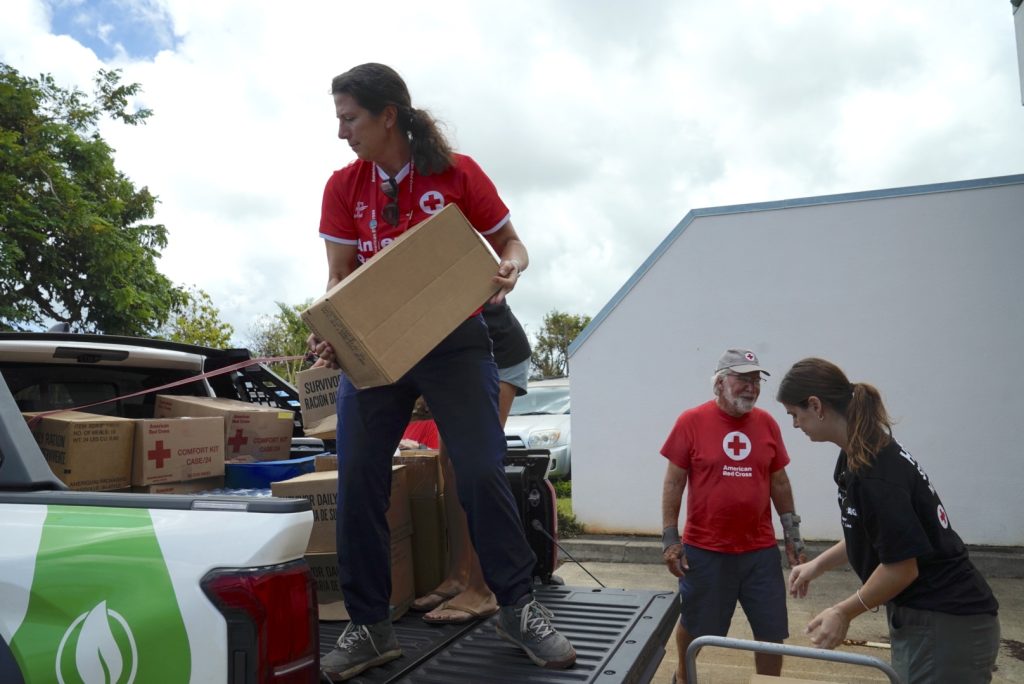
Days before Hurricane Lowell battered Kaua‘i on Labor Day, the American Red Cross Kaua‘i Chapter activated 18 local volunteers to help people who needed a shelter before the storm and help after it passed.
Since then, volunteers from around the state and California have flown in to help, bringing the number up to 100 on Sept. 11.
“The mission of the Red Cross is to alleviate human suffering,” said Molly Schmidt, chief executive officer for the American Red Cross Pacific Islands region.
As the days have rolled on since Lowell’s impact, more power has been restored and the American Red Cross has scaled back its services, with only one of the five shelters still open: the Kīlauea Neighborhood Center, which had 27 people staying there Tuesday night.
Kauaʻi resident Savannah Gibson, the community disaster program manager with the Kaua’i chapter, has been traveling the hardest-hit areas trying to learn what is needed.
On Sept. 11, she took a small team to deliver food and water to the North Shore, where she greeted every person she saw with a smile, offering food, water and supplies.
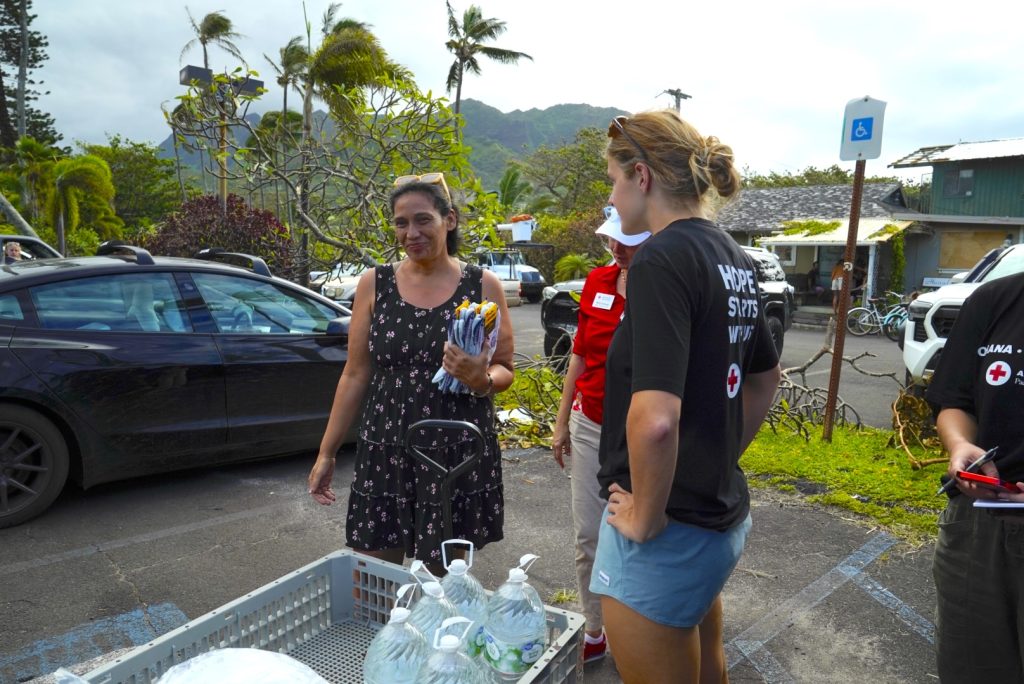
As Gibson pulled into the parking lot at Hanalei Colony Resort in her American Red Cross truck filled with food, ready-to-eat meals and water, a woman approached on her bicycle and greeted Gibson with a smile.
“Would you like some acupuncture?” the woman asked. “It’s free.”
The oceanfront vacation spot turned into a hub for North Shore residents the days after Hurricane Lowell. On that day, residents were walking out of the resort’s Gaia Restaurant with plates of hot food. In the parking lot, Lehua Listman, who works at the resort, had a wagon of ice and jugs of water she was giving away to anyone who needed it.
“Everybody comes together and takes care of each other,” Listman said. “Especially on this side. Our little ahupua‘a, you know, we malama Kaua‘i.”
On the drive north, evidence of the Category 2 storm was everywhere as Gibson made the winding turns through Kūhiō Highway with a loaded truck bed with food and water. Trees were splintered and stripped of leaves. Power poles were down.
In some places, power lines were still on the roadway.
But Gibson’s spirits were high, approaching every person with a smile. When she wasn’t stopping to see people, she was hanging her hand out the window, bottle of water in hand, to pass off to road crews working at bridges.
While at Hanalei Colony Resort, Gibson met Megan Wong, one of the North Shore’s residents and community advocates, and learned quickly about the unique challenges that residents from Princeville to Ha‘ena face when disaster strikes.
While utility services and power have been slowly restored in most areas of the island, the North Shore remained primarily without power for more than a week. Only on Tuesday evening were some areas seeing the lights come back on.
Unlike residents in the southern and western portions of Kaua‘i who are able to reach larger population centers with grocery stores and gas stations within 10 or 15 minutes during light traffic, residents from Hanalei and Ha‘ena easily get cut off in any flooding as high waters force bridge closures.
Princeville residents were also cut off from the southern parts of the island when large trees fell and blocked Kalihiwai Bridge.
Schmidt rode with Gibson to help pass out comfort kits and see what specific needs the community had.
As they journeyed through the North Shore, Schmidt said the encounters they had with community members were important.
“People feel seen and valued and a part of the process,” she said. And if there are needs that are unmet, we’re open to filling them.”
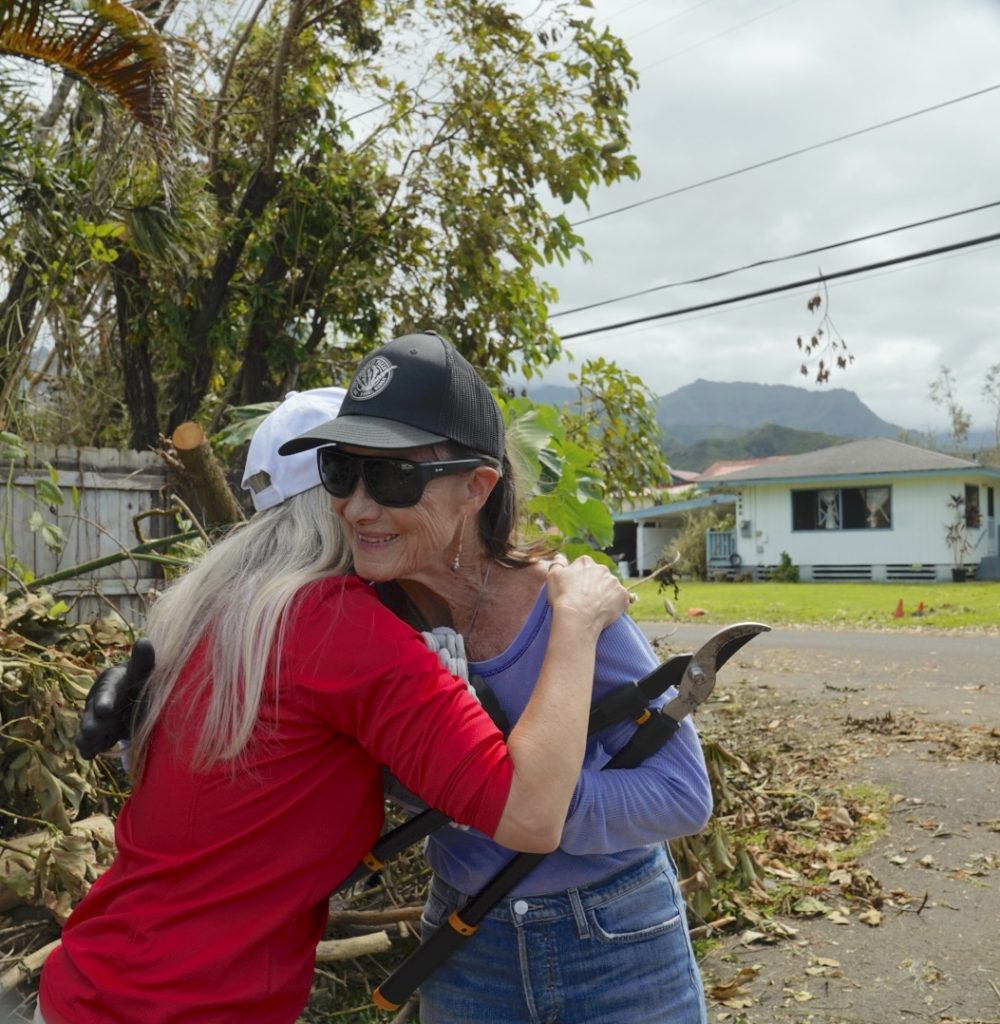
As a result, residents in Hanalei and Ha‘ena rely on each other to get them through the impacts of a disaster.
“Our motto on the North Shore is community-led, government supported,” Wong told Gibson. “They (county crews) don’t usually step in without us telling them this is what we need. And lots of times it’s we just need radios because we can’t communicate (if the power goes down).”
That’s why the North Shore is usually the last place on the island to get help, Wong said, adding: “Because they know we got it.”
Gibson responded: “I know you got it, too, but I also still want to give you guys that support.”
The most requested item by residents during Gibson’s visit to the North Shore was work gloves.
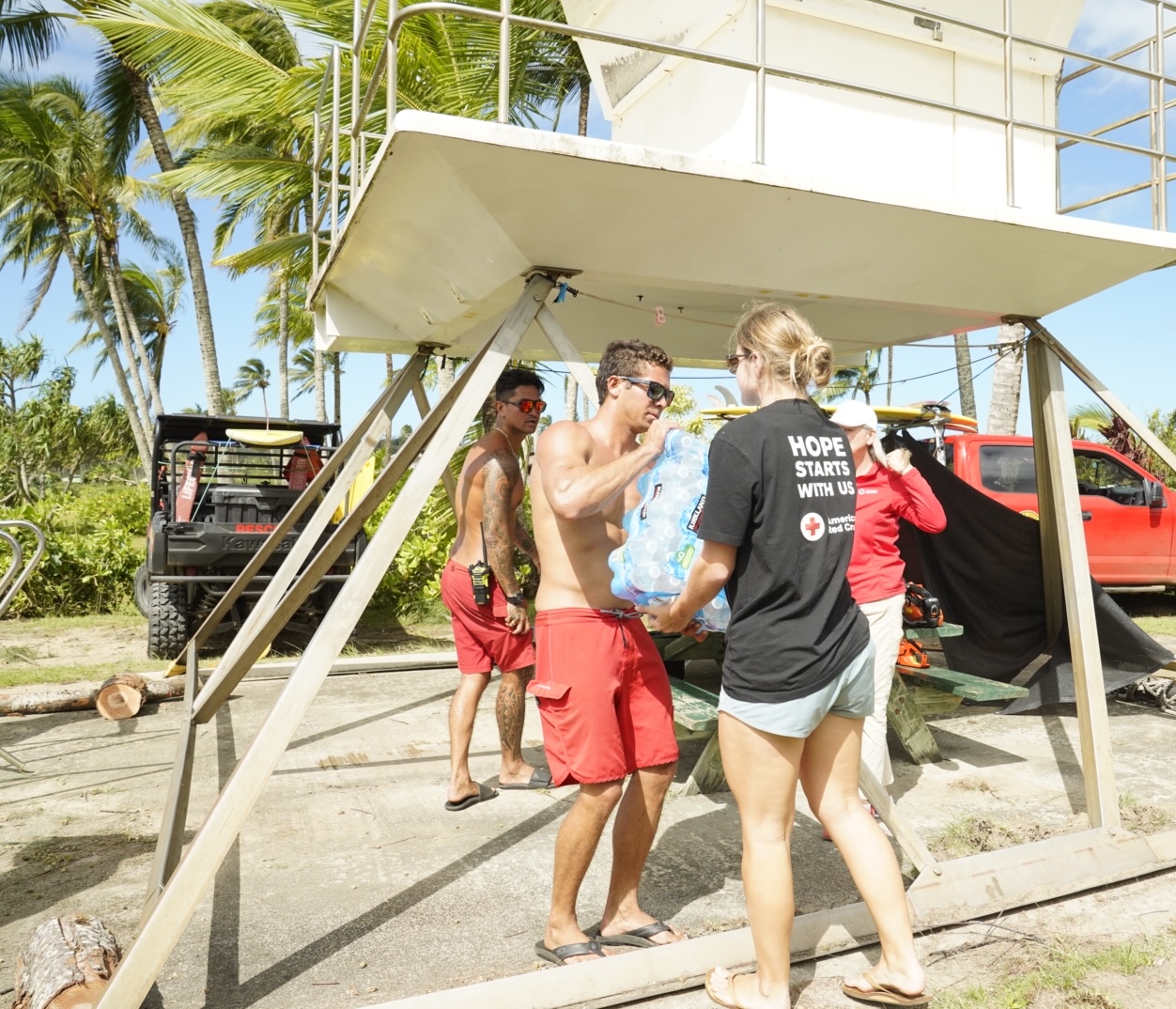
This also was the request by a group of ocean safety officers at Hanalei Pavilion working in the heat to move the lifeguard tower that had blown several feet away back to its original spot.
Gibson also handed out water to the lifeguards.
Tyrus Sialu, Kaua‘i County Ocean Safety North District Captain, said it was good to see the Red Cross: “It’s relief and a lot of weight off our shoulders.”
Shannon Carley, spokesperson for the American Red Cross, said pre-disaster efforts by the nonprofit include getting evacuation centers or refuge areas ready. After the storm, if people can’t go home, she said, they transition into emergency sheltering where they partner with the Salvation Army to provide three meals a day and bring in cots.
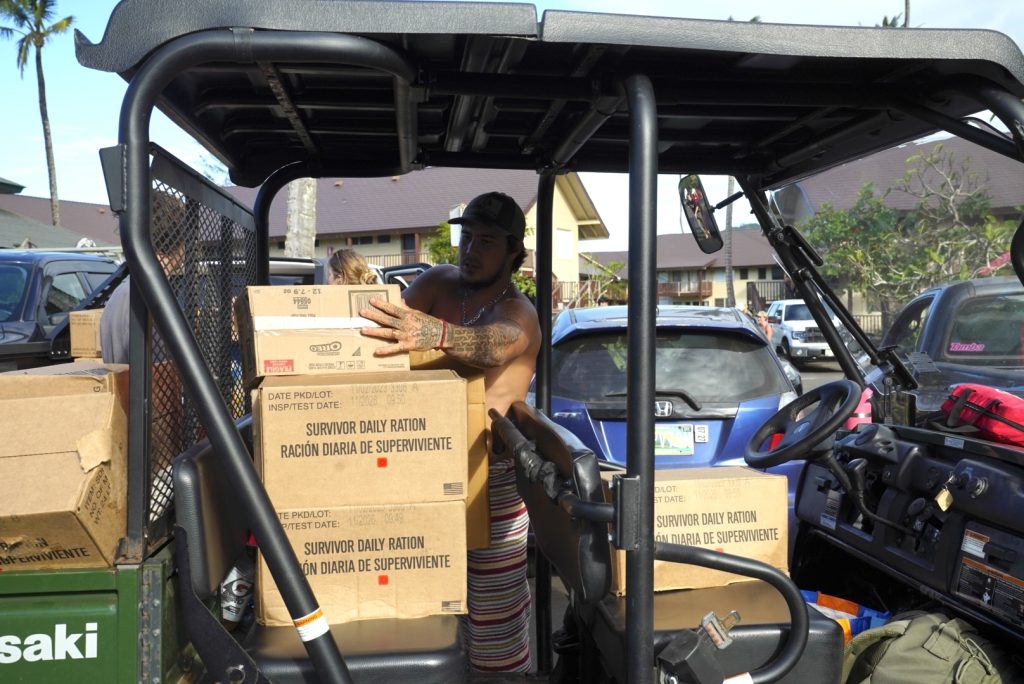
In Lowell, Carley said American Cross reconnaissance teams were out in communities trying to assess damage and where the need was greatest. In the following days, volunteers would return to those areas and provide water, ready-made meals, snacks, along with cleanup kits so that people can start getting all the muck out of their house.
Cleanup kits typically include trash bags, heavy-duty work gloves, poles that will connect into making a mop, along with a scrubbing brush attachment and sponges. The American Red Cross will provide additional supplies and does take requests.
Part of that solution, Schmidt said, is having local people engaged with the American Red Cross because the people who live on Kaua‘i know best how to help those who live here.
“We want Kaua‘i to be able to support Kaua‘i,” she said.
In the first few days after Lowell, Gibson said 12 new people joined the American Red Cross.
Learn more about how to volunteer at redcross.org/Hawaii.