


“Volcano Watch” is a weekly article and activity update written by Hawaiian Volcano Observatory scientists and affiliates.
Ocean swells are constantly beating on the ocean floor. This nonstop drumming creates continuous signals that travel through Earth and recorded on seismometers around the globe, including here in Hawai‘i.
Changes in the speed of these ocean noise signals can give us clues about volcanic activity.
Most of the time, we don’t look at this noise … paying attention instead to the seismic signals generated within a volcano.
By using a technique called ambient noise interferometry to look at the ocean noise in seismic data, we can see that these signals slow down or speed up when traveling through the volcano.
But why is it important that we identify such changes in speed?
Here at Hawaiian Volcano Observatory, we are most interested in understanding when and where a volcanic eruption will occur. Such speedups and slowdowns in ocean noise signals can be because of a variety of physical changes beneath the surface of a volcano, including changes that could be related to potential eruptive activity.
As magma travels to the surface before an eruption, it pushes on the rocks around it. The overlying rocks react to this pushing by breaking open, forming fractures and cracks beneath the ground surface.
The presence of these cracks and fractures causes ocean noise signals to travel slower through this region.
Along the rim of a volcano’s caldera, existing fractures and cracks experience the opposite effect as magma accumulates in shallow storage chambers before an eruption.
As magma moves upwards, it pushes outward toward the caldera rim, causing existing fractures and cracks to close. This decrease in the number of cracks along the caldera rim allows ocean noise signals to travel more rapidly through this region.
We use data recorded at seismometers positioned around Kīlauea to monitor for such changes in the velocity of ocean noise signals.
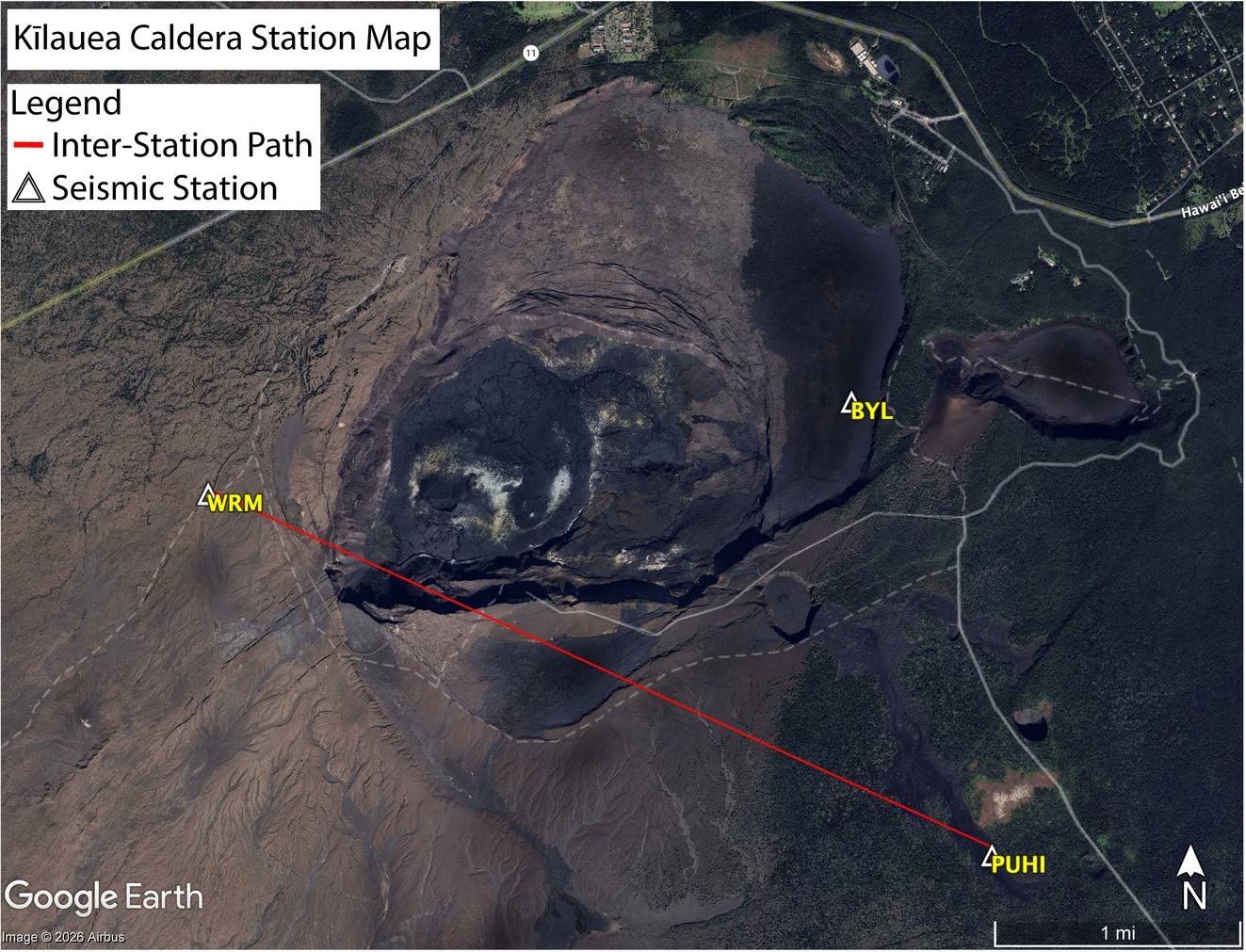
For example, we determined changes in velocity for the volume of crust between seismic stations WRM and PUHI — which are located on opposite sides of Kaluapele, Kīlauea’s summit caldera — before the 2020 summit eruption.
Beginning 2 months before that eruption, the velocity of ocean noise seismic signals decreased, becoming the slowest right before the eruption began. The path between PUHI and WRM extends across the top of the shallow magma reservoir at Kīlauea summit, below Halemaʻumaʻu Crater.
As magma migrates to the surface before the start of an eruption, the opening of cracks and fractures causes the velocity of the ocean noise signals to decrease. We interpret this observed decrease in velocity in the Kīlauea summit region to be indicative of magma shallowing.
We can similarly analyze velocity changes in ocean noise at seismometers around Kīlauea to look for clues suggesting the start of new lava fountaining episodes during the ongoing episodic summit eruption.
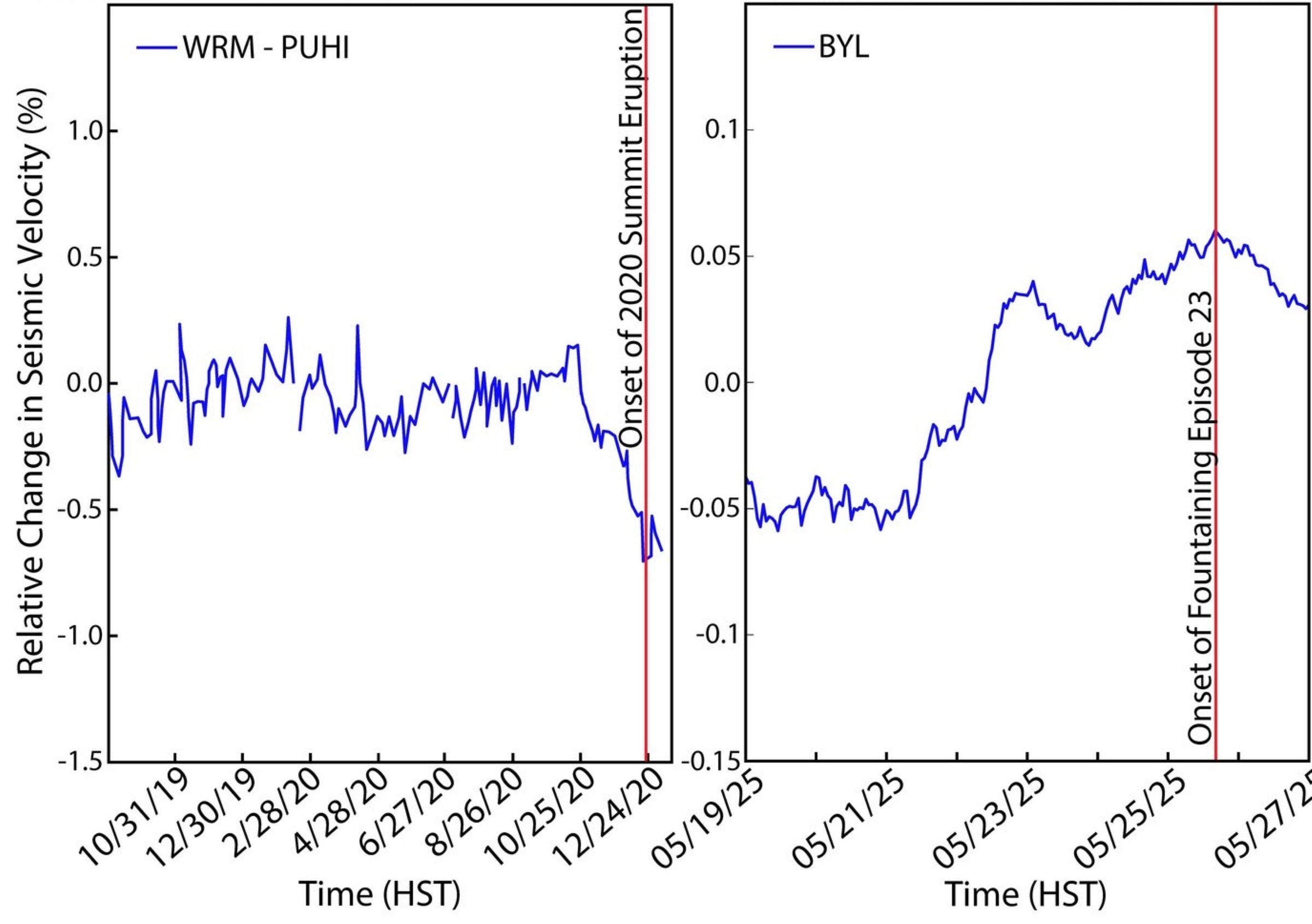
To forecast the start of fountaining episodes, we focused on velocity changes at seismic stations along Kīlauea’s caldera rim. In this case, as discussed earlier, we are looking for increases in velocity at these stations indicative of crack closure because of magma accumulated within the storage chamber beneath Halemaʻumaʻu.
As such, we observed increases in velocity of ocean noise at caldera rim station BYL in the 4 days before the onset of fountaining Episode 23 on May 25, 2025.
While the ambient noise interferometry technique is still being tested and evaluated with every new fountaining episode, scientists at Hawaiian Volcano Observatory see promising results.
Looking at ocean noise could be another useful tool for forecasting when eruptive activity will begin at Kīlauea volcano.
* * * * * * * * *
VOLCANO ACTIVITY UPDATES
KĪLAUEA volcano
VOLCANO ALERT LEVEL: Advisory
Kīlauea has erupting episodically since Dec. 23, 2024, in the summit caldera. Episode 53 of lava fountaining lasted for 9.6 hours Aug. 12-13, with a fountain from the north vent reaching up to about 500 feet. No unusual activity has been noted along Kīlauea’s East Rift Zone or Southwest Rift Zone.
WHAT’S NEXT: Summit region inflation since the end of Episode 53 indicates another fountaining episode is likely, but more data are needed to make a forecast.
MAUNA LOA volcano
VOLCANO ALERT LEVEL: Normal
Mauna Loa is not erupting. Click here to visit the Mauna Loa page at the Hawaiian Volcano Observatory website and read the most recent monthly activity update dated Aug. 6.
Hawaiian Volcano Observatory continues to closely monitor Kīlauea and Mauna Loa volcanoes.
* * * * * * * * *
EARTHQUAKE ACTIVITY UPDATES
Two earthquakes were reported felt during the past week in the Hawaiian Islands:
- MAGNITUDE-3.1 earthquake at 7:13 p.m. located 26 miles southeast of Nāʻālehu at a depth of 5 miles.
- MAGNITUDE-5.2 earthquake at 5:48 p.m. Aug. 11 located 26 miles east-southeast of Nāʻālehu at a depth of 6 miles.
Visit the Hawaiian Volcano Observatory website for past “Volcano Watch” articles, Kīlauea and Mauna Loa updates, volcano photos, maps, recent earthquake information and more. Email questions to askHVO@usgs.gov.