


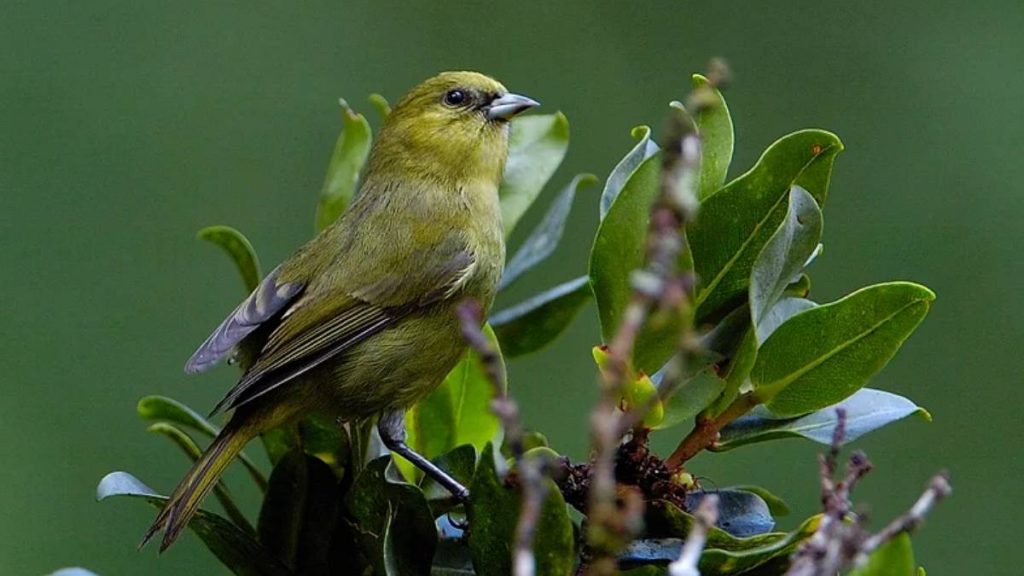
Kauaʻi’s native honeycreepers could disappear from the island by the end of the year unless emergency conservation efforts succeed, a state wildlife biologist told the Kauaʻi County Council earlier this month during a sobering briefing on the rapid collapse of several endemic bird populations.
The presentation came at the request of Councilmember Fern Holland, who said she wanted the public and county leaders to understand the seriousness of the crisis.
Bret Mossman, forest bird coordinator with the state Division of Forestry and Wildlife, told council members that an unprecedented explosion of mosquitoes across the Alakaʻi Plateau that began in late 2025 has devastated native forest birds already threatened by avian malaria and habitat pressures.
“We’re looking at the complete extinction of Kauaʻi’s endemic honeycreepers as soon as this year,” Mossman said.
Among the hardest-hit species is the ʻakikiki, which Mossman said has not been observed in the wild since August 2025. Wildlife officials now believe the species is extinct in the wild on Kauaʻi, although 41 birds remain in conservation breeding facilities.
Another species, the ʻakekeʻe, is down to what biologists believe may be a single remaining wild female after this year’s breeding season failed to produce surviving young.

Population estimates for both species have fallen dramatically. Mossman said surveys in 2023 estimated roughly 3,500 individuals combined, but after last year’s mosquito outbreak, biologists believe fewer than 100 birds remain in the wild across both species.
“The vast majority of both populations” were lost following the mosquito surge, he said.
To prevent complete extinction, the state is pursuing several emergency strategies, including expanding captive breeding programs, collecting additional birds from the wild and relocating some species to higher-elevation habitat on Hawaiʻi Island, where mosquito populations remain significantly lower.
Officials hope to capture up to 40 birds by October and release approximately 20 into protected habitat within a bird sanctuary on Hawaiʻi Island while maintaining others in conservation breeding programs.
Mossman acknowledged that relocating birds away from Kauaʻi is not the preferred long-term solution.
“The ultimate goal of any of this conservation work is to make sure these birds come home to Kauaʻi,” he said. “We’re just taking some steps in between to make sure that they can survive.”
The state also plans to establish aviaries near Kōkeʻe on Kauaʻi to house birds locally while longer-term mosquito control efforts continue. Two aviaries are expected to arrive from Maui, with officials hoping to have them operational by October.
Council members questioned whether current funding levels are sufficient to address the growing crisis.
Council Vice Chair Mel Rapozo asked Mossman about state appropriations for mosquito control after lawmakers allocated approximately $1.6 million this year for forest bird conservation.
Mossman said the funding represents only a fraction of what wildlife managers requested.
According to Mossman, conservation officials sought roughly $12 million statewide for forest bird projects, including about $1.5 million each for Kauaʻi and Maui mosquito-control efforts, but final legislative appropriations fell well short of those requests.
He said large-scale mosquito suppression is essential because the invasive mosquitoes that spread avian malaria can travel several kilometers, requiring treatment across thousands of acres to protect remaining bird habitat.
The county discussion also highlighted broader ecological concerns beyond the birds themselves.
Council Chair Bernard Carvalho Jr. asked whether losing Kauaʻi’s native honeycreepers could affect the island’s forests.
Mossman agreed that native plant communities are already showing signs of losing pollinators and said additional discussions with watershed organizations will be necessary to understand the long-term ecological impacts.
Despite the dire outlook, Mossman said he remains cautiously optimistic that some species can still be saved through aggressive intervention.
He pointed to recent breeding successes in captivity and advances in genetic preservation, including frozen cell lines collected from endangered birds that could someday support future recovery efforts as reproductive technologies improve.
Still, he emphasized that time is running out.
“The sooner we get them out into the wild, the better for the population,” Mossman said. “If we do nothing, they almost certainly will go extinct.”