


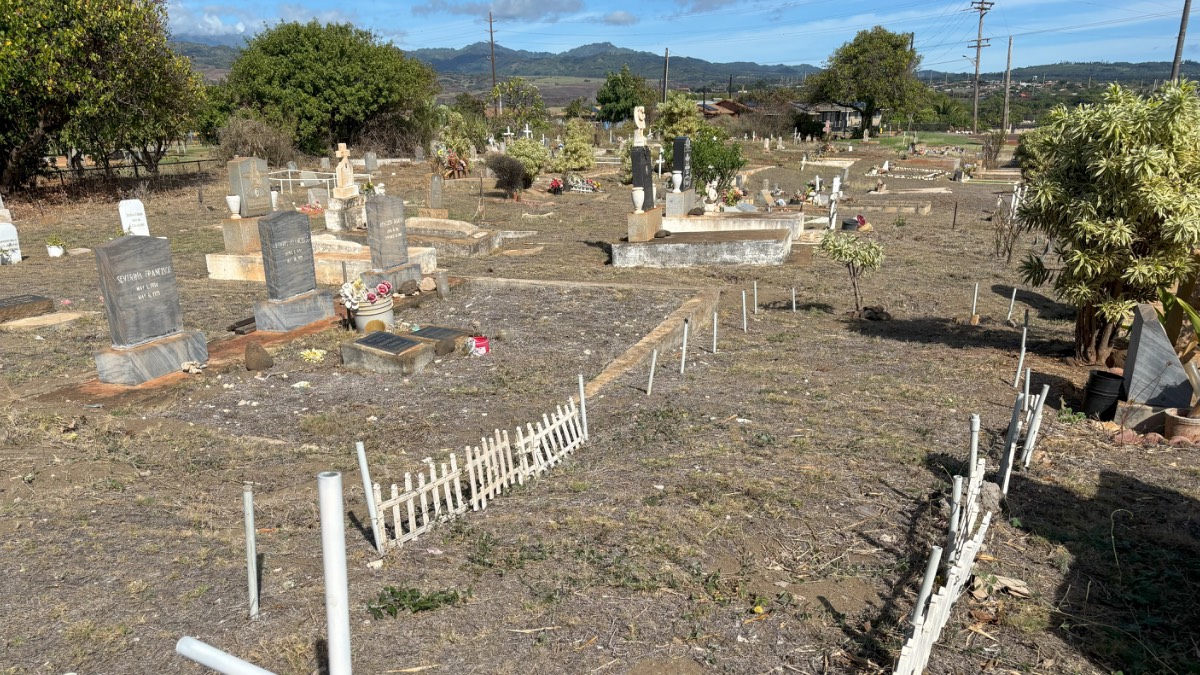
The state of Hawaiʻi Department of Accounting and General Services is another step closer to erecting a monument remembering a battle that occurred just over a century ago, when 16 Filipino strikers and four police officers died in a violent clash over a labor strike in Hanapēpē.
The state department awarded the $125,000 bid on June 22 to Pacific Blue Construction LLC to build the memorial, which will stand at the front of Hanapēpē Chinese, Filipino and Portuguese Cemetery, where the strikers are buried in a mass grave, according to a news release from the Department of Accounting and General Services, or DAGS.
Construction starts Sept. 1, and the DAGS Kauaʻi District Office is overseeing the project. It’s expected to be completed by February 2027.
“This memorial ensures the sacrifices made during the Battle of Hanapēpē are never forgotten,” said Acting Lieutenant Governor and DAGS Director Keith Regan. “It honors the workers who stood up for dignity, fair wages and safer working conditions, while acknowledging the lives lost on all sides of a tragic conflict.”
The memorial will consist of two concrete columns with a gap between them, symbolizing two sides of the conflict. The columns are oriented so that no matter the time of day, they always cast a symbolic shadow, representing that dark chapter of labor history.
DAGS designed the memorial.
The 1924 Battle of Hanapēpē is considered by many to be a foundational and tragic episode in Hawai‘i’s labor rights history.
In September of 1924, Filipino workers – mostly Visayan – across all the territory’s sugar plantations went on strike. They were camped out in Hanapēpē, with demands for more money, from one dollar a day to two dollars, and fewer working hours, from 10 hours a day to eight hours.
On Sept. 8, 1924, a Visayan strike camp kidnapped two Ilocano strikebreakers to prevent them from crossing the picket line. On Sept. 9, when the sheriff and police tried to free the captured men, a deadly confrontation broke out, resulting in 20 deaths and over 100 arrests.
In the end, 58 strikers pleaded guilty and received a four-year prison sentence.
“By preserving this history, we recognize how those events helped shape the labor rights and workplace protections that benefit Hawaiʻi’s workers today, and we remind future generations of the importance of learning from our past,” said Eric Agena, program manager for the DAGS Kauaʻi District Office.