


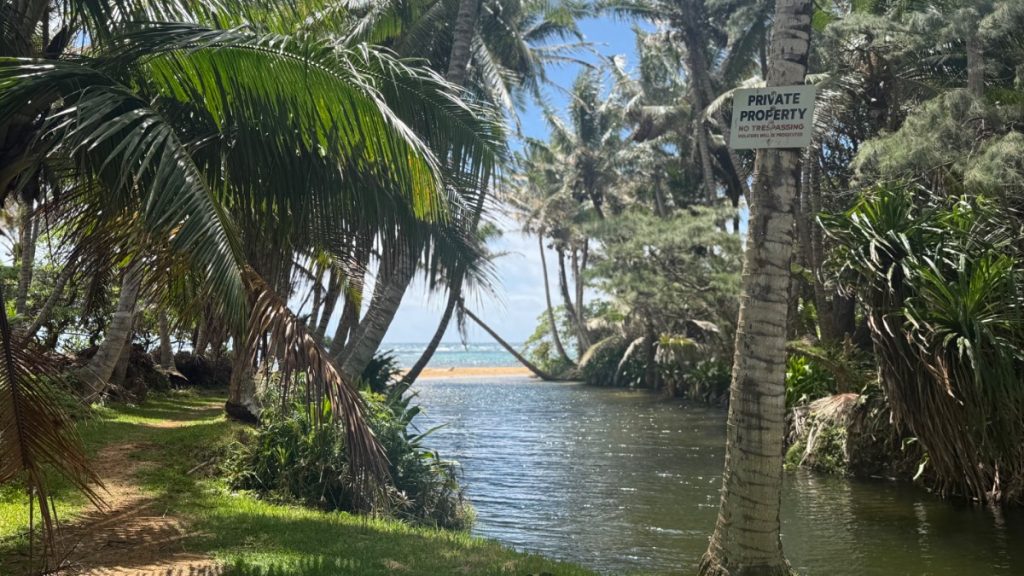
The Kauaʻi County Council on Wednesday approved a resolution authorizing the acquisition of a private strip of land, and by eminent domain if necessary, for public pedestrian beach access at ʻAliomanu Bay in Anahola.
“The reason the condemnation is moving forward is that they are unable to get an agreement,” Council Chair Mel Rapozo said during the council meeting in Līhuʻe.
Resolution 2026-16 declares it serves a public purpose to obtain a 10-foot-wide pedestrian easement adjacent to a stream bordering a 1.39-acre private oceanfront property located in the ‘Aliomanu area on the Kawaihau District.
But this action took the property owner Jerry Crabtree, an elite Stanford professor of medicine, by “surprise.”
He told Kauaʻi Now on Thursday he had received notices about the possibility of buying the land, but wasn’t aware of the public meeting with testimony that occurred on June 3.
While there is a “Private Property, No Trespassing” sign to the right of the path, Crabtree said: “The beach access is open to everyone, and no one has ever been refused passage by my caretaker or me.”
Jeff Linner, a 40-year resident of the area, testified at the County Council meeting: “No one ever stopped me from going through, and so I don’t think you can condemn if somebody lets you go through the property. So, I mean, before you should have spent a lot of money doing it, and everybody can go through it.”
But several people testified Wednesday in support of the resolution, including Nālani Kaneakua, program director of the Koʻolau Limu Project, who said it was important because “we don’t need to be walking in the stream anymore.”
She also shared pictures of her students and the “work we have been doing and using that space.”
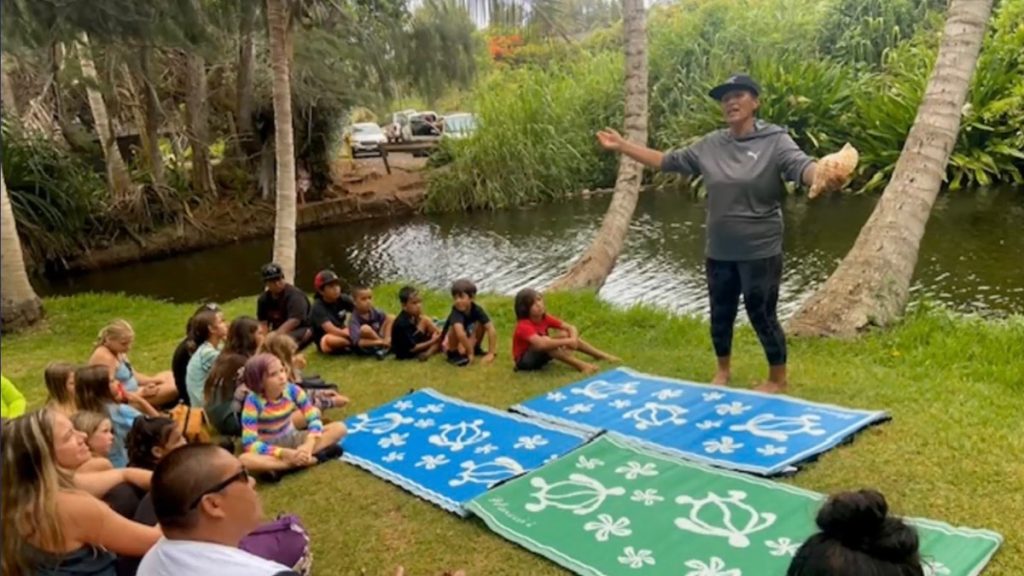
“A lot of our cultural practices diminished rapidly when all the homes along the coast were being built,” Kaneakua said. “We use that area all our lives for gatherings, food, cultural practices, medicinal uses, harvesting limo, and many other things. Some of the best memories came from fishing in the area.”
Kaneakua said some programs can draw up to 50 students to come and learn about the area. She said they can learn about conversation and erosion. But she said they see “no trespassing” signs.
“All we want to do is get the kids out there to learn about their culture, to learn about the area,” she said.
Crabtreeʻs caretaker, who wanted to remain anonymous, was at the property on Thursday and said: “I can take down the ‘No Trespassing’ sign right now if that makes everyone feel more welcomed.”
Crabtree said: “The pictures of the kids sitting on the lawn was actually my property. Owned, mowed, and cared for by me often with my own hands. I was happy to let them use it for their studies and will continue to do this in the future.”
After being told about the council meeting, Crabtree watched it online and said there were some inaccuracies.
“I never heard of any children in the river with their backpacks and have no idea of where this might come from,” he said. “I am a biologist and love teaching kids about Nature. There is no way that they would need to go into the stream.
“As I have mentioned, I have never forbidden a single person from crossing my property. I love teaching kids about biology, and this is why I have taught biology for the past 40 years. I would never do anything to keep kids from this delightful experience.”
Crabtree not only taught biology, but made key discoveries in the medical field over several decades that fill up a wikipedia page.
The resolution states the access would support recreation, environment, stewardship and educational activities. County officials also added that the easement would become part of the islandʻs network of public shoreline access routes, providing residents and visitors with a pathway to the beach.
Crabtree, who has owned the property next door for nearly 30 years, said there was never an issue about using that path until Nancy Kidder, the former owner of the property, decided to sell.
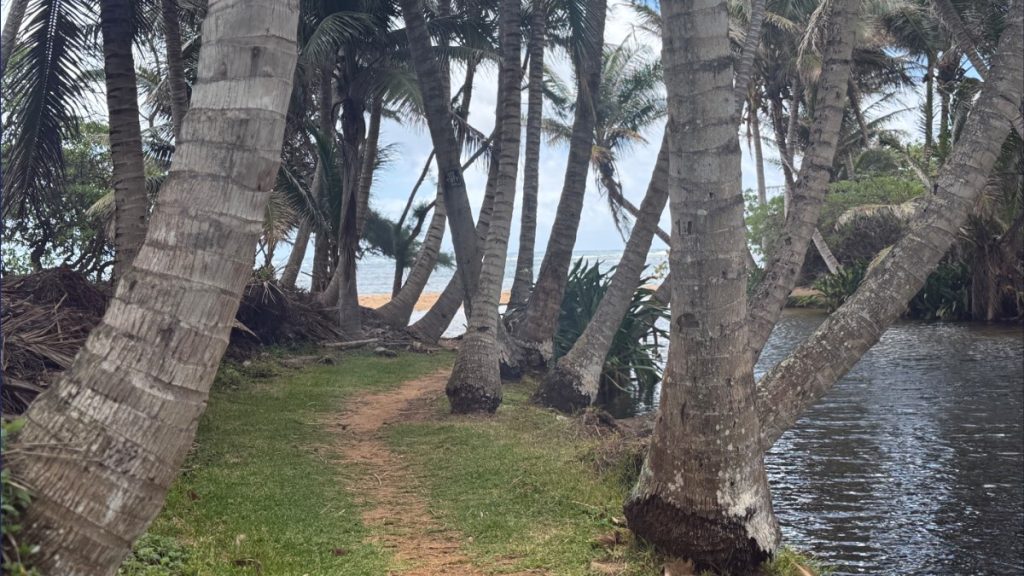
“She never to my knowledge forbid anyone from walking over her property,” he said. “However, there was an unfortunate time when her property was for sale, and the real estate agent forbid people access to the beach. I felt his actions were inexcusable.”
In a 2019 article in The Garden Island, it details a dispute in which Crabtree is on the side of keeping the beach access for everyone. Crabtree had received a letter from lawyer Jonathan Chun, who represented the property owner Aliomanu Beach Living Trust, saying he did not have “prescriptive rights” to walk across the property.
In that article, it said Crabtree had been “caretaking the path in question for years.” The letter said when Crabtree was seen by the owner’s Realtor Robb Wall trimming vegetation on the property, Wall informed Crabtree he wasn’t legally allowed to be there. That’s what kicked off the discussion to close the pathway, Crabtree had said at the time.
And at that time, Crabtree said in order to keep the path open, he was prepared to pay the asking price. And he did, in 2022, paying $2.9 million.
More than a year earlier, from June 2017 to June 2018, the county considered buying the property through the Public Access, Open Space &Natural Resources Preservation Fund Commission after it was brought to its attention by Agnes Marti-Kini, known as “Auntie Aggie” to residents.
The current resolution said it was determined that because the property had a cottage, it was not vacant land, and thus the county would be responsible for the cost of the structure’s maintenance and potential liability. And, there was other beach access nearby. So, it decided not to pursue acquiring the entire property any further.
But in 2022, the County Council determined that it would purse just the access easement. The county said the property owners were not willing to convey an easement.
Crabtree said when he bought his property in 1997, the area was used as a dump.
“There were washing machines, TVs, old lawn mowers, car parts, and broken roofing, apparently blown off during the hurricanes, littering the property,” he said. “I hired an excavator and paid to have several large dump trucks full of garbage hauled away and properly disposed of.”
He said he trims the bushes, removes coconuts and makes the area safe for people to walk to the beach.
“This costs about $4,000 per year, and the mowing and trimming cost about $2000 per year,” he said.
The county Planning Department said in the resolution it has identified a potential steward willing to maintain the easement.
Crabtree said he doesn’t think the county will take care of the path as well as he does. He added that he also trims the trees away from the electrical lines.
“I think the people of Kauaʻi have a lot to lose here by a misguided takeover by a government agency that will not take care of this property and that will quickly let it resort to an overgrown, dangerous hideaway for drug dealing and illegal and sometimes violent activity,” he said.
Under the resolution, the county attorney is authorized to initiate condemnation proceedings to obtain the easement and address any associated property encumbrances. The county attorney may also negotiate a settlement with the property owner, subject to approval by the County Council, and if applicable, the court overseeing the case.
Crabtree said Friday he was sending the County Council a note, but he didn’t think it would matter now because the resolution passed.
The resolution takes effect upon its approval.