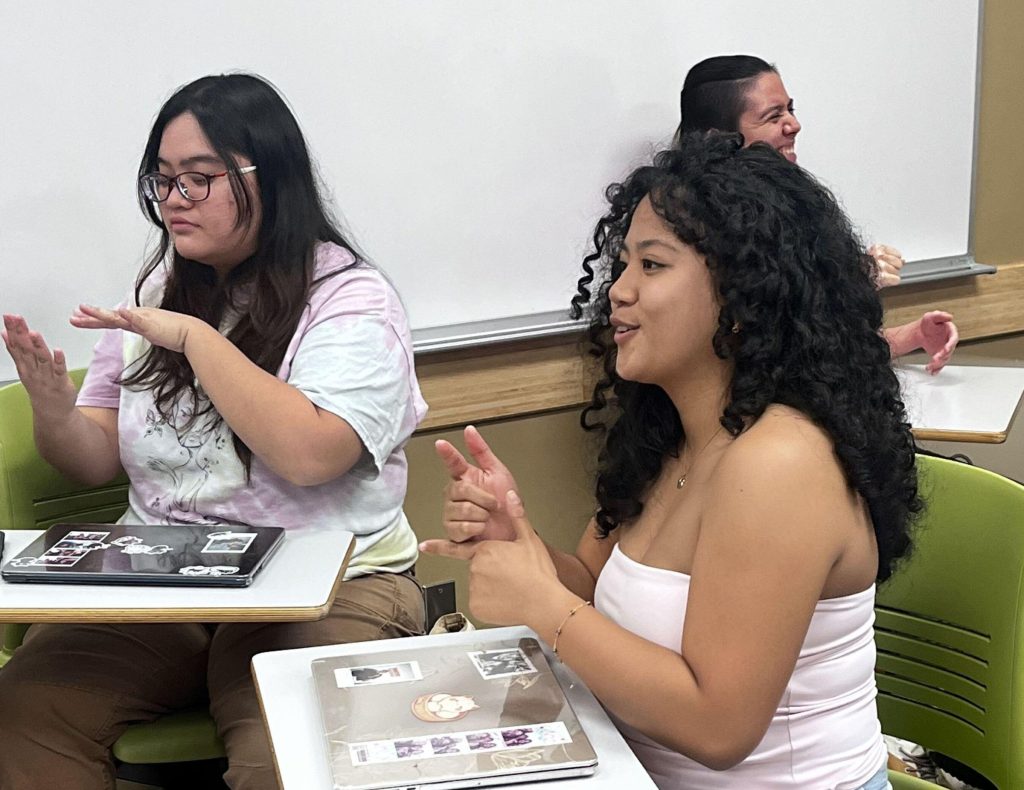



A new group of volunteers is helping more fans be part of the crowd during University of Hawaiʻi at Mānoa athletic events.
American Sign Language students — guided by experts from the deaf and Native Hawaiian communities — partnered with University of Hawaiʻi at Mānoa Athletics to sign the national anthem, cheerleader chants, university fight song and more during games.
It’s the first known partnership of its kind between American Sign Language students and the athletics department. Students volunteer their time to stand alongside cheerleaders and performers, translating the energy of sporting events into sign language.
The effort gives deaf and hard-of-hearing students and spectators a way to experience moments many fans take for granted in a state where demand for American Sign Language services far outpaces the number of interpreters.
Volunteer signer Pumehana Holmes, an English major who grew up with two deaf parents, said the goal is simple: making sure deaf fans feel included.
Holmes has signed since she was very young. Her mother Christine Holmes is an American Sign Language instructor at Kapiʻolani Community College.
“I hope that the deaf community is able to see themselves and see them being supported and that they’re not invisible in the crowd but are wanted in the crowd,” said Holmes in a university announcement about the new partnership.
The effort reflects a broader need throughout the state.
Hawaiʻi faces a critical shortage of American Sign Language interpreters. Hawaiʻi Department of Health reports there are about 2,800 American Sign Language users in Hawaiʻi and an estimated 500 visitors each day who rely on interpreting services.
However, there are currently only about 30 interpreters throughout all Hawaiian Islands. Only 23 are credentialed by the state, with a handful of others with national credentials.
University of Hawaiʻi at Mānoa already expanded American Sign Language coursework to help address that gap and is planning to expand interpreter training opportunities for students interested in the field.
Student volunteer Sabrina Gill said the experience also helps build awareness among hearing fans.
“Having student interpreter volunteers and interpreters are really important for building more access into our [University of Hawaiʻi] community, our [University of Hawaiʻi] games, but it’s also important for hearing people who might not know sign language just to have more visibility and awareness of sign language,” said Gill in the announcement.
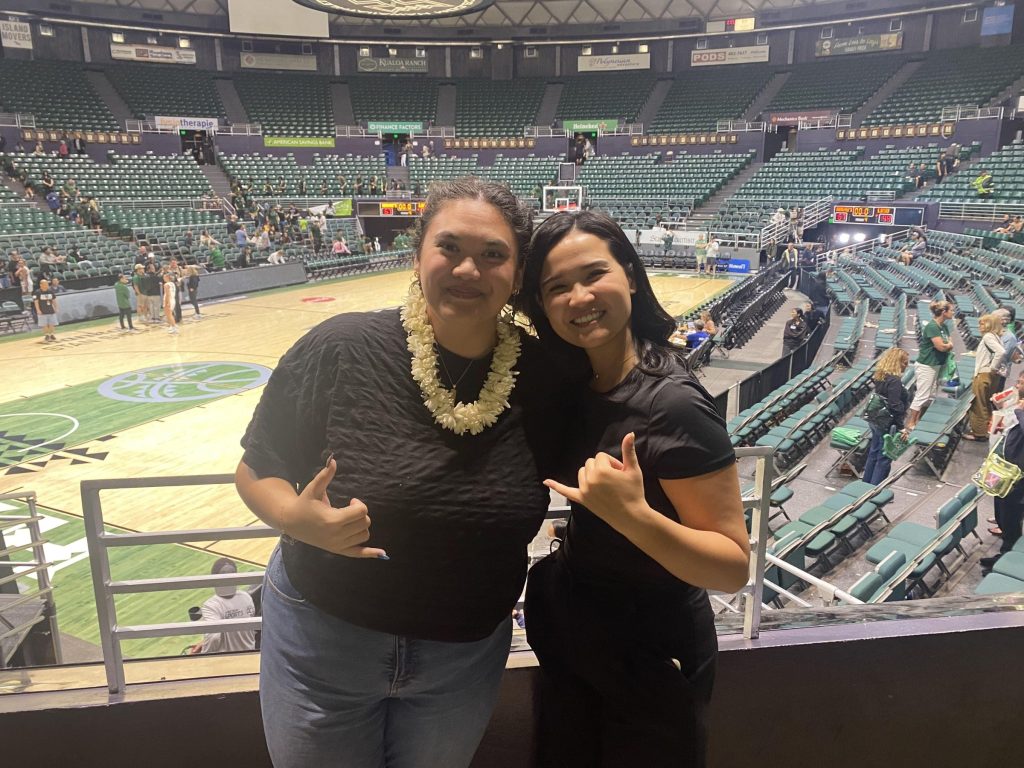
She is working toward her master’s degree in communication and first took American Sign Language as an elective. Gill quickly developed a deep interest, continuing her studies through the advanced 302 level.
The experience fueled her passion for making spaces more accessible for everyone.
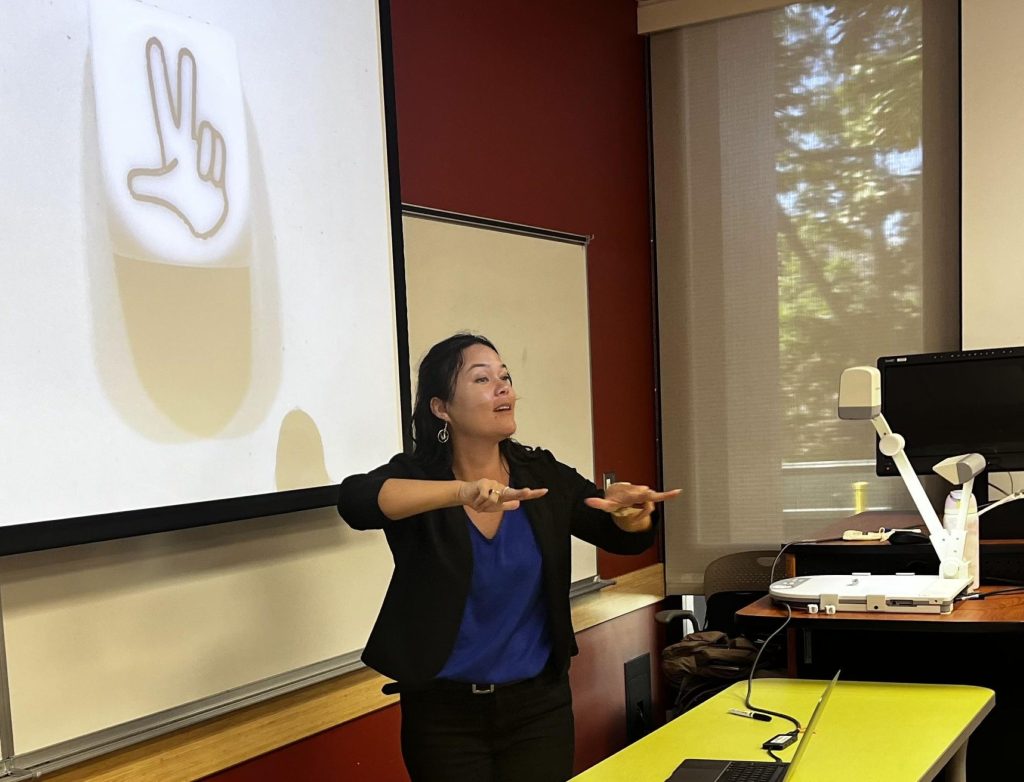
Several additional student volunteers are enrolled in American Sign Language instructor Gisella Tomita’s classes.
Tomita, who is one of three deaf instructors of American Sign Language at University of Hawaiʻi at Mānoa, said moments like this can make a big difference for spectators who rely on sign language.
“It gives me access. It’s amazing,” said Tomita, through an American Sign Language interpreter, in the announcement. “You know events, sporting events, there’s a person who is speaking but where’s my ability to get that information? Where’s the [American Sign Language]? I don’t really know what’s going on or being said. And these students are motivated. They wanna be up there and it just touches me.”
Interest in American Sign Language at University of Hawaiʻi at Mānoa surged in recent years.
Enrollment has grown by 1,400% in 6 years, from 19 students in spring 2019 to 265 in fall 2025. Demand also continues to exceed capacity, with long waitlists for courses.
A 2024 survey also found that 94% of American Sign Language students are interested in pursuing a bachelor’s degree in American Sign Language-English interpreting.
University of Hawaiʻi at Mānoa launches a new path for students this fall — a standalone bachelor of arts degree program in linguistics with a concentration in American Sign Language.