



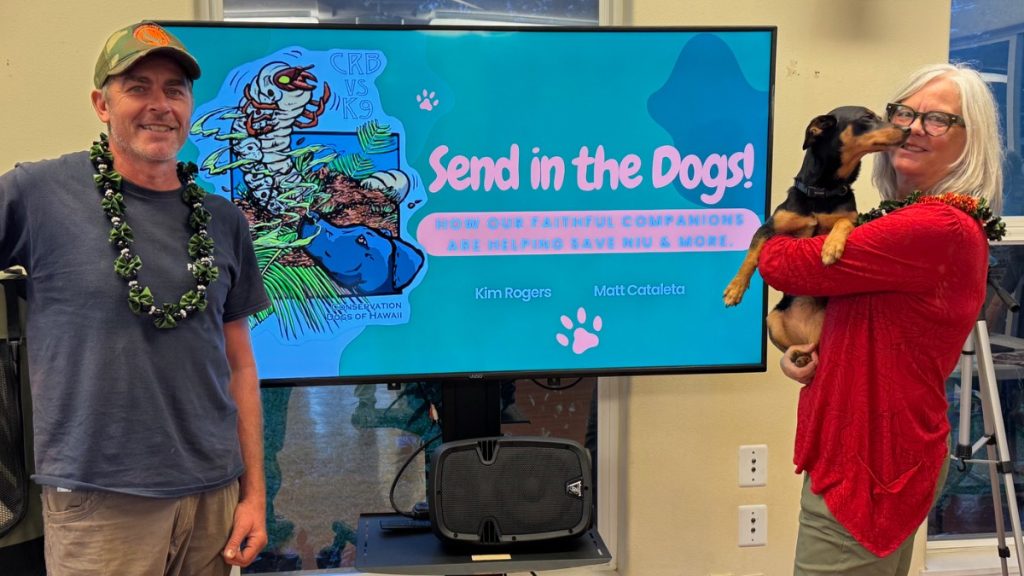
Tails wagged and noses took center stage on Tuesday evening at the Princeville Community Center as conservationists explained how dogs are becoming an unlikely but powerful ally in the fight against the coconut rhinoceros beetle.
Matt Cataleta and Kim S. Rogers of Conservation Dogs of Hawaiʻi presented “Send in the Dogs: How Our Faithful Companions Are Helping Save Niu and More” during the latest installment of the Princeville Moʻolelo free lecture series.
The program focused on how specially trained canines are helping detect breeding sites of the invasive coconut rhinoceros beetle, or CRB, a pest that continues to threaten Hawaiʻi’s iconic coconut palms.
“Response starts with awareness,” said Thomas Daubert, executive director with Friends of Kauaʻi Wildlife Refuges.
“This is one more example of how dogs and their handlers are helping to tackle conservation challenges faced by our Island community.”
Rogers introduced dogs Sunny, Minnow, Raffi and Brego, along with their five human handlers, who were officially certified in November.
Kauaʻi has joined other islands in responding to the beetle’s spread, but the use of dogs marks a distinctive approach. According to the presenters, dogs have participated in various other environmental tasks, including detecting the Chromolaena odorata plant, also known as devil’s weed, a highly invasive plant on the Hawai’i State Noxious Weed List.
In 2017, Conservation Dogs of Hawaiʻi founder Kyoko Johnson participated in a study to determine the efficacy of detection dogs for avian botulism surveillance. Avian botulism is a type of food poisoning that can kill native water birds.
The successful study led to a collaboration in 2020 between Conservation Dogs of Hawaiʻi and the Hanalei National Wildlife Refuge to help establish their in-house K9 program.
From 2020- 2021, the Conservation Dogs of Hawaiʻi team collaborated with the University of Hawaiʻi and conducted a study to determine the feasibility of dogs detecting fruit fly infections in zucchinis.
The dogʻs accuracy was over 90 percent. In 2021, the dogs also assisted biologists on the Big Island in locating seabirds in burrows.
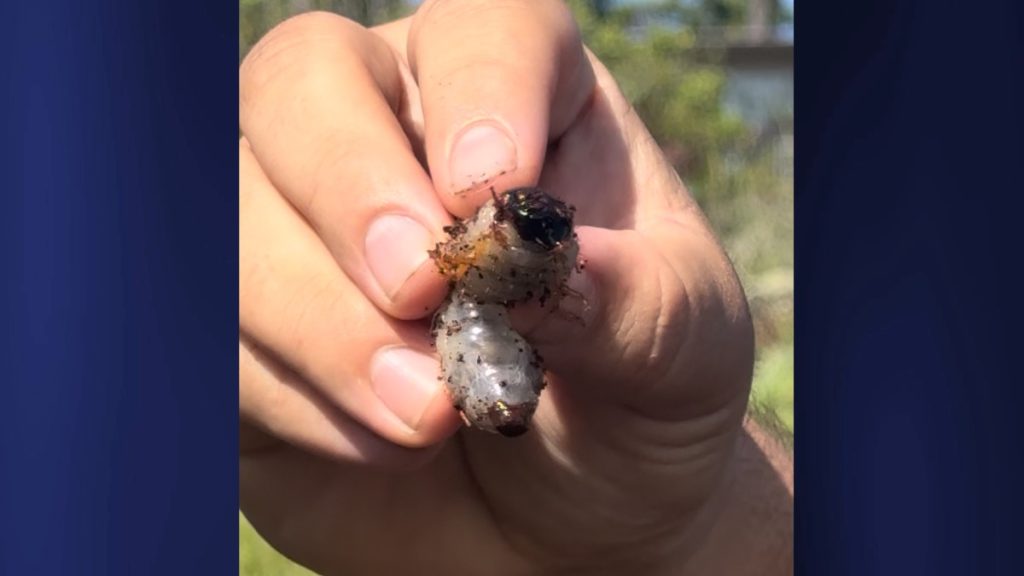
The dogs are uniquely suited to the task because of their powerful sense of smell, which allows them to detect the odor of beetle larvae hidden deep within mulch piles, green waste and decaying vegetation. These are areas that can be difficult and time-consuming for humans to search thoroughly.
In May 2023, the first detection of coconut rhinoceros beetle was made. An average female lays more than 90 eggs in her lifetime.
Over the three years, the beetle larvae has been observed feeding on decomposing organic matter, while adult beetles bore into the crowns of coconut palms (niu), damaging fronds and killing the trees statewide. The pest poses a risk not only to landscaping and agriculture but also to cultural resources and coastal scenery across the island.
During the lecture, Cataleta and Rogers described how volunteer K9 teams undergo rigorous training and certification before being deployed in the field.
“It all comes down to the nose,” Rogers said. “They are like super Olympians when it comes to smelling. Approximately 30 percent of the dog’s brain is dedicated to smelling.”
The dogs are trained using scent-detection techniques similar to those used in narcotics or search-and-rescue work, but instead focus on the specific odor associated with the beetle’s breeding material.
The newly certified volunteer teams are now accepting survey requests from residents, businesses and property managers concerned about suspected beetle breeding activity on their properties. Early detection is key because removing the breeding sites can help slow the beetle’s spread, the presenters said.
Representatives of Conservation Dogs of Hawaiʻi emphasized proper green waste management, regular inspection of mulch and compost piles, and prompt reporting of suspected beetle activity.
“Everybody’s situation is different, whether you’re a farmer or a homeowner,” Rogers said. “There is no single answer, so we recommend you take a multitude of approaches.”
The Princeville Moʻolelo lecture series is free and open to the public, offering educational programs on topics ranging from conservation to local history.
“We invite members of the public to view this fun and informative video, presented as part of the Friends of Kauai Wildlife Refuges Princeville Moʻolelo free lecture series,” Daubert said. “We deeply appreciate the hard work and passion of Kim, Matt, and the entire Conservation Dogs of Hawaiʻi K9 CRB team.”
Residents wanting to learn more about the coconut rhinoceros beetle or to request a CRB survey can click here. Those unable to attend Tuesdayʻs event can view it below.