



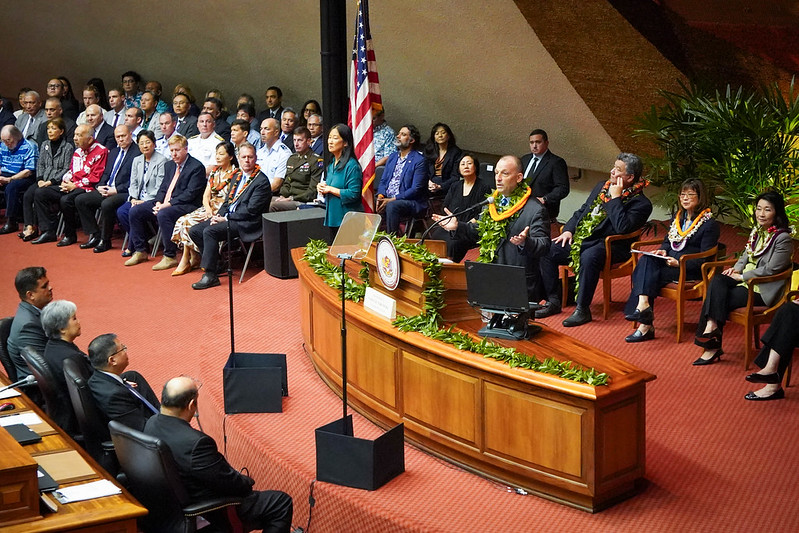
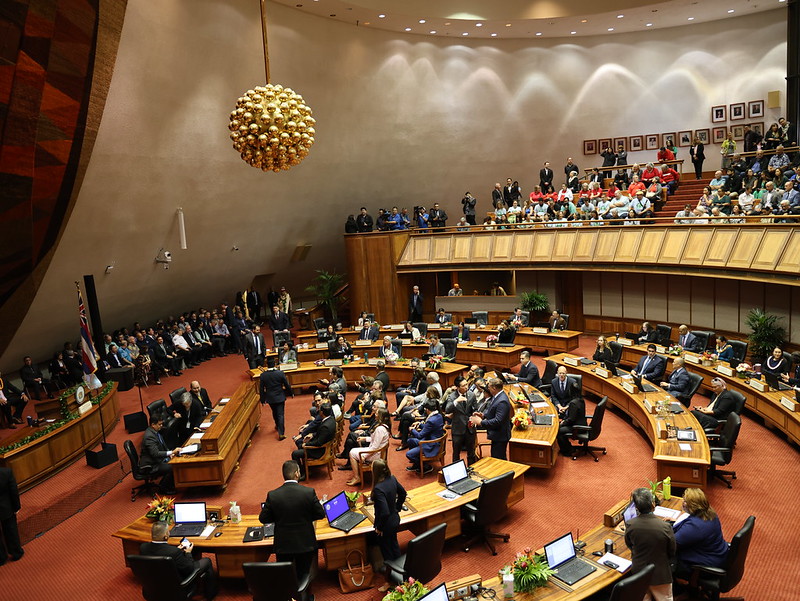
Following a Hawaiian oli (chant) during Monday’s State of the State address in the House Chamber in Honolulu, Hawai‘i Gov. Josh Green shared his administration’s past successes and his ongoing vision to lower the cost of living, address affordable housing and homelessness, grow the economy and protect the environment.
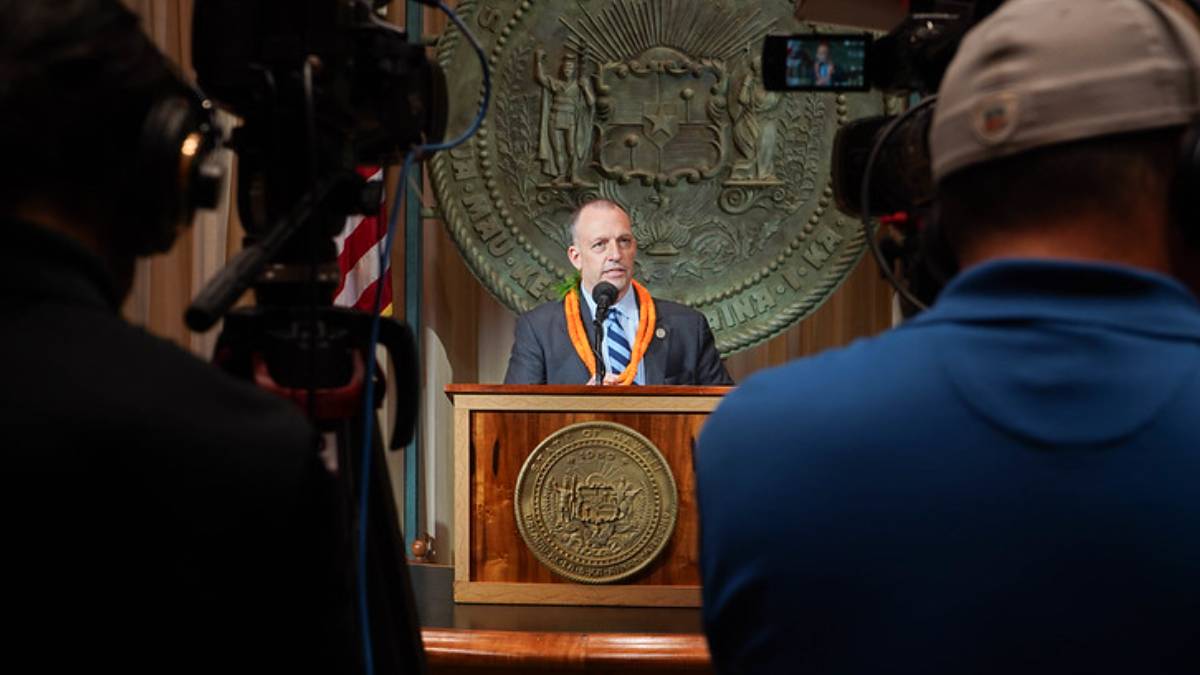
“I want to thank the people of Hawai‘i for allowing us to work for you, asking us to fight for you, and trusting us to serve you,” said Green, who is in the final year of his four-year term.
Green told the audience that when he entered office on Dec. 5, 2022, there were too many families having to make heartbreaking decisions: Pay rent or buy groceries? Struggle financially living in the islands they love or move to the mainland where cost of living is cheaper?
Green said the government reduced spending in 2023 by $1 billion and by another $500 million in 2024 without cutting needed services while also growing the state’s rainy day fund to $1.5 billion.
“That’s what responsible government looks like — lowering taxes for working families without cutting services, and spending carefully,” Green said.
Green said the administration also took steps to protect SNAP benefits during the federal government shutdown, providing a $250 one-time temporary benefit per recipient within 10 days, to ensure local families were not affected by food insecurity over the holidays.
“And we launched Sun Bucks to provide summer food benefits to eligible children statewide,” he said.
In 2025, the federal government’s severe cuts and other actions took more than $3 billion out of the state’s economy, leaving the state with an unforeseen budget shortfall, Green said.
“So to meet all of our responsibilities and our commitment on affordability, I am proposing that there be no changes to our tax cuts in 2026 – these and all previous tax cuts will be completely preserved — but that we pause the tax cuts planned for 2027 through 2029,” he said.
He said this proposal will bring back $1.8 billion for critical services, of which $600 million must be used for food security and child care needs.
“This is the fairest, most responsible, and most compassionate approach to dealing with the challenges the federal government has created,” he said.
Green said he will expand SNAP matching programs to make local produce more accessible.
The governor said in December 2022 that Hawai‘i was facing the highest housing costs in the nation, with an estimated shortage of 50,000 units statewide.
“Too many young people couldn’t find rentals, too many working families couldn’t buy homes, and Native Hawaiians were still waiting — sometimes for generations — to receive land that was promised,” Green said.
After signing emergency housing proclamations to cut through red tape to move projects faster, the state immediately approved more than 10,000 new units of low-income housing. And over the past 18 months, those exemptions helped approve or accelerate nearly 7,000 affordable units statewide.
“We are building new housing in Hawai‘i at a scale not seen in decades,” Green said.
Since taking office, the administration entitled more than 5,500 affordable units and more than 6,500 affordable units have become available.
“Over the next decade, more than 20,000 additional homes are planned on state lands — and we are tracking over 62,000 housing units across more than 250 projects statewide, including 46,000 affordable homes,” Green said.
He also noted the historical expansion of 2,500 homestead leases for native Hawaiians being granted by the Department of Hawaiian Homelands. In 2026, the number of leases awarded will grow to more than 7,000, he said.
To address homelessness, the state will continue to invest $50 million per year to expand kauhale villages (tiny home complexes with shared common areas) statewide.
The state will provide $10.8 million to strengthen Family Assessment Centers and Housing First programs, rapid re-housing, outreach and civil legal services
“We will keep integrating mental health care and addiction treatment into our homelessness strategy — because housing stability and behavioral health have to go together.”
The goal, Green said, is to cut chronic homelessness in half by the end of this year, and in half again in the next four years — “by treating people with basic human dignity.”
To address jobs and economic growth, Green announced a plan to expand stackable film tax credits for productions that hire local crew and talent — with a proposal to remove the credit cap for large productions spending to $60 million or more in Hawai‘i, including streaming service productions for the first time.
Also, the governor supports construction apprenticeships tied directly to affordable housing projects — “building homes and building careers at the same time.” Green added that his administration will create public-private workforce pathways in healthcare, energy and education sectors where jobs are growing and where communities need workers.
“That’s the future we believe in and are working to build — a Hawai‘i where local kids don’t have to leave our islands to succeed, because we’ve invested in creating real opportunities here at home,” Green said.
Green also celebrated the support he received from lawmakers with the passage of the nation’s first “Green Fee,” which increased the Transient Accommodation Tax by 0.75% starting this year, and is expected to generate more than $100 million annually for investments in climate action, conservation, and resilience.
“In Hawai‘i, the environment is not a special interest,” Green said. “It’s our home. It’s our water. It’s our food. It’s our culture — and protecting it is our kuleana.”
Green, a doctor from Hawai‘i Island, also made health care and the lack of service providers on the neighbor islands a priority when he took office.
With an estimated unmet need of 757 physicians statewide, Green said his administration launched the Healthcare Education Loan Repayment Program, a state-funded initiative providing educational loan repayment for more than 900 providers licensed or certified to practice statewide in Hawai‘i.
He said he is including $16.5 million in his proposed 2026 budget to cover the cost of the enhanced Affordable Care Act tax credits for everyone in Hawaiʻi currently using them to buy insurance “to help keep coverage affordable for our families, seniors and children.”
Congress took no action, which allowed these prepandemic federal tax credits to expire on Dec. 31, resulting in significantly higher health insurance premiums for millions this year.
“No family in Hawai‘i should be forced to make those kinds of choices — but if we allow
the ACA subsidies to expire in Hawai‘i, stories like this will become common,” he said.
He said he plans to continue to improve healthcare access and affordability by expanding the loan repayment initiative to hundreds more providers across the state.
“And I am proud to announce that — just a few weeks ago — we successfully fought for
and won nearly $190 million in federal funds for fiscal year 2027, as part of the Rural
Health Transformation Program,” he said.
Green said that over the next five years, this program will bring nearly $1 billion to modernize rural access to care, grow the economy, and create thousands of good jobs across the state.
A full copy of Green’s speech can be found here.