



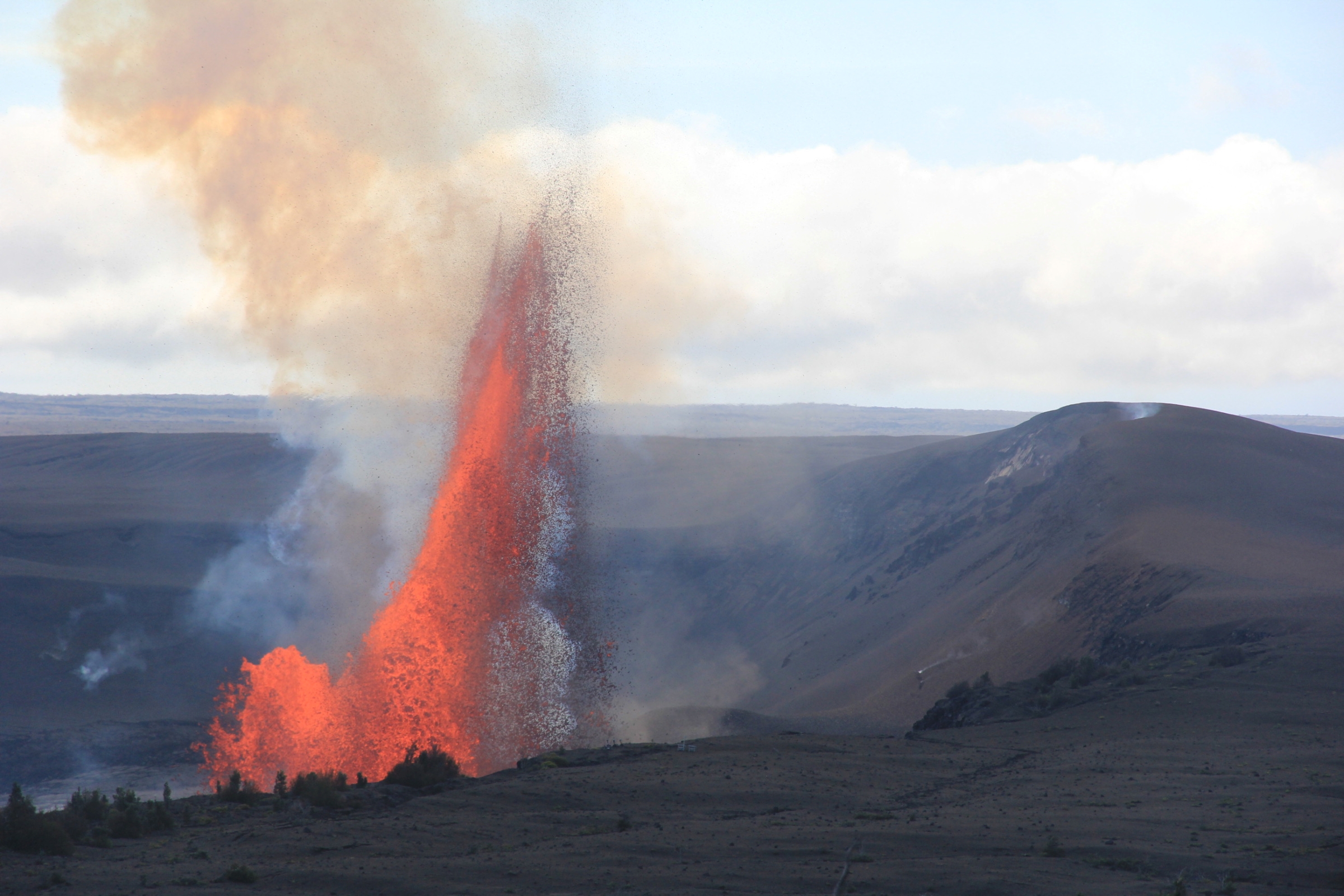
Kīlauea seems to be in a shaking kind of mood after Episode 40 of its ongoing episodic lava-fountaining eruption at the summit ended Monday (Jan. 12), with a third swarm of earthquakes rattling the summit region again Wednesday (Jan. 14) night.
It is yet to be determined if the subsequent temblor swarms following Kīlauea’s most recent eruptive episode will impact lava fountaining activity.
Most of the earthquakes since Monday are volcano-tectonic temblors that accompany crack openings caused by magmatic pressure.
“Volcanic systems remain a complex balance of magmatic pressure and strength of surrounding rocks,” said Hawaiian Volcano Observatory in an information statement issued after the third quake swarm Wednesday. “If the rocks weaken, one possible outcome is injection of magma into a fracture, creating a dike. If the magma breaches the surface, a new vent might be created, shifting the focus of the eruption.”
The observatory added that historically, episodic lava-fountaining eruptions can also cease when magma supply is diverted in this manner.
All activity remains beneath the Big Island volcano’s caldera. There is no observable evidence that magma is migrating away from that area.
Kīlauea’s East and Southwest Rift Zones remain quiet.
The most recent swarm of earthquakes began just after 7:30 p.m. Wednesday beneath Halemaʻumaʻu Crater within the summit caldera and focus of the ongoing episodic eruption that started Dec. 23, 2024.
Elevated seismic activity gradually died down in frequency and intensity throughout the course of 40 minutes. The quakes were spread broadly beneath the east side of Halemaʻumaʻu and south caldera.
All of the detected earthquakes were less than magnitude-2, with most being magnitude-1 or smaller.
The first quake swarm beneath Halemaʻumaʻu began at 12:40 a.m. Tuesday (Jan. 13) and lasted 30 minutes. It was followed by the second swarm — which lasted less than 30 minutes — just after 9 a.m. Wednesday.
The first and second swarms each had magnitude ranges similar to the third. Most of the earthquakes seem to be occurring around the shallow Halemaʻumaʻu magma chamber, about a mile to 2.5 miles beneath the surface.
Elevated seismic activity of these intensities has not been observed at the summit since the start of the eruption.
A small swarm did precede a new fissure opening in the wall of Halemaʻumaʻu Crater, just to the south of the north and south vents, on Aug. 6, 2025, at the start of Episode 30.
Hawaiian Volcano Observatory continues to closely track changes in seismic activity and monitor Hawaiian volcanoes for any changes.
You can check out the U.S. Geological Survey-Hawaiian Volcano Observatory Interactive Earthquake Map of Hawaiʻi for additional quake information.
Short updates also could be posted — as necessary — on the Hawaiian Volcano Observatory website.