



Editor’s Note: This story has been updated Jan. 8 with statements and information from Brue Baukol Capital Partners, owners of the Kauaʻi Coffee Farm property.
Kauaʻi Coffee Co., one of the island’s largest agricultural employers and a major visitor attraction, addressed the Kauaʻi County Council as its land lease approaches expiration in March.
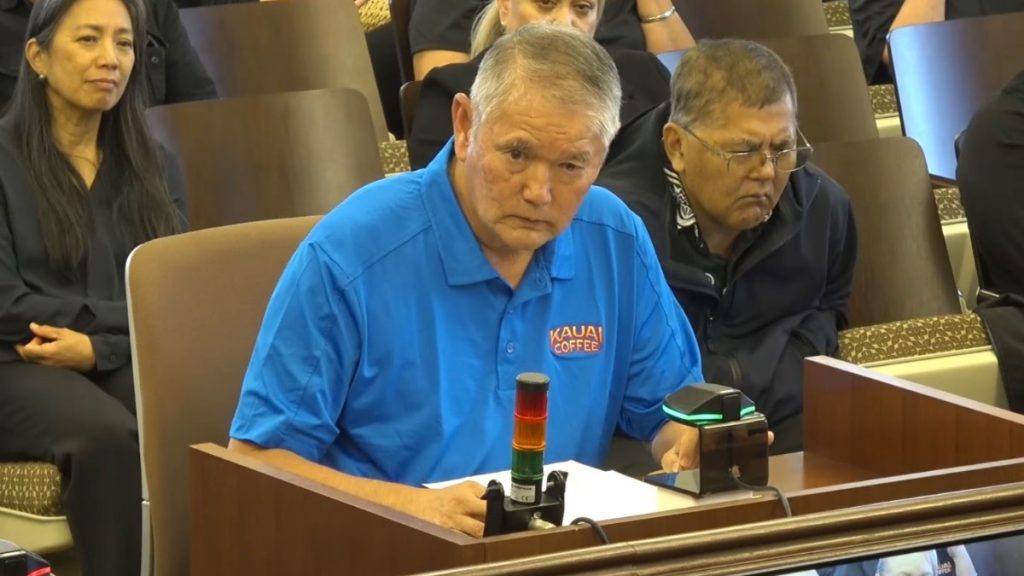
After weeks of public speculation on social media and elsewhere about the company’s future, Kauaʻi Coffee senior advisor Wayne Katayama addressed the Kauaʻi County Council, at the request of Council Chair Mel Rapozo, during its Wednesday meeting at the Historic County Building in Līhuʻe.
“I cannot overestimate the seriousness of why I am here before you today,” said Katayama, who was joined by 20 of his employees. “Brue Baukol Capital Partners recently has publicly communicated that they are not willing to renew the lease, and that is the reason why I am here before you.”

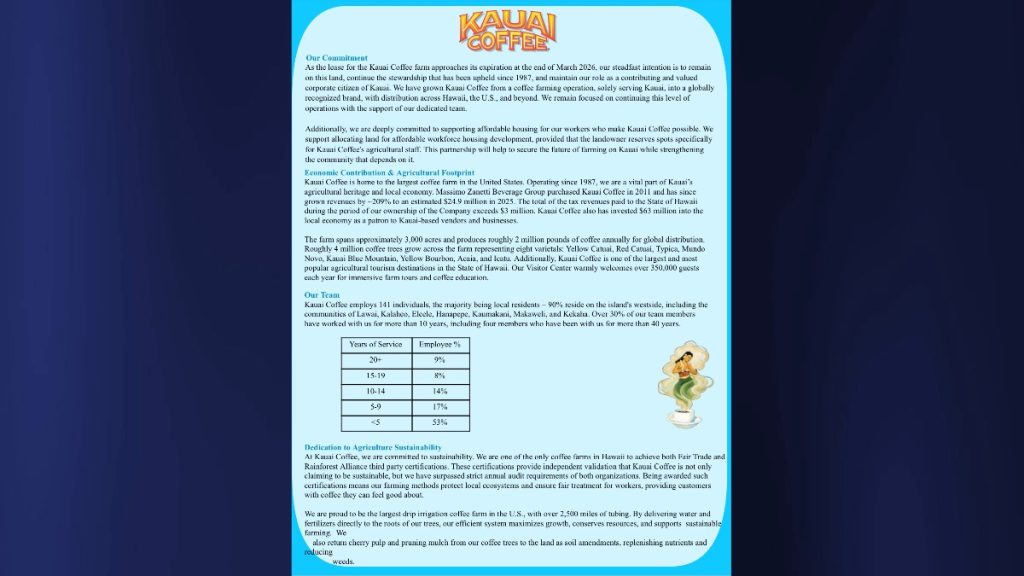
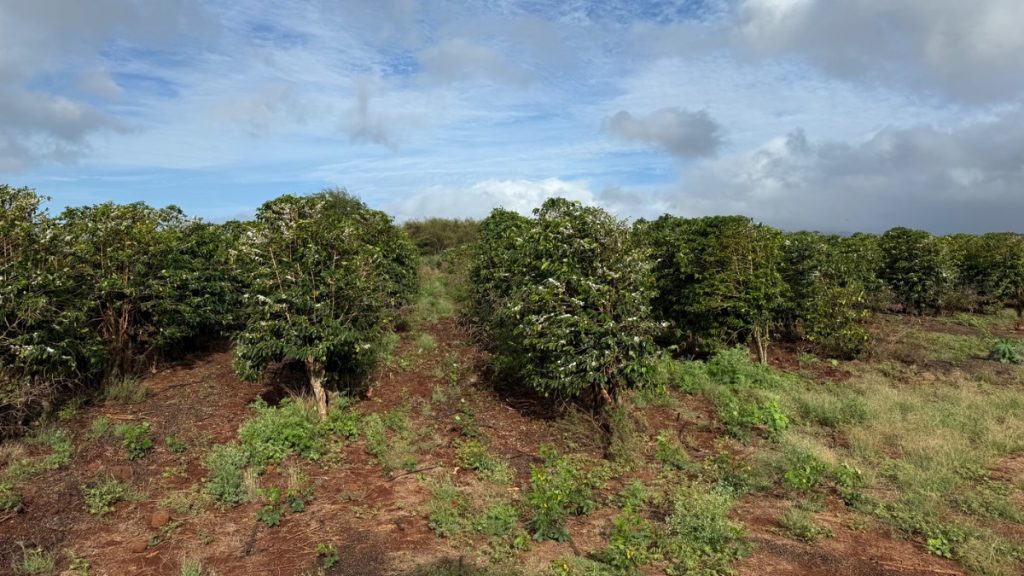
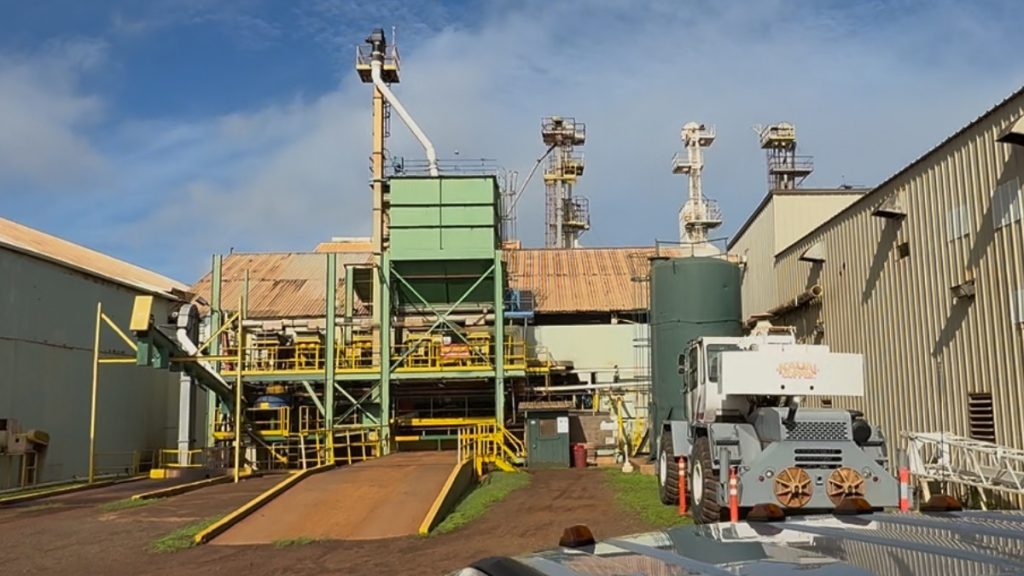
Kauaʻi Coffee farms about 3,000 acres on the island’s West Side, managing roughly 4 million coffee trees and producing between 1 and 2 million pounds of green coffee annually. The company employs 141 workers across farming, processing, roasting, sales, and administrative operations, making it the largest coffee grower in the United States, according to the farm’s website.
But Kauaʻi Coffee has never owned the land it farms. It has leased it since the late 1980s, when former landowner Alexander & Baldwin transitioned the acreage from sugar to coffee. In 2011, the company’s operations were acquired by Massino Zanetti Beverage USA, a global coffee company that also owns Maxwell House and Hills Bros. and helped expand Kauaʻi Coffee into an internationally distributed brand.
In June 2022, A&B sold more than 18,000 acres on Kauaʻi to Colorado-based investment firm Brue Baukol Capital Partners for about $74 million, which includes the South Shore agricultural land where Kauai Coffee has its farm.
Last month, Brian Kubicki, interim general manager of Kaua’i Coffee, stated in a press release that the lease expires in March.
In August 2024, global commercial real estate firm CBRE listed “Kaua’i Coffee Lands” for sale. It said 4,713 acres was available, including nearly five miles of ocean-front and 695 acres designated by the West Kaua‘i Community Plan for urban development. It also said the property had “access to retain the Kauaʻi Coffee brand intellectual property rights as they run with the land.”
In a statement provided to Kauaʻi Now on Thursday, James Priestley, vice president of Brue Baukol Capital Partners said the company began discussions to renew Kauaʻi Coffee’s lease nearly two years ago and proposed terms consistent with the existing agreement.
“We have been engaging constructively and in good faith with Massimo Zanetti Beverage, and we remain focused on outcomes that serve the best interests of the community,” Priestley said.
“Looking ahead, we see opportunities to thoughtfully strengthen Kauaʻi Coffee’s operations, products and the experience for both employees and visitors. If a change in management is necessary, we foresee retaining existing team members, as we did with other company transitions on Kaua‘i.”
Brue Baukol Capital Partners has been invested in Kaua‘i since 2021, successfully acquiring and operating other Kaua‘i businesses, including McBryde Resources, Kukui‘ula Development, Kukui‘ula Realty and The Club at Kukui‘ula, Priestley said.
But Katamaya said that without a lease extension: “All of our 141 employees will be receiving notices that their jobs will be terminated in the next few weeks; the precise date they will be terminated will depend on how we divest ourselves of the operation, but nonetheless, they will be given a notice shortly.”
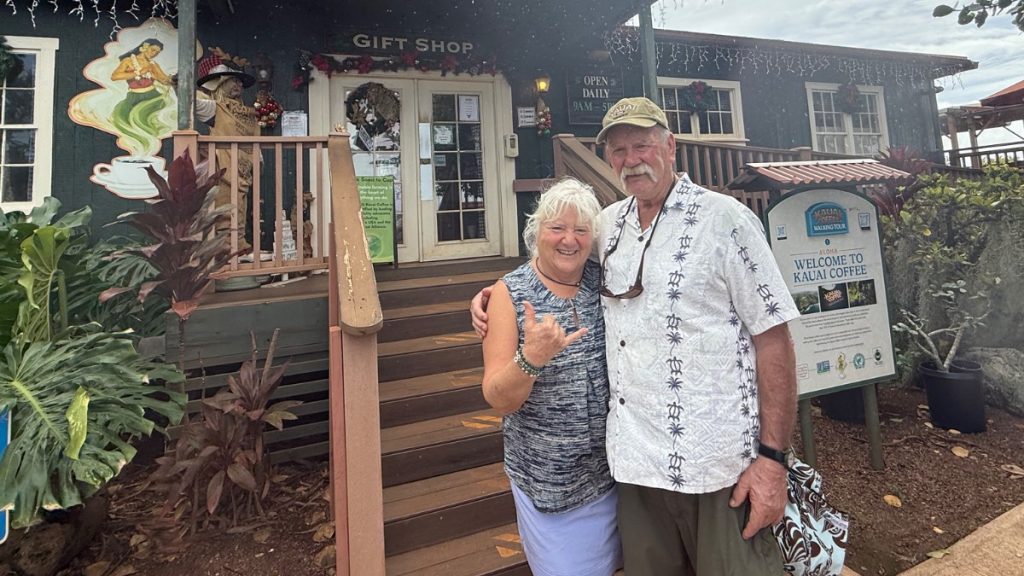
“We’re sad,” said Rose and Ron Eisworth, who were visiting Kaua’i Coffee Company on Dec. 23 from British Columbia.
They are among the approximately 350,000 people who visit the Kauaʻi Coffee farm annually. Visitors enjoy a farm tour that guides them through the property, where they can explore the land, learn about the coffee-making process, and meet the resident animals.
The tour concludes with a visit to the farm’s popular gift shop and museum, along with a fresh cup of coffee.
“Our hearts go out to them,” Rose Eisworth said. “We heard the story online and decided to come visit again. We come every winter because it’s such a beautiful place, and we hope the new landlords renew the lease.”
Ron Eisworth added: “We hope they don’t give up.”
Katayama said at the council meeting: “This doesn’t mean that we at Kaua’i Coffee have given up. Just the opposite, we’ll continue to seek some kind of resolution.”
But he added: “There is a cliff, and it will happen on March 28, 2026.”
Katayama said the fully integrated nature of the operation — from farming to roasting to global sales — took more than two decades to build and would be extremely difficult to replicate under a compressed timeline.
“There has been visits by their teams, but in terms of the process, it seems that it’s very superficial, given the length of time there is available. Normally, these things start a lot earlier. Because there are a lot of details to comprehend, and there’s the drafting of the documents that go along with this.”
He said with less than 100 days before the lease ends, none of the details have been addressed.
“This isn’t something you can turn over quickly; it requires long-term agricultural vision, major infrastructure, financial stability, and intellectual capital.”
He added: “What we really should be doing is looking at what assets we need, what people we need, what they’re going do about people’s seniority, what kind of compensation package you’re going to provide.”
He said some employees also are part of the International Longshore and Warehouse Union Local 142 union.
If no agreement is reached, Katayama hopes his employees will have a severance package.
“I hope they will be available for things like unemployment or displaced workers, you know, partner with programs that the federal government has available. And that’s the challenge for us, for management right now, … keeping them focused because it’s very stressful. But we need to find a win-win.”
Council members voiced concern not only about job losses, but also about the loss of institutional knowledge, water management systems and community ties. About 30% of Kauaʻi Coffee’s workforce has been with the company for more than 10 years, Katayama said, including some employees with decades of service.
“All of our employees are in their communities,” he said. “You know them. You’re related to them. You know their families. You’ve met them through their work.”

Councilmember Felicia Cowden questioned whether the landowner could realistically continue specialty coffee operations after Kauaʻi Coffee’s departure.
“Maintaining a premium specialty coffee business is a challenge,” Katayama said. Hopefully, by having this conversation, we can create a pathway that is a little longer than March.
Priestley said approximately 3,700 acres of the property are designated as “Important Agricultural Lands” and will continue to be used for agricultural purposes.
“We take seriously our responsibility to honor the agricultural legacy of this land and are committed to preserving its agricultural zoning and long-term use,” Priestley said.
Councilmember Addison Bulosan said at the meeting: “I am right there with you guys, and any leverage that I can do to help make sure we continue what you guys are doing, because you’re doing exactly what our community needs.”
Katayama said Kauaʻi Coffee is continuing to seek a resolution that would allow more time to negotiate or transition, including the possibility of relocating operations — though he acknowledged that moving would take years and significant investment.
“The ideal situation would be an off-ramp of two years or more,” he said. “That would allow us to craft something that doesn’t devastate our employees or the community, and it will help us better transition.
“There’s a section of our lease that includes termination conditions,” Katayama said, “And that is the reason why there needs to be a serious discussion on the asset purchase agreement; if not, we’re responsible for moving the equipment that we want to keep. Anything that is left behind would be considered abandoned.”
Rapozo said the testimony highlighted how deeply Kauaʻi Coffee is woven into the island’s identity: “It’s hard to imagine Kauaʻi Coffee going away. It’s part of our culture. It’s part of who we are.”
Councilmember Arryl Kaneshiro said: “I don’t know what the solution is.
“I would like to see Kaua’i Coffee stay there. I don’t know what the intention of the landlord is, so it’s really hard to say what direction this is going to go, but I do hope that they find an amicable solution and understand that it’s not so easy to get rid of Kauaʻi Coffee and think they’re going to run a coffee company that’s exactly the same. … It’s sad to hear.”
Rapozo added: “It says a lot when that many employers show up to support their employer; the union representatives are here to support their employees.
“I don’t know where this road is going to end up. I am hoping there is at least an extension on the lease. Worst-case scenario is that if, in fact, the lease does expire, I hope that the intention of the land owner is to maintain that very important agricultural operation on the island.”
Priestly said that is there intention: “Kauaʻi Coffee has long been an important part of the island’s community, and we deeply respect the role it plays in supporting local families, caring for the land, and contributing to Kaua‘i’s agricultural heritage. Our commitment is to see those values continue.”