



U.S. District Court for the District of Hawaiʻi earlier this week dismissed a majority of claims challenging the state’s Act 96, signed by Hawaiʻi Gov. Josh Green in May, and denied a plaintiff motion for a preliminary injunction to stop the act from taking effect at the beginning of next year.
“In short, the court declines at this stage to halt the implementation of the transient accommodation tax on cruise ships in Hawai‘i,” wrote U.S. District Judge Jill Otake in her ruling, which she issued Tuesday (Dec. 23).

As a result, the state’s new “Green fee” will go into effect Jan. 1, 2026, as planned. It also means the lawsuit — which was filed Aug. 27 — will likely still be undecided even as Act 96 is put into action.
Plaintiffs in the case are Cruise Lines International Association, Honolulu Ship Supply Co., Kaua‘i Kilohana Partners, Aloha ʻĀnuenue Tours and the federal government.
They argue that Act 96 violates the Tonnage Clause of the U.S. Constitution and conflicts with the Rivers and Harbors Appropriation Act of 1884.
The Tonnage Clause in Article I of the Constitution prevents states from levying charges based on a ship’s size and capacity or other port entry fees without approval from U.S. Congress.
Similarly, the Rivers and Harbors Appropriation Act of 1884 prohibits non-federal parties from imposing taxes on vessels “operating on any navigable waters” of the United States.
Plaintiffs contend that Act 96 violates both laws because it is essentially a tax on the privilege of entering the state’s ports and use of its navigable waters. Cruise Lines International Association also argues the act’s notification requirements infringe on the First Amendment right of cruise lines against compelled speech.
Defendants are Hawai‘i Department of Taxation Director Gary Suganuma and the state Taxation Department itself, Kaua‘i County Finance Director Chelsie Sakai and Kaua‘i County, City and County of Honolulu Department of Budget and Fiscal Services Director Andrew Kawano and City and County of Honolulu, Maui County Department of Finance Director Marcy Martin along with Maui County, Hawai‘i County Department of Finance Director Diane Nakagawa and Hawai‘i County.
They say plaintiffs either lack standing, their lawsuit is barred by the Tax Injunction Act and principles of comity — the deference and mutual respect courts of one state or jurisdiction show by respecting laws and judicial decisions of other jurisdictions, whether state, federal or international — or the claims brought by the plaintiffs likely fail on their merits.
“This case is about more than just the tourism business — instead, it raises multiple [and sometimes competing] federalism concerns,” Otake wrote in her ruling. “As may be obvious from this brief synopsis, the Tonnage Clause and [Rivers and Harbors Appropriation Act] assert federal supremacy over interstate maritime commerce.”
Yet in this situation, that interest creates tension with the state’s critical power to generate revenue from businesses operating within its borders. The judge added that there are questions of balance and respect between state and federal court systems implicated.
“In recognition of the importance of a state’s power to levy taxes, Congress — through the Tax Injunction Act — has restricted federal court jurisdiction over state tax matters and channels those tax challenges through the state’s courts,” Otake wrote.
Because of the “vital importance” of taxes to states and Congress clearly wanting to prevent federal court interference with state tax assessment and collection, the judge decided to tread carefully, leading to her denial of a preliminary injunction against Act 96.
Hawai‘i Attorney General Anne Lopez is “very pleased” with the court’s decision.
“The vast majority of the cruise industry’s claims were dismissed,” said Lopez in a state release after the court handed down its decision. “While the litigation is not over, we are confident in the legality of this law and will continue to vigorously defend it on behalf of the people of Hawaiʻi.”
Act 96 established the new Green fee, which requires, in-part, cruise operators to pay their fair share of transient accommodation tax to address threats of climate change in Hawaiʻi.
It is the nation’s first such “fee” to help mitigate the effects of a warming planet.
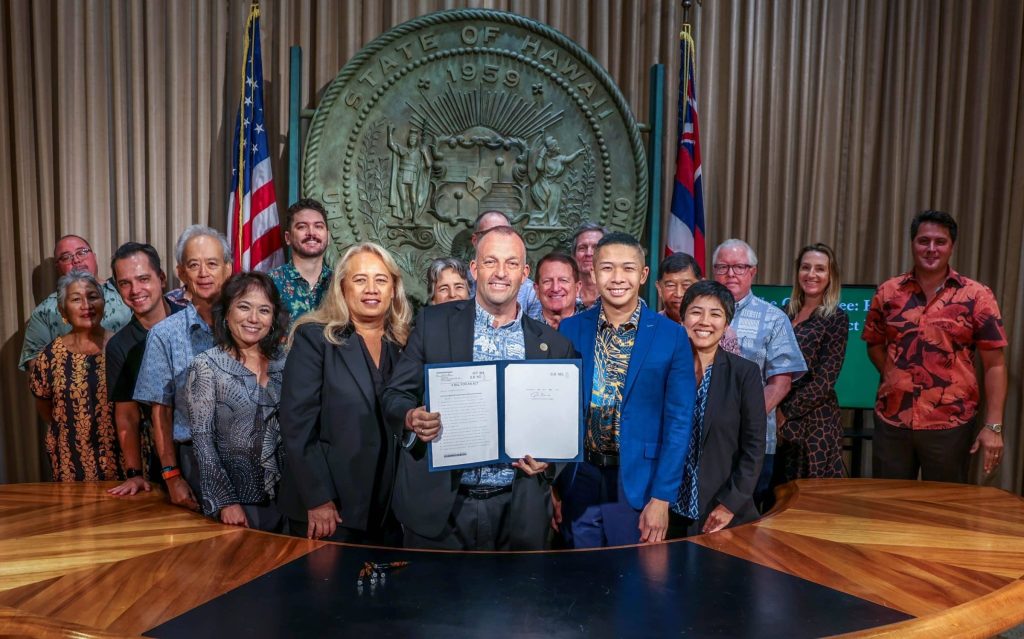
The law raises the state’s transient accommodations tax to 10%, an increase of 0.75% from its current rate.
It also imposes a new 11% tax on the gross fares paid by cruise ship passengers and authorizes each of the state’s four counties to collect an additional 3% surcharge on cruise ship fares, bringing the total tax to 14%.
Act 96 is aimed at promoting equity in Hawaiʻi’s tourism industry and ensuring all visitors to the islands contribute to their sustainability.
Officials estimate the Green fee will generate nearly $100 million annually, providing revenue to deal with eroding shorelines, wildfires and other climate problems. The funds also will be focused on diverse projects improving environmental stewardship, climate resilience and sustainable tourism.
“Cruise tourism generates nearly $1 billion in total economic impact for Hawai‘i and supports thousands of local jobs, and we remain focused on ensuring that success continues on a lawful, sustainable foundation,” said Cruise Lines International Association spokesperson Jim McCarthy in a statement to the Associated Press following Otake’s ruling.
The AP also reported plaintiffs will appeal and asked the judge for an injunction against the new law pending their appeal. They requested a ruling by early this weekend because of the limited time before Act 96 takes effect.
U.S. Department of Justice attorneys also are asking the court to maintain the status quo for 30 days or until an appeals court can rule on the case.
The federal government called the new Green fee a “scheme to extort American citizens and businesses solely to benefit Hawai‘i” while conflicting with federal law.
Hawai‘i will continue to defend the law.
“We must protect and preserve Hawaiʻi’s natural resources and safeguard the health of our residents. Visitors who benefit from our island’s resources have a shared responsibility to help preserve them,” said Gov. Green in the state release following Otake’s ruling. “The Green fee ensures that the resources needed to protect Hawaiʻi are available for future generations.”
You can read Otake’s opinion and rulings in full online.
Kauaʻi Now news reporter Nathan Christophel contributed to this story.