



Volcano Watch is a weekly article and activity update written by U.S. Geological Survey Hawaiian Volcano Observatory scientists and affiliates.
A unique eruption began Dec. 23, 2024, in Kīlauea’s Halemaʻumaʻu Crater, with a style of activity not seen for nearly 40 years.
The eruption, characterized by high lava-fountaining episodes, has continued for nearly a year.
Visitors to Hawaiʻi Volcanoes National Park visitors see remarkable views during the episodic eruptions within the summit, but the latest episode — No. 38 — reminds us how quickly hazards associated with this dynamic activity can change.
The current eruption stands out in style and our ability to observe, document and forecast it.
Sustained, repeated high fountaining — where molten lava is lofted hundreds of feet — is uncommon at Kīlauea.
Only three other similar eruptions have been documented:
- 1959 Kīlauea Iki eruption.
- Initial fountaining phase of the 1969-74 Maunaulu eruption.
- Early episodes of Puʻuʻōʻō from 1983-86.
“Volcano Watch” articles in January will review these past eruptions, which lacked today’s dense monitoring network, satellite observations and real-time cameras.
Modern technology allows Hawaiian Volcano Observatory to document this eruption style in unprecedented detail, as well as provide timely forecasts of eruption onsets.
It also allows the observatory to better understand how quickly hazards can change — sometimes within minutes.
The ongoing eruption began before dawn Dec. 23, 2024, and quickly evolved into a sequence of forecastable short-lived — but intense — fountaining episodes. Each fountaining episode lasted between 5 and 40 hours — with 1- to 3-week pauses in between.
The repeated high fountaining — sometimes as high as 1,500 feet — has dramatically reshaped the landscape around Halemaʻumaʻu.
Pre-existing cracks and fault scarps were blanketed by tephra, potentially leaving void spaces beneath the surface. A new 140-foot puʻu, or hill, was constructed on the northwest rim and the floor of the caldera raised by 223 feet.
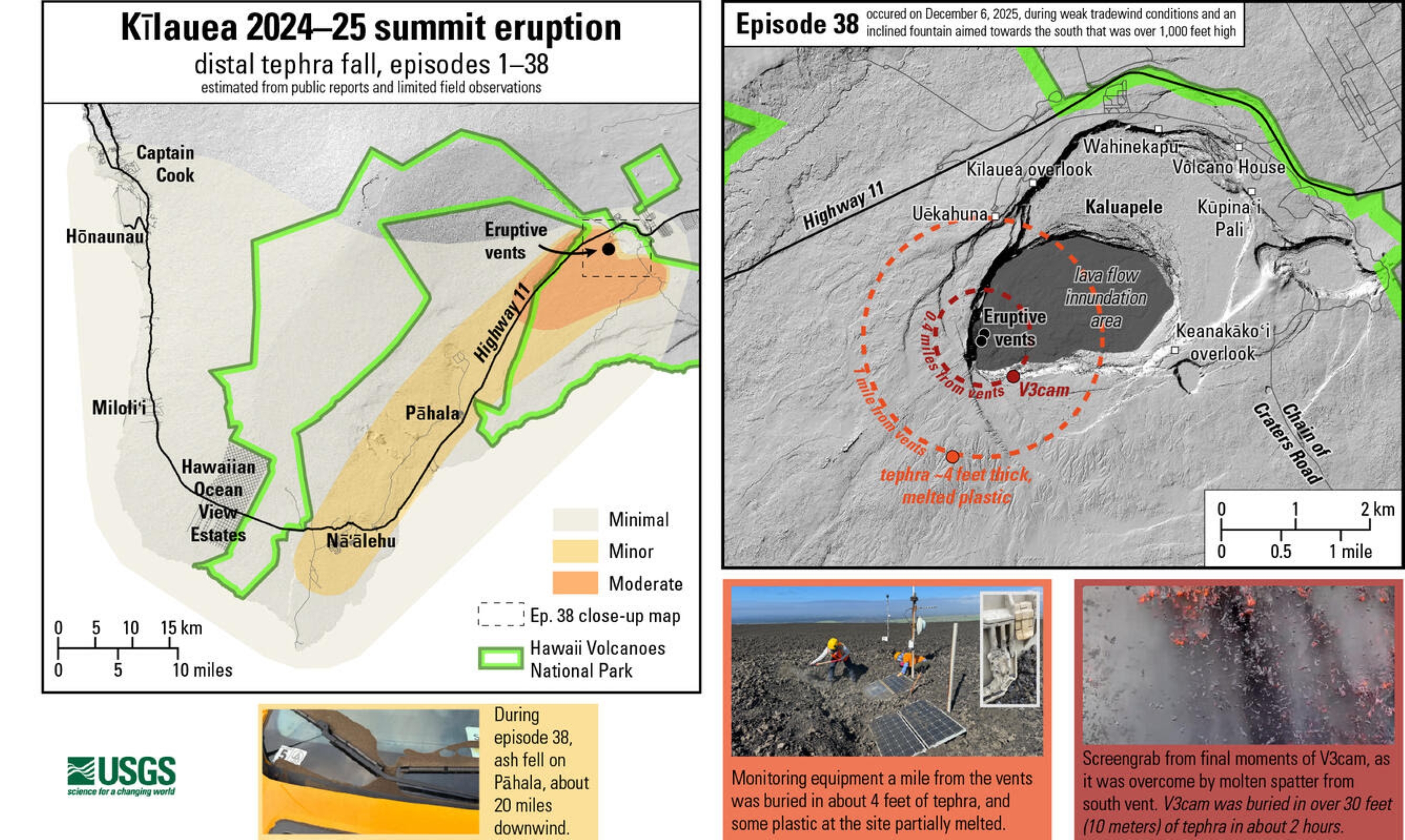
Episode 38 on Dec. 6 underscored that hazards can escalate abruptly.
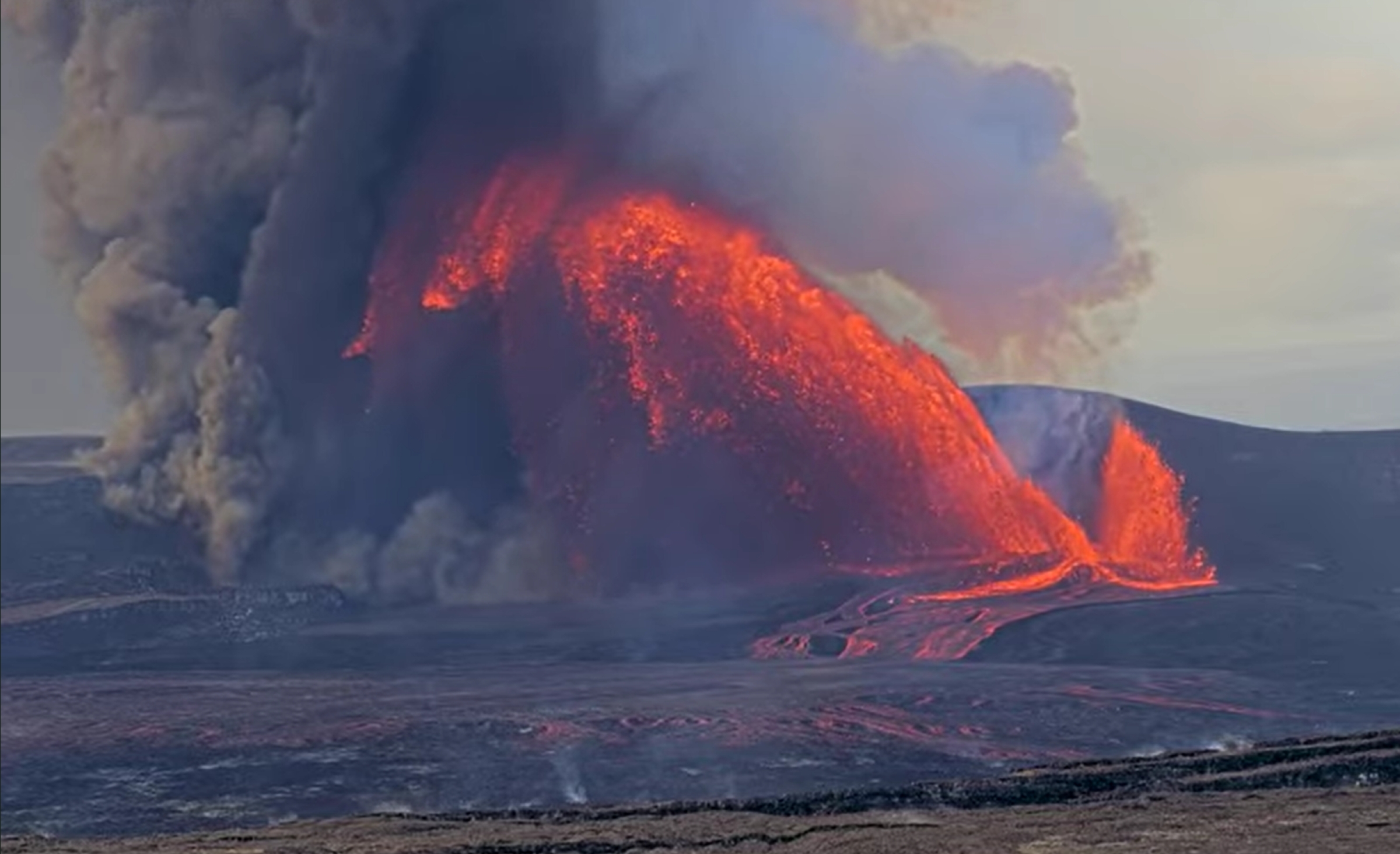
While the 12 hour-long episode began with fountaining from both vents, it quickly became dominated by the south vent. As the episode intensified, the south vent’s geometry changed, causing it to produce powerful inclined fountaining — more than 1,000 feet tall — directed south.
Hawaiian Volcano Observatory’s V3 livestream camera, located about 0.4 of a mile from the vent, captured video of hot spatter and molten lava as it was destroyed; the site is now buried beneath 32 ft of tephra.
Hot tephra also fell as far as the observatory’s Sand Hill station — about 1 mile from the vent — melting plastic components there. Sand Hill is now buried beneath about 4 feet of tephra.
These observations reinforce a key safety message: during high fountaining, life-threatening hazards exist within the area of Hawaiʻi Volcanoes National Park that is closed to the public.
The areas of highest hazard depend strongly on whether fountains remain mostly vertical or become inclined, as they did during Episode 38, and wind can further increase the range of hot tephra and fine volcanic glass.
While trade winds typically result in tephra deposition to the southwest, they are not always present, especially during the winter months. Tephra fell on Uēkahuna Bluff, only about a mile away from the vents, during Episode 4 when there were no trade winds.
Significant amounts of Pele’s hair also has fallen around Kīlauea caldera, as well as in communities neighboring Kīlauea summit and farther south. Volcanic air pollution — often simply called vog, or volcanic fog — can be even farther reaching, sometimes affecting neighboring islands.
Hawaiian Volcano Observatory staff continue to closely monitor Kīlauea behind the scenes.
Field engineers snowshoe across thick tephra deposits to dig out and revive buried volcano monitoring stations. Geologists measure tephra deposit thickness and collect samples that help us understand how the eruption is evolving.
Geodesists track ground deformation and use those data to forecast when the next episode might begin. Seismologists monitor earthquakes and subtle changes that could signal shifts in the magmatic system.
Information technology specialists maintain monitoring data streams, and administrative, facility and safety personnel ensure fieldwork can be carried out efficiently and safely.
Observatory staff — all working together — actively monitor this prolonged and dynamic eruption.
Eruptive activity again paused Dec. 15, with intermittent glow at the south vent. The summit has been reinflating since the end of Episode 38, and current forecasts indicate Episode 39 could begin between Dec. 22 and 27.
This eruption is a once-in-a-lifetime opportunity to view the power and beauty of Hawaiian lava fountain eruptions. Follow guidance posted by Hawaiʻi Volcanoes National Park if you head to the park to view a future episode.
And remember: Closed areas are closed for everyone’s safety.
* * * * * * * * *
VOLCANO ACTIVITY UPDATES
KĪLAUEA
Volcano Alert Level: Watch. Kīlauea has erupted episodically since Dec. 23, 2024, within the summit caldera located within Hawaiʻi Volcanoes National Park.
Episode 38 lava fountaining Dec. 6 lasted 12 hours. The summit is reinflating and glow has been visible intermittently overnight at both vents. No unusual activity has been noted along Kīlauea’s East Rift Zone or Southwest Rift Zone.
WHAT’S NEXT? Another lava fountaining episode is likely between Dec. 22 and 27.
* * * * * * * * *
MAUNA LOA
Volcano Alert Level: Normal. Mauna Loa is not erupting.
Hawaiian Volcano Observatory continues to closely monitor Kīlauea and Mauna Loa.
* * * * * * * * *
EARTHQUAKES
No earthquakes were reported felt in the Hawaiian Islands during the past week.
Visit the Hawaiian Volcano Observatory website for past “Volcano Watch” articles, Kīlauea and Mauna Loa updates, volcano photos, maps, recent earthquake information and more. Email questions to askHVO@usgs.gov.