



Researchers at the University of Hawaiʻi Institute for Astronomy — with a new artificial intelligence tool — are helping to reshape how scientists study the sun.
The University of Hawaiʻi-led team developed the artificial intelligence tool to map the sun’s magnetic field in three dimensions, and it’s working with unprecedented accuracy.

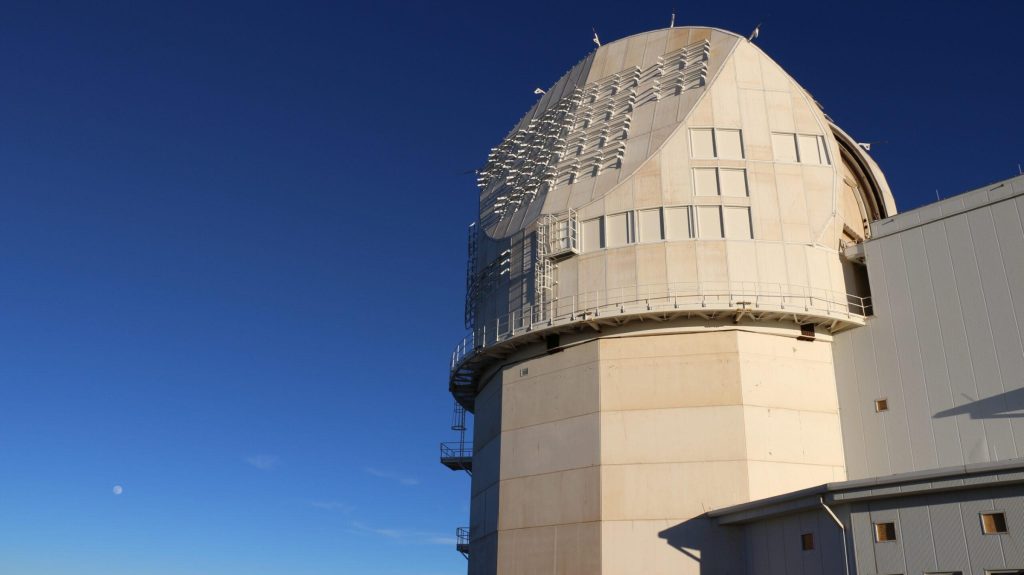
It also supports research tied to the National Science Foundation Daniel K. Inouye Solar Telescope atop Haleakalā on Maui, which was built and is managed by the National Science Foundation National Solar Observatory.
The team’s findings were published in the Astrophysical Journal.
“The sun is the strongest space weather source that can affect everyday life here on Earth, especially now that we rely so much on technology,” said Institute for Astronomy postdoctoral researcher Kai Yang, who led the work, in a recent university release about the new research.
Yang explained it is the sun’s magnetic field that drives explosive events such as solar flares and coronal mass ejections — which can disrupt satellites, power systems and communications on Earth..
“This new technique helps us understand what triggers these events and strengthens space weather forecasts, giving us earlier warnings to protect the systems we use every day,” he said.
The sun’s magnetic field is tough to measure, making it difficult to create accurate maps. Traditional instruments can show the way the field tilts, but not whether it points toward Earth or away, like looking at a rope from the side and not knowing which end is closer.
Another problem is height. When scientists look at the sun, they see several layers at the same time, so it’s difficult to tell the actual height of each magnetic structure.
 Hybrid image of a coronal mass ejection and the solar chromosphere. (Image Credit: SOHO—ESA and NASA; Courtesy: University of Hawaiʻi Institute for Astronomy)
- First sunspot image taken by Daniel K. Inouye Solar Telescope on Maui. (Image Credit: NSO/AURA/NSF; Courtesy University of Hawaiʻi Institute for Astronomy)

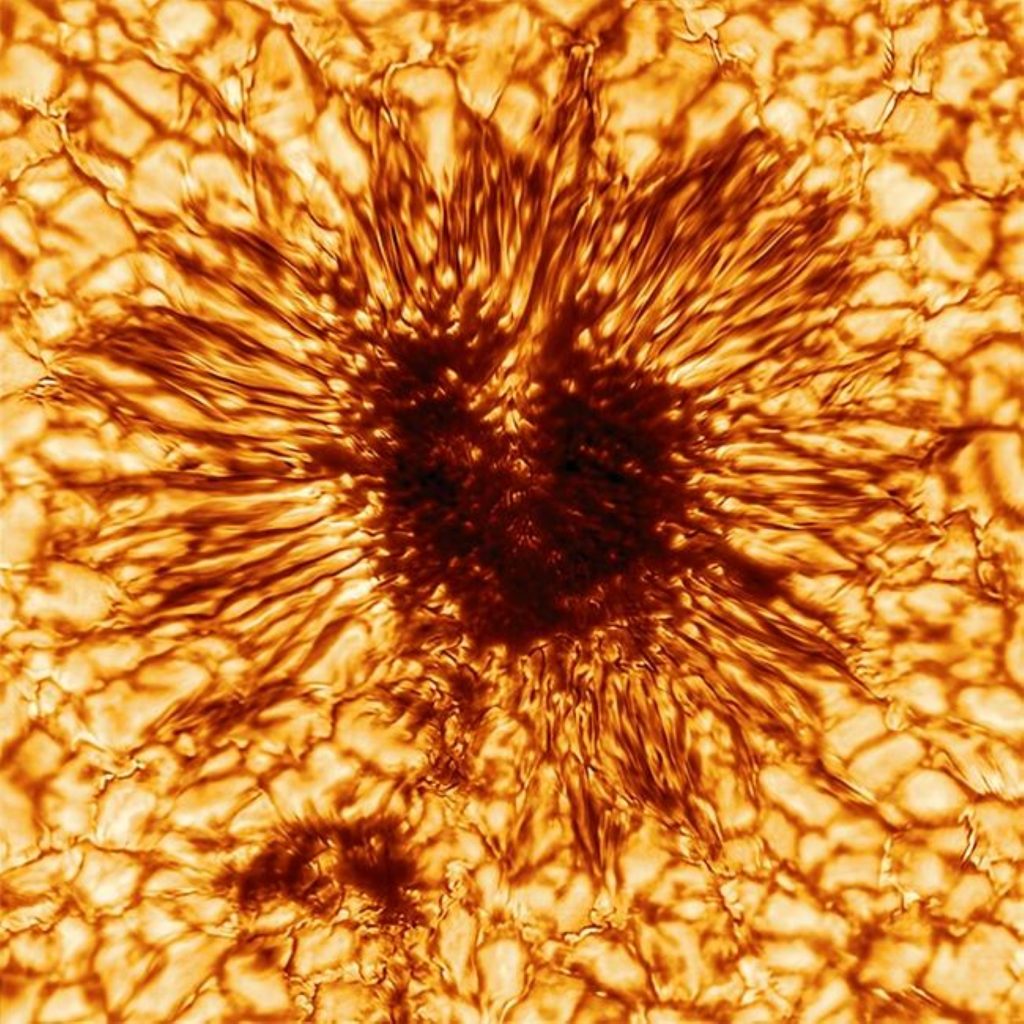

Sunspots make this even trickier because their strong magnetic fields bend the sun’s surface downward, creating a dip.
Institute for Astronomy researchers partnered with National Solar Observatory and High Altitude Observatory of the National Science Foundation National Center for Atmospheric Research to build a new machine-learning system that blends real data with the basic laws of physics.
Their algorithm — the Haleakalā Disambiguation Decoder — relies on a simple rule: magnetic fields form loops and don’t start or end.
The artificial intelligence tool can figure out from there the true direction of the field and estimate the correct height of each layer.
It worked well on detailed computer models of the sun, including calm areas, bright active regions and sunspots. Its accuracy is especially helpful for making sense of the high-resolution images from Daniel K. Inouye Solar Telescope.
“With this new machine-learning tool, the Daniel K. Inouye Solar Telescope can help scientists build a more accurate 3-D map of the sun’s magnetic field,” Yang said. “It also reveals related features, like vector electric currents in the solar atmosphere that were previously very hard to measure.
These advances allow researchers to see the sun’s magnetic landscape more accurately and improve predictions of the solar activity that impacts life on Earth.
“Together, this gives us a clearer picture of what drives powerful solar eruptions,” Yang said.